Whoo, it’s that time of the week again. Kat’s Kable 5! (nerd joke, I guess). In case you needed some validation for reading this, there are over 500 other people subscribing! You’re doing something right. OK, enough boasting (for now). Here’s this week’s list. I am finally free from a busy time, and plan to experiment a little over the summer. If you have any suggestions or feedback, shoot. Did you like the literature special? Any others you’d like to see? I’m all ears (and swagger).
1. The Left-Handed Kid
What a marvelous read. This is a review of a book called The Chinese Typewriter: A History and I LOVED it. The Chinese language has (far) too many characters, so how do you make a typewriter for it?
Students needed to lunge across the type bed, pressing down firmly on complex character slugs and leaning with a lighter touch on simpler slugs, at the risk of tearing through the paper. The demands on tactile memory were substantial. Mullaney asks a Malaysian Chinese-British woman ‘how she had come to learn the locations of more than two thousand characters’ on her machine. ‘I just remember it,’ she says.

2. Medicine’s Secret Ingredient - It’s in the Timing
I am really enjoying the blog from the prestigious scientific journal Nature. This article features some new research that proposes that one of the reasons for the efficacy of a drug is consistent timing. It’s an interesting idea, and something that intuitively makes sense.
(Speaking of science and research: I am going to meet Nobel laureate Rainer Weiss this week and am excited!)
3. The Woman who Knows Everything about the Universe
This is about Virginia Trimble, who I hadn’t heard of earlier. She was first well known for being a muse for Richard Feynman’s artistic skills, but is now a distinguished figure in astronomy. For sixteen years, she read every single article published in 23 astronomy and physics journals and made “year-in-review” articles. Now she doesn’t, but it’s inspiring to just think about it.
Today, new technologies promise to synthesize masses of publication data for scientists. But before artificial intelligence even tried, astronomers had Trimble, who wrote these comprehensive articles every year. For 16 years, she devoted her mind to this task of curation, contextualization, and commentary. And throughout her career, she has largely eschewed long-term research with fancy telescopes, competitive funding, and approving nods from university administrators. Refusing narrow focus, she has gone solo on most of her 850 publications, focusing as much on the nature of doing astronomy as studying the universe itself.
4. Why is the Human Brain so Efficient?
More science! The famous saying is that the human brain is, for some tasks, more powerful than a supercomputer, and only needs the energy provided by eating an apple to run. That is, in some sense, true. What is special about the human brain that makes it so efficient? How can it do complex tasks like recognising faces, making abstract yet inspired connections, and yet remain so low in energy footprint?
5. Authenticity in the Age of Clickbait
Tim Urban, who runs the blog Wait But Why , gives this interview to Heleo. I loved it to bits. Tim Urban is a great guy, and if you haven’t read his blog, you should check it out.
Short, sweet. The idea at the time was [that] no one will read your long stuff on the internet. But part of the reason we started Wait, But Why is [because] it was frustrating how there was nothing in depth. There would be some new science thing and I’d really want to understand it, but it would be an unsatisfying, surface-level article. And I’d read ten other articles and they’d all be saying the same 600 words about it. Or it’d be something funny and it would be such a short list. I’d want someone to go into it. [When] you go to a stand up show, it’s an hour. It’s not six minutes of a David Letterman top ten list, it’s an hour Louis CK set. There were no good Louis CK sets or good science explainers or deep dives into psychology. When these rare longform pieces [did] happen and they were good, they made the rounds. That’s what we noticed.

6. What is Science For? A Portfolio
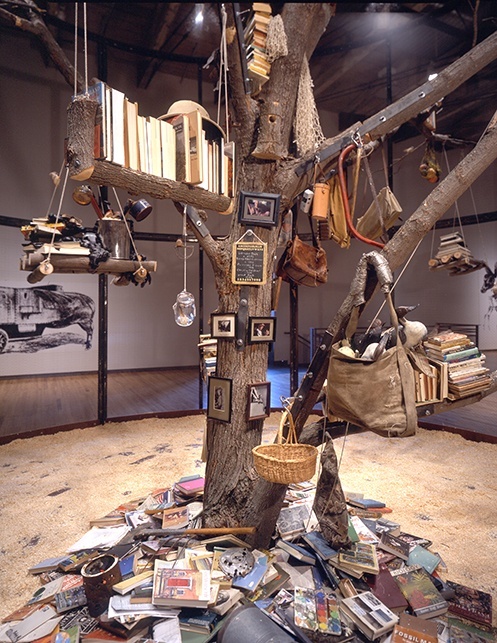
Lovely collection of images and quotes.
“What is science for, if not to modify the associations of people and things?” —Bruno Latour, Pandora’s Hope, 1999
7. Why the Earth’s History Appears so Miraculous
I can’t believe this article, and feel like there’s some sort of paradox here. We survive and live to tell the tale because we’ve been lucky enough to avoid major catastrophe. But the article says “The strange, cosmic reason our evolutionary path will look ever luckier the longer we survive”. So are we creating luck by just surviving? No, that’s not right. This is fascinating. It also mentions Abraham Wald and survivorship bias, which is great.
We live in a world newly endowed with the capacity to end itself with nuclear weapons. For more than half a century, our world has continually threatened to spill over into an all-out nuclear war. But somehow it never has. If it had, you wouldn’t be reading this article.
Perhaps you could use this seven-decade trial run to estimate how likely the nuclear holocaust really is. Since we’ve gone so long without blowing ourselves up, it stands to reason that the probability of such a catastrophe happening in any given year must be fairly close to zero.
“That sounds really good—except, of course, if there had been a nuclear war you wouldn’t be around doing this calculation,” says Sandberg.
8. The Beautiful Complexity of Naming Every Living Thing

Part of the majesty and magic of a name, Ohl writes, is how it gives the listener or reader a firm, solid foundation from which to transport herself to a place she’s never been. Names nudge open portals to new parts of the world or the long-receded past. “As though they were secret incantations, these names grant access to the world of those extinct behemoths,” Ohl writes. “Mental images of prehistoric landscapes take shape at the sound of their names, and we feel we are among the initiated, the entrusted, the knowing.”
9. The decades-long quest to end drought (and feed millions) by taking the salt out of seawater
““The world isn’t short of water, it’s just in the wrong place, and too salty,” says Charlie Paton – so he’s spent the past 24 years building the technology to prove it.”
Paton has been building greenhouses in arid countries, using the (ample) solar power available to desalinate the water needed. It’s working? Looks like it. Paton’s Sundrop Farms grows 15% of Australia’s tomatoes using seawater.
“It was this conflict between photosynthesis and transpiration – that was the kernel of the idea,” Paton says. He started by pondering an age-old conundrum: while sunlight is essential for photosynthesis and growth, the heat that accompanies it makes plants transpire and lose water. In arid places, the benefits of boundless sunshine are overwhelmed by the extreme heat and dryness, meaning farming becomes too water-intensive for it to make any sense.

10. Tom Lehrer at 90: A Life of Scientific Satire
Tom Lehrer is the amazing man who made the elements song and also the lines “‘Once the rockets are up, who cares where they come down?’/‘That’s not my department,’ says Wernher von Braun”. Isn’t that great. Do you like rhymes and limericks too? I write limericks when I’m bored in classes that I don’t enjoy but must attend. The white noise is perfect. Here’s one I’m proud of.
Oh, I believe in yesterday
Before I worried how much my food would weigh
Now over me a shadow
I can’t even see my own toe
And green tea is all I have for entree
See ya. - Kat