Hello there. I got a little delayed with this issue because I have been out and about. That also explains some gaffes if you spot them. I’m not going to proof-read before sending! As always, write back if anything, and the usual Kat’s Kable will be back next week (I feel like I’m saying this very often lately).
If you got this from a friend and want to subscribe, here’s the link.
1. The Great Span
A blog I’ve discovered lately, Kottke, is one of the longest runnings blogs on the internet. Jason Kottke follows lives of members of what he calls “The Great Span”, people who are our only living connections to historical times. He catalogues the lives and deaths of old people, basically, and I found it cute. I never thought of living people as connections to other times, say, the 19th century.
2. Scientists Still Can’t Decide How to Define a Tree
What differentiates a tree from a plant? Any of the normal indicators that you would normally use, like longetivity and woodiness, have many outliers and exceptions. I suppose the best way to answer the question is, “you’ll know it when you see it”.
Notwithstanding the difficulty in defining them, being a tree has undeniable advantages—it allows plants to exploit the upper reaches where they can soak up sunlight and disperse pollen and seeds with less interference than their ground-dwelling kin. So maybe it’s time to start thinking of tree as a verb, rather than a noun—tree-ing, or tree-ifying. It’s a strategy, a way of being, like swimming or flying, even though to our eyes it’s happening in very slow motion. Tree-ing with no finish in sight—until an ax, or a pest, or a bolt of Thanksgiving lightning strikes it down.
3. Have Algorithms Destroyed Personal Taste?
A history of “taste” and “style”, this is an essay about modern fashion, taste and aesthetic. Does individual taste matter so much anymore, especially now that algorithms dictate much of what we choose and consume?
The threat of banality (or the lack of surprise) implicit in full machine curation reminds me of the seemingly random vocabulary meant to improve SEO on Craigslist posts. As one chair listing I encountered put it: “Goes with herman miller eames vintage mid century modern knoll Saarinen dwr design within reach danish denmark abc carpet and home arm chair desk dining slipper bedroom living room office.”
Imagine the optimized average of all of these ideas. The linguistic melange forms a taste vernacular built not on an individual brand identity or a human curator but a freeform mass of associations meant to draw the viewer in by any means necessary. If you like this, you’ll probably like that. Or, as a T-shirt I bought in Cambodia a decade ago reads, “Same same but different.” The slogan pops into my mind constantly as I scroll past so many content modules, each unique and yet unoriginal.
4. Watchmen’s Fearful Symmetry: (almost) frame by frame
I loved Watchmen by Alan Moore when I read it, and immediately went and read it again. This is a deep cut into the graphic novel. If you’ve read it, or if you are interested in some visual candy, this is wonderful. Various aspects of the graphic novel repeat themselves almost frame-to-frame across pages. When I went through it again, I realised the symmetry was probably borne out of an effort to reproduce patterns across pages to reduce the effort required on the artistic side. The effect is great. (h/t Subbu)
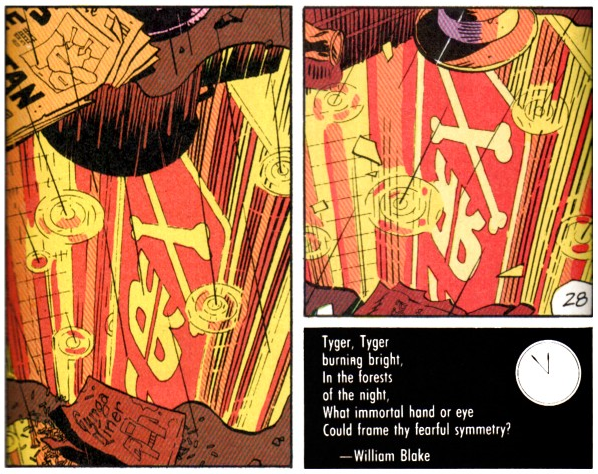 First panel from page one and last panel from page twenty-eight.
5. A Baby’s Battle for Survival Tests How Far Medicine Has Come
A child, Owen Green, was born at an age of 24 weeks, which would’ve meant instant death even forty years ago. But he’s alive and well, and that is truly remarkable. Amazing. I tried to quote something in particular, but the whole piece is full of fascinating facts and anecdotes. Is this when we all say that science is great?
6. No One Wants Your Used Clothes Anymore
What used to be a guiltfree method of getting rid of old clothes is no longer in vogue; making new clothes is easier and cheaper. What’s to blame? Swiftly changing fashion trends and changes in manufacturing capability count as a few.
This begins a series of “previews” of sorts for future special editions that I hope to get around to actually doing soon. This one’s fashion. If you have something interesting, send along my way. I’m hopelessly deficient in the fashion department.
7. The Strange, Uplifting Tale of “Joy of Cooking” Versus the Food Scientist
This one’s a preview for a food special edition. I learned, while reading this, about an American book called “Joy of Cooking”. It’s a full-on investigation. The book is 87 years old, having gone through multiple editions. A group of scientists did some tests, and concluded that the calorific value of dishes in the book went up unequivocally edition upon edition. The great-grandson of the original author, alarmed, did some tests of his own and realised that the food scientists were doing something wrong.
In an edition of “Joy of Cooking” from the early sixties, she and Marion Becker advised that “well-grown minimally processed foods are usually our best sources for complete nourishment.” With uncanny foresight, on the book’s very first page, they also issued readers a warning: “The sensational press releases which follow the discovery of fascinating fresh bits and pieces about human nutrition confuse the layman,” they wrote. “And the oversimplified and frequently ill-founded dicta of food faddists can lure us into downright harm.”
8. How Sound Affects The Way You Taste Food on Airplanes
Fascinating, to say the least. This tells you why you might like tomato juice on an airplane.

9. Can you Overdose on Happiness?
They stressed that there is nothing necessarily unethical about raising your level of happiness this way. The problem is the lack of evidence that it is beneficial to the individual — particularly in light of the considerable cost of the treatment.
“It’s not my job as a neurologist to make people happy.” Helen Mayberg let her statement hang in the air between us before she continued. “I liberate my patients from pain and counteract the progress of disease. I pull them up out of a hole and bring them from minus 10 to 0, but from there the responsibility is their own. They wake up to their own lives and to the question: Who am I?”
See you next week. - Kat.