Hello there! Thank you for joining me again this week. I’m just back from a mentally and physically exhausting travel trip (the last two issues were sent from outside home) and am really glad to be home sipping my favourite tea from my new teapot. I hope you’re having a good and rejuvenating weekend as well.
This week’s issue is full of eclectic things. Literature, careers, flying spiders, and rare bats, books and people. Piqued your interest? Let’s dive in.
If you got this from a friend and want to subscribe, here’s the link.
1. How to Pick a Career (That Actually Fits You)
Tim Urban is at it again! To be fair, this piece came out in April, but I never got around to reading it in one sitting. It’ll take you some time, but it’s worth it. I’m at the age where I need to decide what I’m going to do in life, and so I have to define or find a career for myself. Urban, of famed blog Wait But Why , talks about how to unlock your aspirations, find your inhibitions and remove them, and more. This is more an exercise in introspection than just a read. Like all things he writes, it’s very detailed and constructed carefully.
2. Bibliomaniacs in Battersea
Impassioned and yet rational account of a rare book fair held annually in England. David Attenborough opened it this year, and by association it must be a great fair. Some choice excerpts:
It is like walking around the gallery of a major library, with the added thrill of knowing that, if you just sold one your vital organs, you might take home one of the exhibits.
But Bollioud-Mermet gets one thing spot on: the delirium of the bibliomaniac is wont to outweigh their financial judiciousness: “Madly impassioned of all that is beautiful or curious, [bibliomaniacs] exceed the limit of their means”. I pass a woman sternly addressing one of the dealers: “Just tell me honestly, how much has he bought?” Beside her is her husband, looking half sheepish, half pleased with himself.
It doesn’t work. Half an hour later, I am striding back to the dealer’s stand, determined, against all sense, to buy something I can’t afford. The manuscript, I am told, has been sold. I don’t know whether I am more relieved or disappointed.
All these excerpts speak to my soul.
3. What Time Feels like when You’re Improvising
Nautilus magazine has been running a series of pieces on the interplay of science and art. I really loved this one: when you improvize spontaneously and are in the “zone”, you enter what psychologists call a flow state. You are thoroughly in the moment, your actions are highly intuitive, and time can either last forever or disappear in an instant, whichever way you like to think of it. The neuroscience has it: when you are in a flow state, parts of your prefrontal cortex that correspond to self-expression and goal-oriented behavior fire up more than normal, and parts of your brain that are in charge of inhibitory control slow down. Truly then, improvization is an altered state of mind.
4. The Smaller the Theater, the Faster the Music
Need I apologize? This piece is from the same Nautilus series as the previous one, and it’s also a delight. It’s an interview of Philip Glass, famous composer, and painter Fredericka Foster. They talk about a bunch of cool things – maintaining curiosity as an adult, the similarity of composing music and painting moving water, and more. Here’s a picture of one of Foster’s paintings of water; it totally blew me away because it captures motion in a moment. You truly need to be one with the water and at its own timescale to attempt something like this at all.
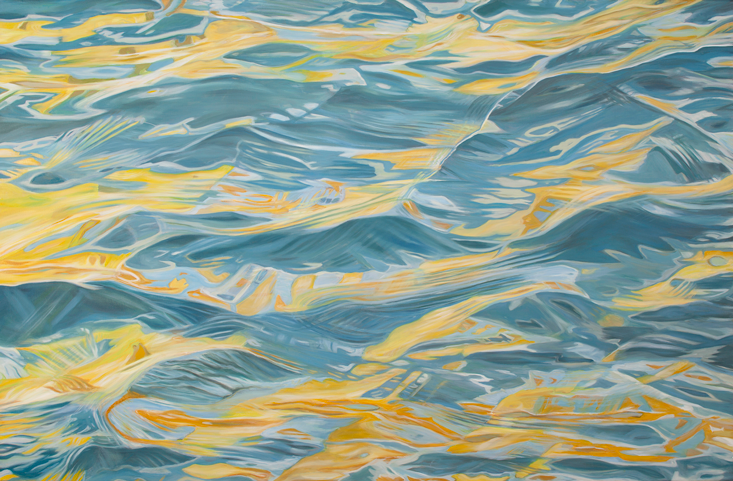
“Foster’s “Lake Union” shows ripples that are less than a second apart.”
5. Let’s Talk about Genre: Neil Gaiman and Kazuo Ishiguro in Conversation
Interviews are great, and this one has two people I admire and like. Ishiguro’s recent novel The Buried Giant was given the tag of being “fantasy” literature, and Ishiguro wasn’t particuarly happy with that. He says he just wrote fiction. I, for one, believe that fantasy fiction is just that, fiction. It is one of my personal projects to collect nice things about fantasy and science fiction literature, and if you want a barrage, let me know.
I felt like I’d stepped into some larger discussion that had been going on for some time. I expected some of my usual readers to say, “What’s this? There are ogres in it . . .” but I didn’t anticipate this bigger debate. Why are people so preoccupied? What is genre in the first place? Who invented it? Why am I perceived to have crossed a kind of boundary?

Interlude
Let’s take a moment to agree that good interviews are like flowing water; the flow of the conversation is confident and smooth, but the surprises, waves and ebbs are pleasant surprises that never repeat. I love reading and listening to good interviews; there’s really nothing like two people who get the questions they’re asking each other. What do you think? Anything you would like to share?
By the way, I did an interview special a long time ago. It was #49! (I feel old, this was 15 months ago.)
6. The Unlikely Upside of Cape Town’s Drought
“Surprising, even beautiful things can happen when it feels as if the world is about to end.”
Cape Town was almost on the verge of completely running out of water for its citizens, and it was averted by, in part, a city-wide effort to reduce daily water usage by a drastic amount. I learnt, while reading this, that Cape Town still harbors a good deal of racism and ostracization, but that much of this disappeared when water itself was on the line. It’s funny when you think about it. It took a huge water crisis for people to start being people together in a city.
On the drought Facebook page, which now has 160,000 members, a spirit has arisen of egging each other on. The members, who hail from different classes, call each other “fellow water warriors.” They give each other digital fist-bumps for their low water usage, their “gray water systems,” “submersible pumps” and other odd contraptions they’ve engineered to make their homes more water-wise. The weirder and more DIY the better. Monique and Clint Tarling, a family living just outside the main city, showed me the “sustainable shower” they built out of a 500-liter tank and pallets. Revealing their new priorities, the shower is on their front stoop, and they can no longer enter their house through the main door.

7. The Electric Flight of Spiders
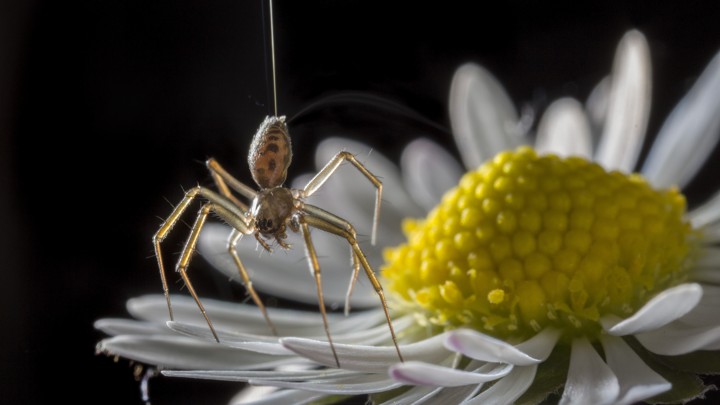
Spiders perform an act of travel that scientists called “ballooning”, and scientists have finally figured out how they do it. I’ll let the article explain it.
Spiders have no wings, but they can take to the air nonetheless. They’ll climb to an exposed point, raise their abdomens to the sky, extrude strands of silk, and float away. This behavior is called ballooning. It might carry spiders away from predators and competitors, or toward new lands with abundant resources. But whatever the reason for it, it’s clearly an effective means of travel. Spiders have been found two-and-a-half miles up in the air, and 1,000 miles out to sea.
Ballooning spiders operate within this planetary electric field. When their silk leaves their bodies, it typically picks up a negative charge. This repels the similar negative charges on the surfaces on which the spiders sit, creating enough force to lift them into the air. And spiders can increase those forces by climbing onto twigs, leaves, or blades of grass. Plants, being earthed, have the same negative charge as the ground that they grow upon, but they protrude into the positively charged air. This creates substantial electric fields between the air around them and the tips of their leaves and branches—and the spiders ballooning from those tips.
8. The Last Bat: The Mystery of Britain’s last Solitary Animal
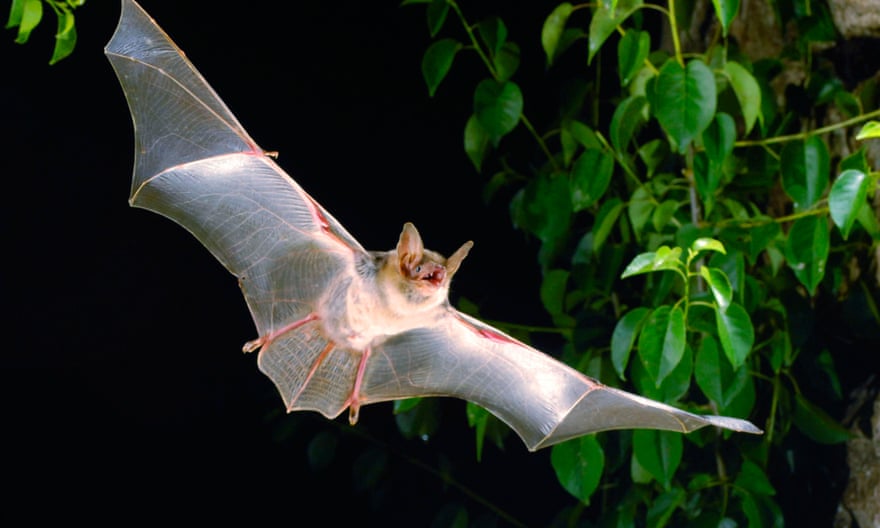
In a cave in Sussex, England, there lives one mouse-eared bat. Is he the last of his species? It’s fascinating but also heartbreaking at the same time. The species is almost extinct now, despite there being a group of passionate and dedicated people trying to save it. I’m just shrugging. The bat sure looks beautiful.
9. Secrets of the World’s Super-Explorers
Now we move on to another group of people - members of the Explorers Club, an organization that is over a hundred years old and boasts the likes of Teddy Roosevelt, Neil Armstrong and Charles Lindbergh as past members.
Yet its members know The Explorers Club for what it is: a shifting chronicle of discoveries that have changed the world as we know it. A club that can casually say its members were the first to travel to the North Pole and the South Pole. First to the highest point on Earth (the summit of Mount Everest) and first to the lowest point on Earth (the Mariana Trench). Even beyond our planet: First to the surface of the moon.
This is fascinating, and it sounds straight out of a Jules Verne novel. Intially very selective almost to the point of being morbidly elitist, the club now has over 3000 members, with a slowly increasing membership of women. I honestly don’t know what the “role” of the club is now – send people to Mars, I suppose.

“A display case holding the Explorers Club flag that was taken to the moon in 1969, at the Explorers Club Headquarters.”
10. He Holds up a Lantern for the Rest of Us: Ann Patchett on Donald Hall
A tribute to poet Donald Hall, who died earlier this year. I hadn’t heard of him earlier, but this was such a nice piece. I’m out of it now, tired, and have written enough this week already, so I’ll stop.
While proofreading, I realized that I started this issue off with a lot of energy, which slowly ebbed away as I finished up. I’ll blame the travel. Nonetheless, this was a very fun issue to compile.
Till next week, my friend. - Kat.