Hello! A bunch of things before we get into it this week. First, the state of Kerala (in India) is reeling from terrifying rain and subsequent flooding. Every single district has been affected, and it makes my heart ache to think about how (and when) they’ll be able to repair all the damage that has been wrought. If you want to help, the state is in need of funds for the rescue effort. There are a number of ways to pay, all details here. If you’ve already donated, thank you.
I missed last week’s issue with no forewarning. I was a little sick and a little busy with things, and I couldn’t compile nor read for the weekend digest. This week’s is normal, and I personally love everything that’s on it. I feel happy when I can send ten pieces from ten different sources, and that happened this week again. Enjoy the list, and as always, if anything, please feel free to write back at any time. You can just reply to this email and I promise to reply.
If you got this from a friend and want to subscribe, here’s the link.
1. Ikea Opens First India Store, Tweaking Products but Not the Vibe
IKEA has finally opened its first store in India, and I’m pretty excited about it. What’s nice and interesting is how they’ve tweaked their products to better suit Indian customers. What better way to do that than to offer samosas in the restaurant? Apparently IKEA reps visited around a thousand Indian households to understand what people needed and how they lived. Meanwhile I’m typing this while sipping tea from an IKEA mug made using an IKEA French press.
2. Continuous Urbanization in Japan
This was an interesting read because it made me aware of a surprising trend in Japan. There aren’t disproportionately densely populated parts of cities; it seems like the urbanization is almost continuously and uniformly distributed, and this is true not only within urban areas, but between urban areas as well. I also learnt of a model called “Hotelling”, where the optimal location for any new building is “where it’s at” – where everything else is. As one area gets more dense and popular than its surroundings, this principle ensures it gets more and more crowded until it reaches its capacity. This does not seem to be the case for Japan. Here’s a Google Earth view of Tokyo (from the article), you can see the (sort of) uniform spread for yourself.

3. The Strangely Human Messages We Send To Aliens
I enjoyed this read immensely. The two Voyagers are spacecrafts that were launched in the 1970s and have now reached the outer edges of the solar system. They have 12-inch gold discs inside them, for potential alien species that may encounter the probes as they fly away from us. What goes into this design? Is it likely that they will be intercepted? (Not very). However, the discs are also a message from humans to humans, embodying how humans would like themselves to be introduced as to aliens. The piece also talks about how to design a symbol marking the danger of nuclear waste in such a way as to be understood by future generations of humans, perhaps 10,000 years from now. Is that task much different from the Voyager disc?

4. The Nastiest Feud in Science
From aliens and nuclear waste signs to the extinction of the dinosaurs… I would call this a wholesome overview of history and future. I, and I assume you, believed that the asteroid impact hypothesis was clearly the correct reasoning behind the extinction of the dinosaurs. 65 million years, an asteroid impacted the earth in shallow waters in the Yucatan peninsula in Mexico, and set off a global chain of calamities. But Gerta Keller believes that this is bogus, and she has spent decades convincing (or trying to) other scientists that the extinction was actually caused by sustained volcanic activity in India. The asteroid did hit, but it was not the cause for the extinction. This is as much about science and hypotheses as much as it is about scientists’ fierce animosity.
Keller’s resistance has put her at the core of one of the most rancorous and longest-running controversies in science. “It’s like the Thirty Years’ War,” says Kirk Johnson, the director of the Smithsonian’s National Museum of Natural History. Impacters’ case-closed confidence belies decades of vicious infighting, with the two sides trading accusations of slander, sabotage, threats, discrimination, spurious data, and attempts to torpedo careers. “I’ve never come across anything that’s been so acrimonious,” Kerr says. “I’m almost speechless because of it.”
5. Why We Should be Cooking like our Grandmas
According to this article, I have embraced “grandma cooking” rather completely. And I don’t mind that at all.
Broadly speaking, grandma cooking refers to an approach to food preparation that is thrifty, intuitive, inherently seasonal, and delicious—the kind of food that nourishes and delights without unnecessary flash.
More than anything, I liked how this piece asks you to deepen and develop your cooking insticts. There is a sort of culinary muscle memory, it says, that you can hone and improve, especially when you are looking to learn while cooking.
6. The Limits of Expertise
This is a piece from another new outlet I’ve started following recently, Quillette. In today’s political and ideological climate, people have begun to (perhaps rightly) doubt the value that experts bring to the table. An anti-expert view is akin to an anti-elitist view now.
In other words, smart people keep getting it wrong and scepticism about their competence has grown as a result. This seems to be a fairly straightforward story at first glance, and yet the public will only take their antipathy so far. Nobody says, “I want someone unqualified to be my president, therefore I also want someone unqualified to be my surgeon.” Nobody doubts the value of the expertise of an engineer or a pilot. This apparent inconsistency is what frustrates the anti-anti-elitists so much, not least because it seems to be unjustifiable.
However, it is worth drawing a distinction between these two types of expertise—the kind people question, and the kind people don’t. In short, people value expertise in closed systems, but are distrustful of expertise in open systems. A typical example of a closed system would be a car engine or a knee joint. These are semi-complex systems with ‘walls’—that is to say, they are self-contained and are relatively incubated from the chaos of the outside world. As such, human beings are generally capable of wrapping their heads around the possible variables within them, and can therefore control them to a largely predictable degree. Engineers, surgeons, pilots, all these kinds of ‘trusted’ experts operate in closed systems.
7. The People Keeping Bees on Paris’ Most Famous Landmarks
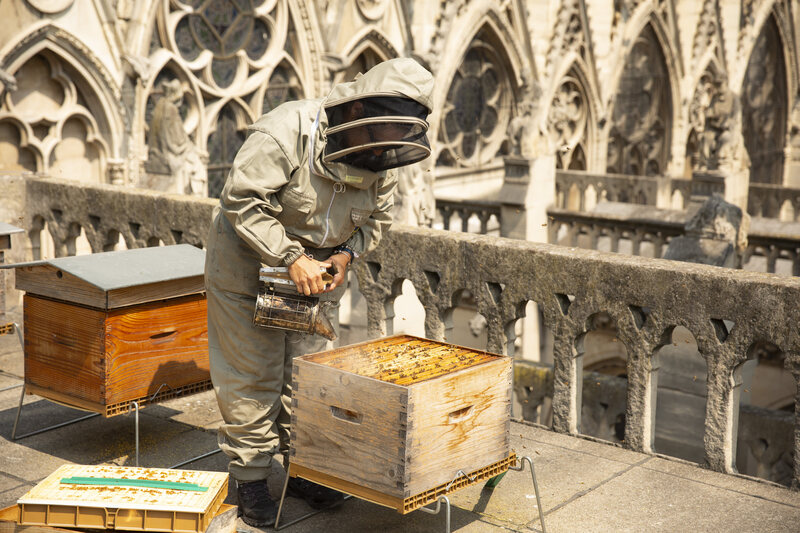
Whoo. I did not know that local Parisian honey was a burgeoning artisanal business. The first Parisian beekeeper’s story is truly fantastic: entrusted with a new beekeeping kit, he realizes that he must let the bees out before its time for him to take them to their intended destination. Where does he accommodate them? On the roof of the Opera Garnier. And now Parisian honey is a prized ingredient, and also very expensive.
8. Some Thoughts on Teaching
What are your thoughts on a teacher who did not, or does not, use what she teaches in her life/career? For example, in this essay, the author talks about learning information theory from a professor who went back from class to do research in it in the afternoons. Doesn’t that make the entire pedagogical process a lot more credible for the student?
Many of my college professors practiced what they preached. My information theory professor would teach me information theory in the morning, and then spend the afternoon furthering the field. Sure, what she taught was somewhat elementary by her standards, but she was well aware that this elementary theory was the foundation on which her life’s research was built. It showed, and it stayed with me. A few years later, in grad school, I would make my mark by being the first to connect information theory to a seemingly unrelated problem in circuit design.
9. The Ultra-Pure Super-Secret Sand That Makes Your Phone Possible
Spruce Pine, a remote town in the USA, is the world’s leading supplier of ultra-pure quartz. This pure sand is critical to the functioning of whatever device you’re reading this on. The sand used in construction is junk, as compared to high-purity sand. By high-purity, I mean hiiiiigh purity - 99.99999999999% pure. I can’t wrap my head around that.
10. Making Sense of the Universe
“Rohini Godbole talks about her experiences as a particle physicist, the discovery of the Higgs Boson, and the story of Indian women in science.”
This was a very nice interview. Godbole is a stalwart of sorts in particle physics in India, although I hadn’t heard of her before. Not only does she do cutting edge research, but she is also involved in promoting science education and literacy in the women of India. She was the co-editor of a book called Lilavati’s Daughters , a collection of essays on women scientists of India.
That’s all, my friend. See you next week. - Kat