Hello! What a busy week it’s been. I’ve begun with my semester again and everything is a whirlwind. There isn’t too much time to read, but may I never use that as an excuse. Anyway, with no further ado, here goes. How has your week been?
1. What Am I Worth to Advertisers? My Obsessive Quest to Put a Price on My Attention
Online advertising is ubiquituous now, and there’s always a game being played between advertisers, advertising platforms and adblock-employing users. What happens if you disable all your adblock software, and look at all the ads that are thrown at you? That’s what the author of this article did, and it was such an adventure. In a day, advertisers spent just under $3 to show him the ads that he saw. I thought that number would be smaller; what do you think?
More than anything else, trudging through the numbers on these various campaigns got me thinking about information pollution, and the sheer amount of space in our day that’s monetized. Introducing limits sounds pleasant enough—who wouldn’t want fewer ads?—but that might also tip the balance even further in favor of huge brands with budgets to burn on the ad spaces that would become costlier through artificial scarcity. Maybe aggressive ad density could be taxed like cigarettes, air pollution, or anything else with negative externalities. I’m not the first or last person to see the reliance on advertising—especially online—as flawed, and we should all be deeply concerned by the way it incentivizes the sort of mass data collection Facebook and Google do.
2. Women’s Pockets are Inferior
I’ve read a lot on the internet about how the pockets in women’s jeans are inferior, not ergonomic, and in some cases useless. The evidence is now out.

3. An Insider’s Tour of New York’s Disappearing Magic History
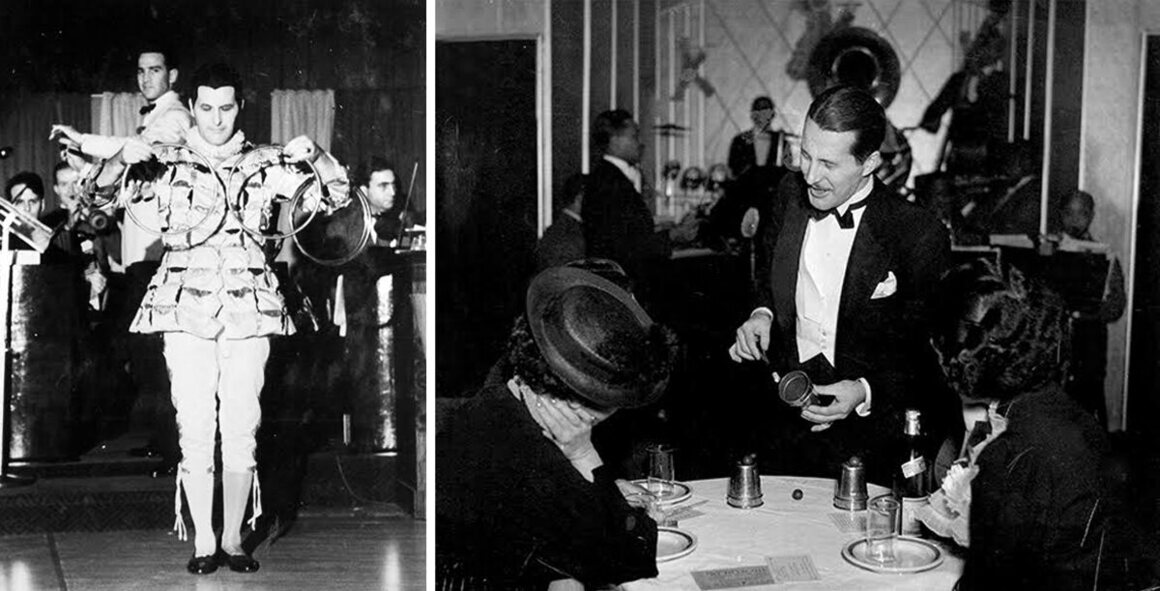
This was so fascinating! What magic? How magic? Why magic? The answer to “where magic”, though, is easy: New York.
Even if you know how cups and balls works, in the hands of a skillful performer, you won’t see the movement of the balls, no matter how carefully you look. When Penn and Teller do it in full view it still feels like magic. The same principle applies to New York itself. However many times you walk down a street, paying close attention, some detail escapes your notice, or only exists for those in the know.
4. Her Key to Modeling Brains: Ignore the Right Details
I’m always happy to read about mathematicians or physicists who, after their PhDs, work in other fields. Carina Curto did her PhD exploring the mathematical backings of string theory, but now works on neuroscience, helping to build mathematical models to understand the working of the human brain.
Halfway through grad school I started looking for something else. I sat in on an economics course, which was totally boring, because they spent all their time reviewing vector calculus, and I was not interested in learning that for the sixth time in my life. And then I discovered neuroscience kind of randomly. I sat in on a course and went to some talks, including one by Larry Abbott, who is a very famous theoretical neuroscientist at Columbia University and a former physicist. He talked about the visual system, but he had this way of approaching the neuroscience questions as a theoretical physicist would. And I said to myself, “Oh, this feels like what I thought theoretical physics would feel like.”
But then it was kind of amazing. After a few years, I started having my own ideas. I started asking questions that were meaningful to neuroscientists, and having ideas about how I could tackle some neuroscience problems that were quite mathematical — bringing in tools even from areas of math like topology and commutative algebra and combinatorics that were not traditionally being used. That was very exciting. I got to use much more sophisticated math but still address questions that were meaningful to the neuroscience.
5. Is This Man the Elon Musk of E-Waste?
This is how this article starts off:
Eric Lundgren, the 33-year-old, fedora-wearing CEO of a major electronic waste recycling plant in Los Angeles, could be called both the Elon Musk and the Edward Snowden of e-waste. Elon Musk because in 2017 he built an electric car out of recycled batteries that broke the world record for electric vehicle range. Edward Snowden because he’s currently serving a prison sentence for copyright infringement, as a result of printing 28,000 Windows restore disks to be distributed with repaired computers. Lundgren’s court case and electronic creations have made him an icon for the Right to Repair Movement and e-waste reuse.
This guy is amazing.
6. “Write a Sentence as Clean as a Bone And Other Advice” from James Baldwin
I’ll just give you a sample. This is a great list. h/t Kara’s daily newsletter Brass Ring Daily
When you’re writing, you’re trying to find out something which you don’t know. The whole language of writing for me is finding out what you don’t want to know, what you don’t want to find out. But something forces you to anyway.
One writes out of one thing only—one’s own experience. Everything depends on how relentlessly one forces from this experience the last drop, sweet or bitter, it can possibly give. This is the only real concern of the artist, to recreate out of the disorder of life that order which is art.
7. Tales from the Gulag
A short story by Varlam Shalamov about working and living in, and attempting to escape from, a Soviet Gulag. Quite chilling.
Only something external was capable of taking us out of our indifference, of distracting us from the death that was slowly getting nearer. An external, not an internal force. Internally, everything was burned out, devastated; we didn’t care, and we made plans only as far as the next day.
[…]
I returned to the barracks, lay down, and shut my eyes. It was hard to think. Thinking was a physical process. For the first time I saw the full extent of the material nature of our psyche, and I felt its palpability. Thinking hurt. But thinking had to be done. He was going to get us to make a run for it and then hand us in: that much was completely obvious. He would pay for his office job with our blood, my blood. We’d either be killed at Black Springs, or we’d be brought back alive and given a new sentence: another fifteen years or so. He must be aware that getting out of here was impossible. But milk, condensed milk. . . .
8. NASA is Learning the Best Way to Grow Food in Space
The in-space experiment to grow plants is called, uninspiringly, Veggie. It hasn’t been very successful, but it’s very important if we are to send long manned missions into space. We don’t know yet how plants grow in zero gravity or in the presence of radiation in space. The biggest problem so far has been mould growing on plants, and the usual techniques that gardeners and farmers apply on the ground don’t apply in space. What to do? Keep going.

9. The Amphiphilic Liquid Coating That Keeps Your Avocados Fresh
As they do so, they build a kind of film that locks in moisture and repels oxygen. So Apeel has developed a substance, which they either spray on fruit or dip the fruit in, that exploits this relationship between lipid molecules you find naturally in fruits. “When we deposit them on a piece of produce and it dries, the result is that we form this special structure, this special barrier, which mimics that structure which is employed by longer shelf life produce,” says Rogers. Apeel isn’t inventing a newfangled substance. It’s using the plant kingdom’s own evolved defense against our trifecta of maladies. By coating produce with interacting molecules, they create a microclimate within the fruit to keep good actors in and bad actors out.

Phew. One less than the usual ten. See you soon - Kat.