Phew. Hello there. This food special has been sitting on the back burner for a few months now (if you see what I did there). I finally got around to compiling and putting it all together, and I am so excited. It contains so many things I love – sourdough bread, spices, hummus, new plant-based (or vegan) foods, the science and history of cooking.
I read a book a year or so ago by Jonathan Safran Foer called Eating Animals. The biggest takeaway from that book was the idea that every decision about food we take, is basically farming by proxy. Eat only the foods whose farming and creation you support. I read a book a few months ago called Taste, Memory by David Buchanan, which talks about heirloom species of plants being stewarded by some passionate farmers (for lack of a better word). I really loved it. Lately, I’ve been devouring books about bread baking, since that’s what I’m really invested in right now, and I’ve also been devouring all the bread I’ve been baking. If you want stories or pictures, feel free to reply and ask! On my to-read is a suggestion from a friend, Consider the Fork. Any food books you would recommend?
If you have anything at all to say, just hit reply. I promise you a reply.
1. The Secret Tricks Hidden inside Restaurant Menus (BBC)
This is a trove of funky facts about restaurant menus: people are more likely to order wines if the names have been printed in hard-to-read fonts, and heavier menus are understood to convey an upscale experience, to name a few.
This sort of descriptive language is widely used by the food industry. The British retailer Marks & Spencer famously uses long-winded, and often sensual, descriptions of the food it sells in its adverts, to convey the impression of the quality of its products.
“This is not just a pudding,” one advert declared. “This is a melt in the middle, Belgian chocolate pudding served with extra thick Channel Island cream.” It saw sales rocket by 3,500%.
2. The Spice of Life (Slow Food Intl)
This is a tale of the renaissance of quality spices being used in Indian food, which has been fueled by the growth of the Slow Food movement. It’s written by none other than Amitav Ghosh, and it is really a fresh breath of …fresh spices. I cook with Indian spices every day and can’t imagine life without them.
Consider, for example , cacio e pepe, the Italian pasta dish that is flavoured only with cheese, salt and pepper. This simple but elegant dish has become a touchstone by which accomplished chefs measure the skills and techniques of their colleagues. […] But strangely no food specialist seems ever to have considered the possibility that the other ingredient mentioned in the name of the dish – pepe or pepper – might also be worth experimenting with. In recipe after recipe this vital condiment is listed simply as ‘freshly ground black pepper’ – an ambiguous phrase since the word ‘fresh’ refers here to the act of grinding and not the age of the peppercorns.

3. Who Invented Hummus? (BBC)
One of my weekend tasks is to make a large box of hummus for myself. As someone who eats so much of it, this history of the dish was fascinating to know more of. In 2009, at the bequest of the Lebanese minister for tourism, a massive plate of hummus weighing 2000 kilograms was made to prove that Lebanon was the home of the iconic dip. In response, a famous joint in Israel created a 4000 kilogram dish. Not to lose the final say, the Lebanese established the currently standing Guinness world record - 10,452 kilograms of hummus. The Lebanese must be crazy? Or the Israeli? It’s all done for the cause of hummus, so nobody is.

4. Love Is Like a Sourdough Starter: It Can Last Forever or Get Super Smelly and Weird (Bon Appetit)
Another of my weekend things to do is bake a loaf or two of sourdough bread. I have a culture of wild yeasts and lactobacilli bacteria in my fridge as I type, dormant and lying in wait for Friday morning to be fed. My sourdough starter is like a low-maintenance pet. The author of this piece describes her starter as a lover. With flowing prose and delightful illustrations, I highly recommend.
Personally, I felt like having a sourdough starter was sort of like dating. When I felt sad about something, I thought about Mary and how things between us had been growing (literally), and how soon she would do more than spiritually feed me; she would physically feed me. These are all things I also value in human partners.

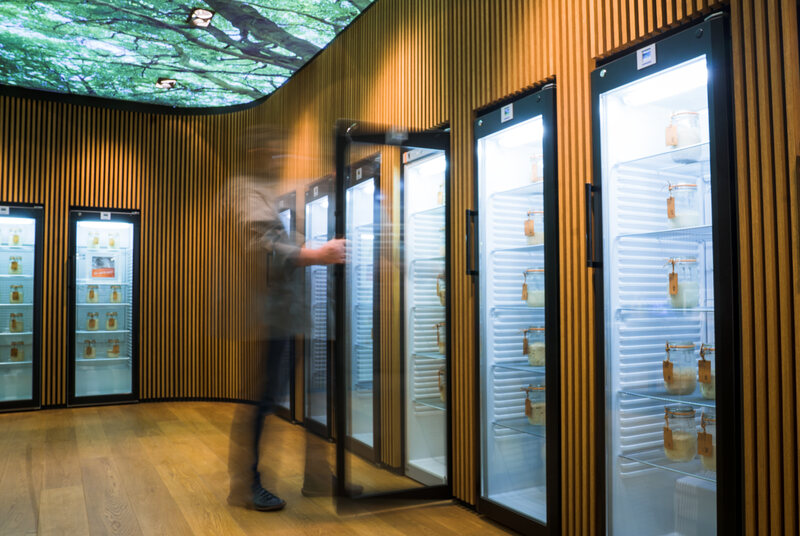
5. Inside the World’s Only Sourdough Library (Atlas Obscura)
More sourdough! In a city in Belgium, Karl De Smedt collects sourdough starters from bakers and bakeries around the world. He has a hundred and five! It’s incredible. A starter is really like a pet:
Last week, De Smedt returned from Seattle, Alaska, and Canada, where he collected three starters said to be left over from the Klondike Gold Rush. (His visit caused a small local news furor.) He took one of his own starters with him, and when his camper got too cold, he took a cue from miners of yore and slept with it to keep it warm.
And look at this:
By sequencing the microbiological makeup of starters, the library is already finding patterns linking the world’s sourdoughs. Two starters, one from Switzerland and one from Mexico, share a wild yeast, Torulaspora delbrueckii, present in none of the others. It’s a puzzling phenomenon that De Smedt thinks may be linked to their high-altitude origins. In another instance, two starters contained the same combination of lactobacilli, and the only connection was that they were both created by women.
6. Using Science and History to Unlock the Secrets of Bread (New York Times)
This was absolutely incredible. I have a small inkling that I’ve shared this a while earlier, but it fits in to and augments the previous two pieces. Nathan Myhrvold, a former CTO of Microsoft (also has a PhD in physics, yay), created a massive book called Modernist Bread in partnership with chef Francisco Migoya.
Two years ago in Paris, Nathan Myhrvold wandered the Louvre on a mission, camera in hand, documenting every image of bread that he could find. “Sadly, art historians don’t catalog paintings by whether or not there’s bread in them,” he said.
So Mr. Myhrvold, the former chief technology officer of Microsoft and a founder of the investment firm Intellectual Ventures, built his own catalog. That day, he shot about 100 buns and rolls that peeped from underneath oil-rendered French linens and gleamed in dark Dutch still-lifes.

There are five volumes!
Some more on sourdough and bread:
7. Navigating the Uncanny Valley of Food (Wired)
This is a topic that again, is close to my heart. Many firms and laboratories are now attempting to create lab-grown meat, so as to be better via both environmental and ethical perspectives. The biggest challenge is not the taste, but the texture. As someone who doesn’t eat meat, I don’t really know , but I can imagine how big an issue this can be.
But with a long, arduous road to perfection still ahead, it’s worth considering the option of avoiding Mori’s valley altogether through the creativity of chefs. Chefs are opportunistic creators: Without a set target to imitate, they are free to explore infinite variations on a flavor theme. They can nimbly veer away from potential hurdles in pursuit of freeform deliciousness. […] By embracing the natural character of their source ingredients, chefs expand the spectrum of craveable experiences that plant foods can offer beyond mere imitation of animal products.
And it ends with:
The whole point of creating CGI humans in movies is so they can do amazing things normal people can’t, and I look forward to the day when we can expect that same thrill from the snacks we eat at the theater.
8. These Cannabis Farmers Carry Out an Ancient Tradition High in the Himalayas (Narrative.ly)
“In a remote village almost 9,000 feet above sea level, a very old leaf is one of the only means to make a living. Their only problem: growing it is against the law.”

9. The Why of Cooking (The Atlantic)
This is a review of books about cooking, or metacookbooks, one could say. Samin Nosrat’s now year-old book Salt, Fat, Acid, Heat is one of them, and it is a riot. I read through a few pages of a friend’s copy, and the book is full of delightful nuggets of information. However, the primary contribution of its philosophy is that there are only four things you need to get right in every meal – those foretold by the book’s title. Doesn’t it make sense?
Her book is full of perspective-altering moments that are akin to being told about the arrow hidden in FedEx’s logo and never being able to unsee it. Her guidance in salting water boiled for pasta (which is to do so very generously—it should taste “like the summer sea”) led me to see how much of an exponential leap in quality can come from simply not being afraid of over-salting. There are plenty of books that contain the same information as Salt, Fat, Acid, Heat—indeed, its bibliography cites books by McGee, Ruhlman, and Pollan—but, at least for readers new to cooking, it demonstrates how some parts of its predecessors could stand to be boiled off.
10. All by Itself, the Humble Sweet Potato Colonized the World (New York Times)
“The distribution of the plant baffled scientists. How could sweet potatoes arise from a wild ancestor and then wind up scattered across such a wide range? Was it possible that unknown explorers carried it from South America to countless Pacific islands?”
I love the science and history of food. Don’t you think too that it’s vitally important to know where the sweet potato arose from?

11. The Local-Carb Diet
Hakai is a lovely magazine that focuses mainly on oceans and ocean conservation. This essay, however, is about people of the Pacific northwest who are almost obsessive with their love and desire for local food. However, it’s not just to feel connected; plants that grow naturally in an area are an important possible source of nutrients.
You could describe Murphy as a botanist, an independent scholar, or perhaps an artist of plants, and her husband, Russel Barsh, as an expert on the rights and histories of North America’s Indigenous peoples, a Harvard-educated lawyer, or an ecologist. Together, the pair have a near-encyclopedic knowledge of the history and ecology of this little corner of the Pacific coast: the San Juan Islands, part of the archipelago that crosses the Juan de Fuca Strait and becomes the Gulf Islands on the other side of the Canadian maritime border. The two also have a radical view of how islanders could become more self-reliant by transforming how they farm and manage the land here. The couple’s vision includes the cultivation and consumption of plants now mostly unfamiliar to modern diets, such as camas.
And a few more:
- Home Is Where the Vazhapu Kootu Is (Goya Journal)
- How England Got Its Curvy Cucumbers Straightened Out (Atlas Obscura)
And the food specials I made earlier:
That was a lot. If you’ve read until here, thank you for indulging me. See you over the weekend - Kat.