When I first read tweets by Americans about the panic, anxiety and helplessness they felt about the Trump leadership and government, I thought to myself, “how can something external on a large scale affect you personally?” Now, whenever I think about footprints, emissions and the environment, I feel the same.
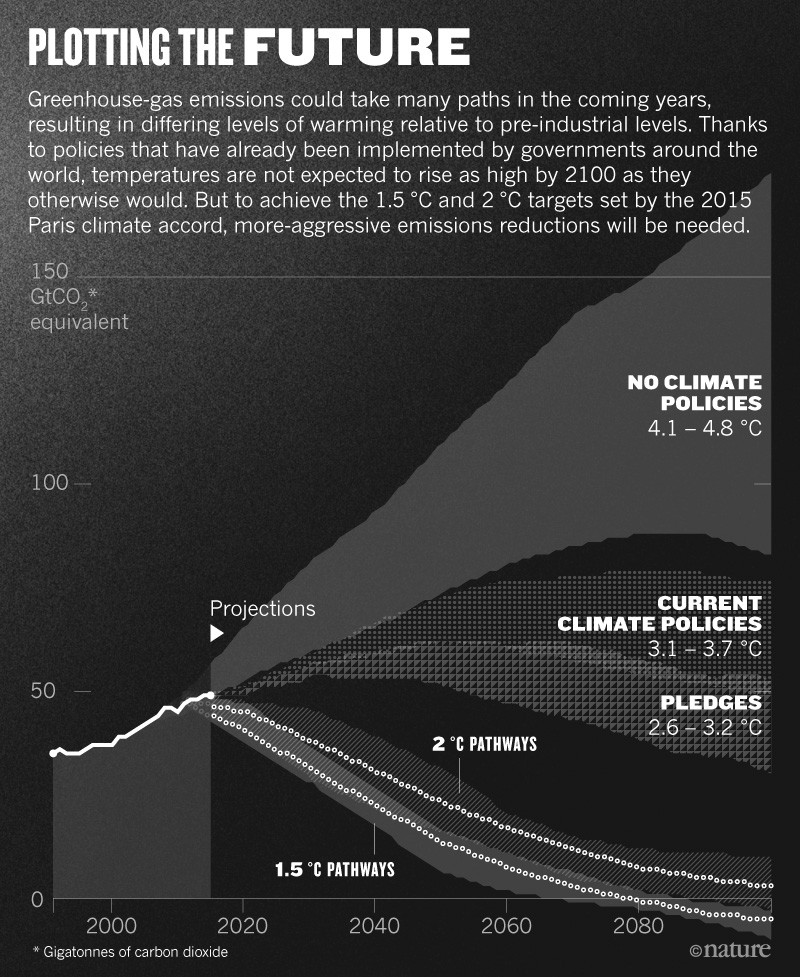
If you haven’t seen the latest report submitted by the IPCC, I recommend you do. You can find it here. The press release PDF contains its call to action. We have only a decade or a decade and a half to drastically reduce our greenhouse gas emissions, and even that will not prevent some of the effects that have already been set in motion courtesy a 1 degree celsius rise in global temperatures. We (or at least I) used to think that climate change was a faraway danger, something to contend with in decades or perhaps centuries to come, but no. It is here. It is now. And as an individual, you can make choices and perform actions that will collectively amount to something significant. The first step is to know about what’s happening.
Hence, here’s a list of things to read.
If you got this from a friend and want to subscribe, here’s the link. Also, if any of the links are paywalled and if you don’t want to pay for a subscription, try opening the link in incognito mode in your browser; it usually works. It does for me.
0. Losing Earth: The Decade We Almost Stopped Climate Change
This gorgeous interactive piece from the New York Times speaks of the 1980s, the decade when we had enough scientific wherewithal to know that climate change was happening and was going to balloon into something large. Governments and corporations could have taken a stance and taken steps from the outset to be sustainable; sadly, that didn’t happen. Welcome to the 21st century.
1. The judge in a federal climate change lawsuit wants a science tutorial
A good introductory piece. A US federal judge wanted eight questions of his answered by experts. It was a good call on his part, and more so because these are now out in the public to be read by all. It started off with nine cities, including New York and San Fransisco, which are suing oil companies for the damage they’ve caused to the environment.
On a related note, I have seen statistics circulating around the internet that the top 100 companies in the world contribute to 71% of pollution, or warming. To which I only shrug. The companies are not the end consumers of whatever they are producing; the actual human consumers around the world are. If you find a corporation not behaving ideally, try to not support them. I recognize that in some cases, it is not possible to eliminate them entirely from your lives. For example, after living for a year in the US, I realize that it is nigh on impossible to live here without a car. If you can’t rid yourself entirely of that dependence, reduce it. And so on. Blame the corporations, vote for more progressive policies and governments, but do your bit too.
2. Electric Buses Are Hurting the Oil Industry
This is good news, I suppose? Public transport is a key thing, and as more and more cities move to make theirs more energy efficient, they’re turning to electric buses. China, almost single handedly, has converted the electric bus market to one of scale.
The numbers are staggering. China had about 99 percent of the 385,000 electric buses on the roads worldwide in 2017, accounting for 17 percent of the country’s entire fleet. Every five weeks, Chinese cities add 9,500 of the zero-emissions transporters—the equivalent of London’s entire working fleet, according Bloomberg New Energy Finance.
Also, Why Public Transportation Works Better Outside the U.S.
3. The worst effects of climate change may not be felt for centuries. So how should we think about it now?
This is an excerpt from the book The Wizard and the Prophet , from which I’ve shared excerpts in the past as well.
Overall, climate change asks us to reach for higher levels on the ladder of concern. If nothing else, the many misadventures of foreign aid have shown how difficult it is for even the best-intentioned people from one culture to know how to help other cultures. Now add in all the conundrums of working to benefit people in the future, and the hurdles grow higher. […] Climate change is all of these and more: gradual, impalpable, world-altering, multigenerational, a situation that will not become readily tangible until irreversible lines already have been crossed. “It is not the sort of problem that Mother Nature raised us to solve or even notice,” philosopher Jamieson has written.”
I don’t know if I believe what’s being put forward in this, but I do recognize that climate change is a different sort of problem than what our brains have evolved to solve on a regular basis. However, so are things like math and science, completely disconnected from our immediate survival, and we have tackled those successfully. Why can’t we wrap our heads around this “problem” as well?
4. Can the world kick its fossil-fuel addiction fast enough?
As a species and society, we’re very dependent on fossil fuels. I tried once thinking about all the parts of my life that would be impacted were fossil fuels to disappear. Not only travel, but my lifestyle and food habits would have to change to. Fossil fuels are what bring me my food, whether it be grown locally or not. Around the world, major steps need to now be taken to reduce the emission of greenhouse gases emitted by fossil fuels.
5. California advances an ambitious climate policy that should be a model for the world
The state of California passed a bill that requires all energy in the state to come from carbon-free sources by 2045. As it is, this bill won’t make a significant dent in the global rate of emissions, but as the title of this piece says, California can act like a sandbox for a trial of this policy. Will it work? Can other states and countries be inspired by it? California’s Silicon Valley has led the world’s technology for years, now the state can lead in other ways too. What do you think about nuclear energy? In terms of carbon emissions, it is one of the best. The only issue we have as of now is one of safety, and it seems like it shouldn’t be too hard to take care of that, right?
Related: Apple Now Runs On 100% Green Energy, And Here’s How It Got There.
6. Disposable America
This just makes me angry. Sure, convenience is a good thing, but wilful convenience when you know that it’s bad for you and your environment? That characterizes American consumerism. The real reason this happens is because America is relatively pristine even now. As an affluent country, it faces very few of the immediate impacts of environment destruction and degradation. At the same time, we also have bigger things to deal with than plastic straws. This is only the first straw.
Also, Why It Took Dunkin’ Donuts 10 Years to Build the Perfect New Cup and Starbucks tries to save 6 billion cups a year from the trash … with help from McDonald’s.
7. Ghost Tigers: Climate Change and the Escalation of Extinction and [How to Write About a Vanishing World](https:
//www.newyorker.com/magazine/2018/10/15/how-to-write-about-a-vanishing-world)
Both sad pieces about indelibe loss of culture and wildlife as our climate changes. The first essay opens with the subtitle, “As the climate crisis intensifies, try this simple exercise: count how many animals you can’t see.”.
In her Pulitzer Prize-winning 2014 book The Sixth Extinction, Elizabeth Kolbert describes the disappearance of varied organisms as a way to understand our current catastrophe: the earth is hemorrhaging species at a rate not seen since the dinosaurs’ disappearance 65 million years ago. […] Throughout, Kolbert underscores that in our planet’s history, no creature has had such a direct hand in evolution as Homo sapiens. In this, she writes, “we are deciding, without quite meaning to, which evolutionary pathways will remain open and which will be forever closed.”
The above excerpt is from the first piece, and the second piece is by Elizabeth Kolbert herself.
In 2006, Samuel Turvey, a researcher with the Zoological Society of London, participated in a survey aimed at locating the last remaining Yangtze River dolphins, or baiji. Six weeks of intensive monitoring failed to turn up a single baiji. When the survey results were made public, in the journal Biology Letters, Turvey was deluged with interview requests. In one twenty-four-hour period, he spoke to more than three dozen news outlets around the globe.
“It turned out it was possible to galvanize the world’s media on behalf of the baiji,” he observes in his book “Witness to Extinction.” But only after the dolphin was gone for good: “That’s what would sell. That’s what constituted a story.”
8. Want to Fight Climate Change? Educate a Girl
_In 2017, a broad coalition of researchers, scientists, business leaders and policymakers came together for Project Drawdown. This was a multidisciplinary effort to identify the most substantive solutions to not just halt global warming, but actually cause an annual decline — or “drawdown” — in the concentration of greenhouse gases in our atmosphere.
The team looked at dozens of methods of minimizing carbon dioxide (CO2) emissions, and in the end, they drew up a list of 80 immediate and practical measures — along with 20 near-future concepts — that can keep CO2 out of the sky. What they did, in other words, was rank the 100 most powerful solutions to reversing global warming._
Educating girls was number 6.
This was striking. In comparison, rooftop solar panels came in at #10, and electric vehicles at #26. The reason why educating women is important, aside from climate change, is that they get more aware, marry and have kids later in life, and are better equipped to handle a disaster if thrown at them.
9. How to Plant a Trillion Trees and [Trees Could Change the Climate More Than Scientists Thought](https:
//www.quantamagazine.org/forests-emerge-as-a-major-overlooked-climate-factor-20181009/)
Reforestation on a large scale is another thing we need to do in order to reverse rising levels of greenhouse gases. Reports of trees’ power in capturing carbon from the atmosphere are not greatly exaggerated. However, we must be careful as well. The second piece here talks about tree systems influencing weather systems on a global level. I learnt that the Amazon rainforest discharges 17% more water per day than the Amazon river. Not only do forests create their own storms locally, but they also serve as the suppliers to a global conveyor belt of humidity in the atmosphere. Trees in Europe can send up water that ends up as rainfall across the Atlantic.
Such results also imply a profound reversal of what we would usually consider cause and effect. Normally we might assume that “the forests are there because it’s wet, rather than that it’s wet because there are forests,” said Douglas Sheil, an environmental scientist at the Norwegian University of Life Sciences campus outside Oslo. But maybe that’s all backward. “Could [wet climates] be caused by the forests?” he asked.
10. Carbon Farming Works. Can It Scale up in Time to Make a Difference?
Carbon farming is a different technology from carbon capture. In capture, we build complicated machines that suck CO2 out of the air. In carbon farming, farmers plant their land in such a way so that it absorbs more carbon. Plants that aren’t directly useful can be planted, and then be sent straight to compost pits where the carbon is “sequestered”, so to speak. It sounds like a good idea, and in places where land is aplenty, I think it is a good additional thing to do. This piece talks about a certain Lani Estill, who while rearing sheep for wool, also plants vegetation in and around her land to capture carbon. They’ve even been allowed to call their wool “climate beneficial”.
I have some more too.
- Welcome to the Age of Climate Migration
- How Windmills as Wide as Jumbo Jets Are Making Clean Energy Mainstream
- Denmark’s Carbon Footprint Is Set to Balloon: Blame Big Tech
- How a deliberate oil spill will help protect the environment
- The global south is rich in sustainability lessons that students deserve to hear
- The Revolutionary Giant Ocean Cleanup Machine Is About To Set Sail
-
Miami Will Be Underwater Soon. Its Drinking Water Could Go First
I didn’t include any pictures this time as a sort of statement, I guess. It’s not an optimistic issue like Kat’s Kable is usually, and so where is the space for nice pictures?
I’d love it if you wrote back with what you think about what you can or should do, and what you think about humanity’s place in the world. Do we have a duty to live sustainably and totally anthropocentrically?
This issue helped me to put some of my thoughts down on this aspect of the human civilization. I hope it gave you some visibility too. - Kat.