1. Tossing a Bird That Does Not Fly Out of a Plane
This was shocking and saddening. Thanksgiving is an American festival where turkey is the customary ceremonial food, but in a village in Arkansas, things get more perverse. Every year, the village of Yelville gathers to throw a turkey off a low-flying airplane. I should clarify at this point that a turkey cannot fly. However, is it worth expending effort to stop this spectacle? Billions of animals are killed for food in the US alone; does one more count toward anything? I suppose that’s what makes me most sad–life is not a number.
Was it worth it, ending a town’s beloved annual event to save a few birds from a few moments of confused terror? Was it meaningful, given how many billions of birds raised for meat face a far more gruesome life and death? Would it stick, given the steeliness of the residents of this corner of the Ozarks and the devotion of Americans to their meat-eating and cold-weather traditions?
2. The Crisis of Intimacy in the Age of Digital Connectivity
This essay argues the following: we generally assume that the rise of digital devices and social media is connected to a lowering of intimacy, but we do not consider digital intimacy as real intimacy. I enjoyed it and it raised some uncomfortable issues: it seems that online, personal sharing abounds but empathy is rare.
Or, rather, there is no more and no less intimacy now than there was during the analog era; the intimacy has been transferred to another format. Human beings are intimate creatures. After entering a world of impersonal connection, human beings cannot help but respond by rendering every interaction as personal as possible. Faced with a civilization based on the Uniform Resource Locations, we express ourselves in lust and hunger and violence. Sitting in front of infinitely interchangeable and accessible screens, each of us stupidly needs to feel special, and will do what it takes.
In our state of jumbled brokenness, of intimacy without empathy, fostered by the era of digital connectivity, we have returned to magic, to the primordial fear of contact. […] The debates that take place online are mostly not debates at all, not in the sense of an exchange of ideas. They are accusations of blasphemy and indulgences in the pleasures of blasphemy. The current moment has been described as “post-truth,” which is a misnomer. The problem is that everyone has their truth and nobody admits doubt. There is no shortage of totalizing moral clarity in the world. Indeed, there’s a glut. I see my beetle and nobody else’s.
3. I Found the Best Burger Place in America. And Then I Killed It.
This piece was doing the rounds on the internet, and I finally got around to reading it. It’s a nice complement to the previous piece, since it talks about the influence of the internet. The author of this piece earlier named a burger joint called Stanich’s, in Portland, Oregon, USA, as the best place to get a burger in the country. Completely overwhelmed by touristy crowds, the joint is now closed. It was used to serving a regular clientele who were at peace with the place’s personality, and it was not at all prepared to handle one-time crowds of tourists who only wanted to say “been there, done that”. Another interesting thing this article spoke about is why lists are so appealing to humans.
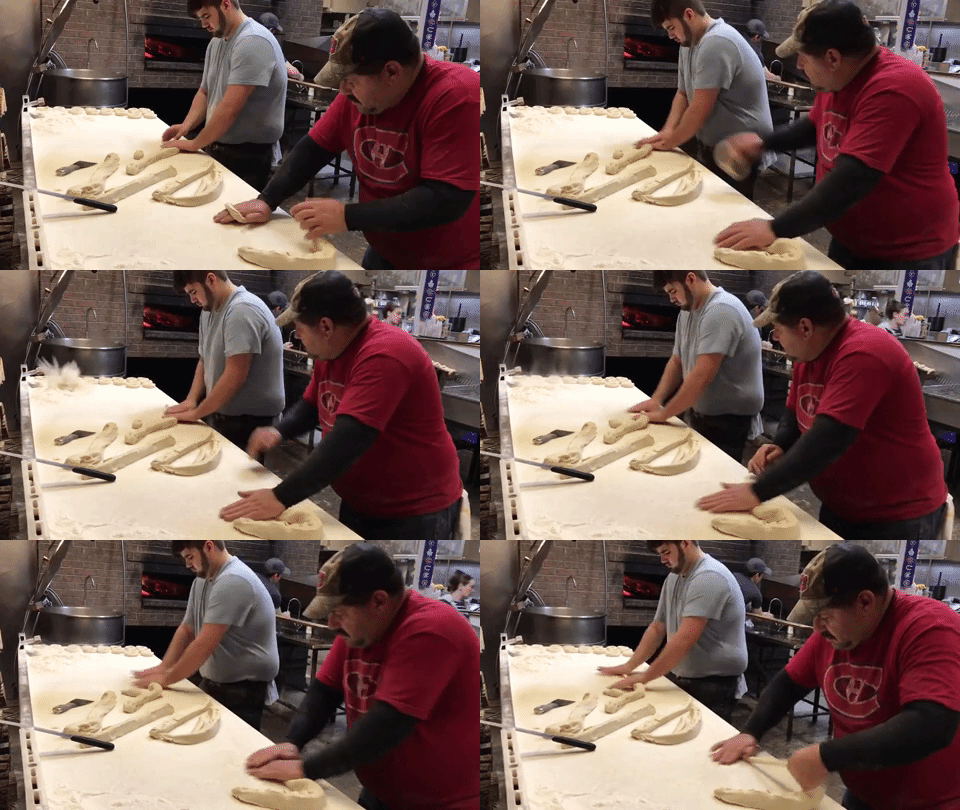
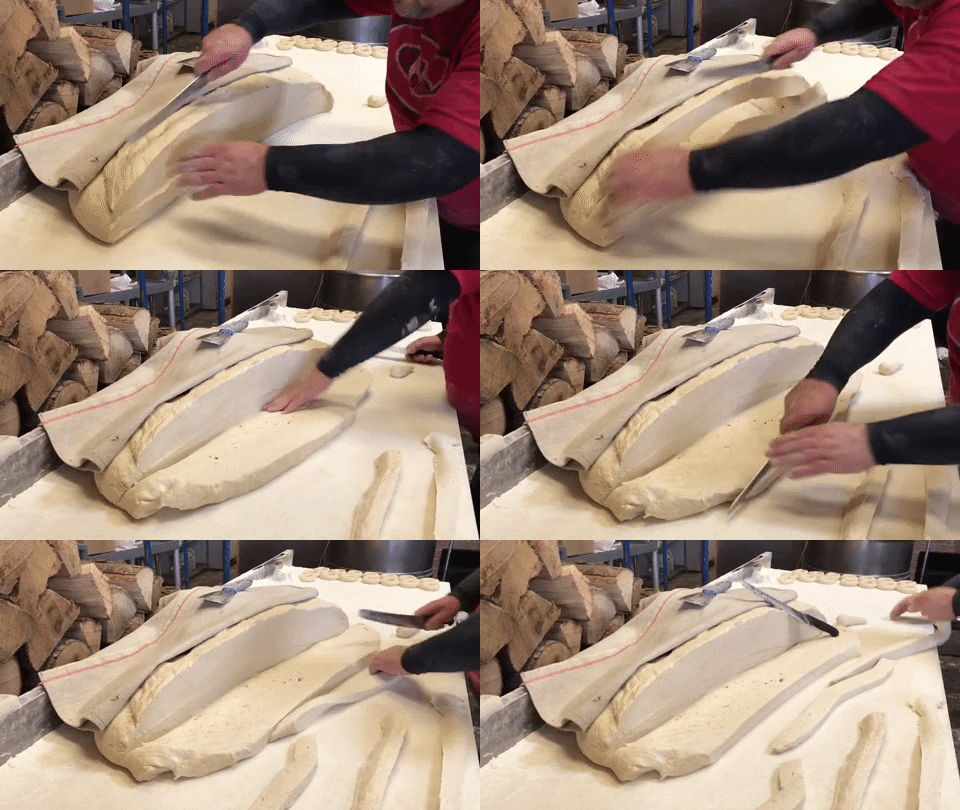
4. A day in the life of Lloyd Squires, Vermont’s ‘best’ bagel maker
I bake bread every weekend, and find myself spending disproportionate amounts of time on YouTube and Instagram looking at pictures and videos of bread being made. That’s why I adored this: a photo-essay detailing the day of Lloyd Squires, who spends all his time each day preparing, making, or delivering baels. It’s hypnotically calming.

5. What I Learned About Life at My 30th College Reunion
This is, yes, a list. A list of observations made by Deborah Copaken as she attended the 30th reunion of her Harvard class. Some of my picks.
Nearly all the alumni said they were embarrassed by their younger selves, particularly by how judgmental they used to be.
We have all become far more generous with our I love you’s. They flew freely at the reunion. We don’t ration them out to only our intimates now, it seems; we have expanded our understanding of what love is, making room for long-lost friends.
Love is not all you need, but as one classmate told me, “it definitely helps.”
6. To Adapt to a Changing Climate, Kyrgyzstan Revives Its Nomadic Past
The nomadic Kyrgyz people of old lived nomadically and maintained a very low carbon footprint. Even now, Krygyzstan has a pretty low footprint per person, but it is impacted disproportionately by climate change intiated by other parts of the world. Being a landlocked country, it is extremely vulnerable. How to deal with it? By reverting back to the nomadic, adaptive lifestyle of the past.
7. Palm Oil Was Supposed to Help Save the Planet. Instead It Unleashed a Catastrophe.
A hard-hitting piece of writing from the New York Times : palm oil is used in western developed countries as one of the ingredients of biofuel. When these countries passed legislation incentivizing the use of vegetable oils as fuels instead of gasoline, they set in motion events that led to MASSIVE climatic shifts in various countries around the world. The cutting down of forests in Borneo and Indonesia has released so many greenhouse gases that it will take decades of biofuel usage to even make the entire act carbon-_neutral_. Everything is connected.
Suhadi wanted to tell the lawmakers the same thing he told them in two previous visits to Capitol Hill: that the palm trade, driven by American investment, is slowly killing his country. “It’s important for you to understand that all acts of deforestation in Indonesia start with a signature,” he said. “And more than a little of it starts right here.”

8. Killer Tulips Hiding in Plain Sight
This was super scary. It reminds me of the now well-known connection between antibiotic resistance in humans and the profusion of antibiotics fed to factory-farmed animals for human consumption. Apparently the two industries were using the same antibiotics for years without realizing it. A similar thing is happening with fungicides in agriculture as well: humans are apparently dying of things that could easily have been cured earlier. It’s happening because of the use of azoles, a class of antifungals used widely in agriculture. It’s got to the point where if you have a weakened immune system or if you are prone to get one of these diseases for which an antifungal is prescribed, you shouldn’t be gardening at home. I found the whole thing a bit bizarre.. but again, everything is connected.
9. Why Doctors Hate Their Computers
Atul Gawande is a perceptive writer, doctor and public health specialist. Here he talks about the increasing use of computerized records by the healthcare industry in the US. Doctors are being forced to upload all details of their patients and their visits to these computer systems. In theory this should work well: all information is in the system and mistakes will be reduced. However, this eats up into a huge chunk of time, so much so that some American doctors record their conversations with patients, outsource it to trained doctors in India who transcribe these in the required format and send it back. Again, this sounds a bit crazy. However, I do feel that with the increasing prevalence of artifical intelligence and machine learning techniques, a number of these repetitive tasks can be automated to synergize well with the doctors’ day to day work.
10. How the World’s Most Difficult Bouldering Problems Get Made
Bouldering is a relatively new sport, indoor climbing, but with a bit of a difference. This piece talks about the lives and methods of “setters” - people who create the challenging courses that climbers have to conquer.
In bouldering the goal is not about attaining the summit along a particular set of pitches, but to use specific body movements to progress through a prescribed sequence of holds along both horizontal and vertical axes. Bouldering opened up people’s minds about what was possible on a climbing wall. It made all climbing more precise, more mental.
If you think about a climb as a sentence and each move as a word, the holds are individual letters. The most commonly used holds provide a horizontal edge that you can hang from. When the hold is extremely positive, which means it has a large lip or is otherwise easy to grab, climbers call it a jug. A crimp, by contrast, has an edge that’s so thin, you can fit only your fingertips on it.

See you next week. -Kat.