I’m on time! I’ve been at a conference the whole of the time after last week’s newsletter, and it’s been brain-sapping. I’m tired, but soon I’ll be back home. Glad I could carve out the time to read and curate this issue, I must say.
There’s not too much energy left to write much of an introduction this week, so on to the list. One question, though. I have some more time now; are there any special issues you want to see? You can find the previous ones in the archive.
If you got this from a friend and want to subscribe, here’s the link. Also, if any of the links are paywalled and if you don’t want to pay for a subscription, try opening the link in incognito mode in your browser; it usually works. It does for me.
0. Other Newsletters
I was introduced to email newsletters a few months before I started this one, my own. Whether daily, weekly or monthly, they are a wonderful, deliberate and personal way of sharing writing, experiences, and curiosities. I’m currently sharing a few every week as a way of spreading the cheer. (also check out #8 on this week’s list.)
- Laura Olin: Laura Olin sends out a cute weekly list. “Lovely and/or meaningful things in the form of links, notes, and updates on projects. Every Thursday.”
- RadReads: Khe Hy sends out a weekly newsletter, but it’s so much more than just that. He’s developed a vibrant community of readers, and it’s fun to be part of. The emails themselves are well curated, with pieces and insights from him, as well as some things from all over the internet.
1
When you don’t know what to do, make tea
If you know me at all, you’ll know that I am always drinking tea. According to this article, perhaps I’m doing that because I never know what to do, and I cannot argue with that impeccable logic. The warmth of a cup of tea is supposed to make you more warm and caring as compared to, say, a cup of ice coffee.
Indeed, when work brought me to London for a few months this fall, the thing I was most struck by was the kindness of the tea-making act. In the office, whenever anyone was getting up to make themselves tea, they would ask the people sitting nearby if they wanted a cup, too. A few minutes later, they’d return, bearing a little clattering bouquet of ceramic mugs with milk and sugar, adjusted to your liking. Everyone did this; everyone took turns. It was just a small thing. But it helped brighten up your day.
2. I work with kids. Here’s why they’re consumed with anxiety.
This was a sobering read. It takes an American perspective to the issue, but I believe that the same thing is happening in many parts of the world (albeit to lesser extent), India included. As children go through schooling, they need to start thinking about careers, decisions, and more. Something that’s scary is that teachers in schools can send notifications to students’ and parents’ phones alerting them of newly posted grades. No wonder you would always be anxious. As Professor Oak in Pokemon would say, “There’s a time and place for everything! But not now.” Why ever do tweens and teens need to think about “work-life balance”?
The kids often used workplace lingo to describe their lives. One sixth-grader talked about a school assignment in which she had to develop a life plan that included her future career, which schools she should attend, and what she ought to major in at her chosen university. It was only later that I realized visualizing the future like this meant that every grade, every volunteer hour, every achievement or failure carried the weight of fulfilling that imagined future.
3. PowerPoint Is the Most Efficient Way for Kids to Manage Their Parents
This is …amazing. A case study of a few kids who made PowerPoint presentations petitioning for something or the other from their parents. The logic is that merely asking takes little effort, and so if they spend the time on a PowerPoint, then they show that they really want whatever they’re asking for. Can’t argue with that. See sample slide, I’m floored.

In a slide that he headlined “I Know What Your Thinking,” Cade wrote, “I’ve heard it from you mom, ‘We would but there is just too much stress with moving houses.’ Well, boy do I have an answer for you. Studies have shown that when petting a dog your body releases a number of ‘feel good’ hormones, such as serotonin, prolactin and oxytocin. There for releasing stress.” (He meant “you’re” and “they’re” but that’s not the point here.)
4. In India, building Bridges between Life and Art
I’ve never been to the Kochi-Muziris Biennale, and it seems unlikely that I’ll go anytime soon. However, I’m glad that the New York Times has a piece about it and the art it’s showcasing. It looks wholesome and perhaps the “exhibit” I’m most excited is the Edible Archives one, which offers meals made with heritage rice varieties of India.

5. The Embroidered Computer
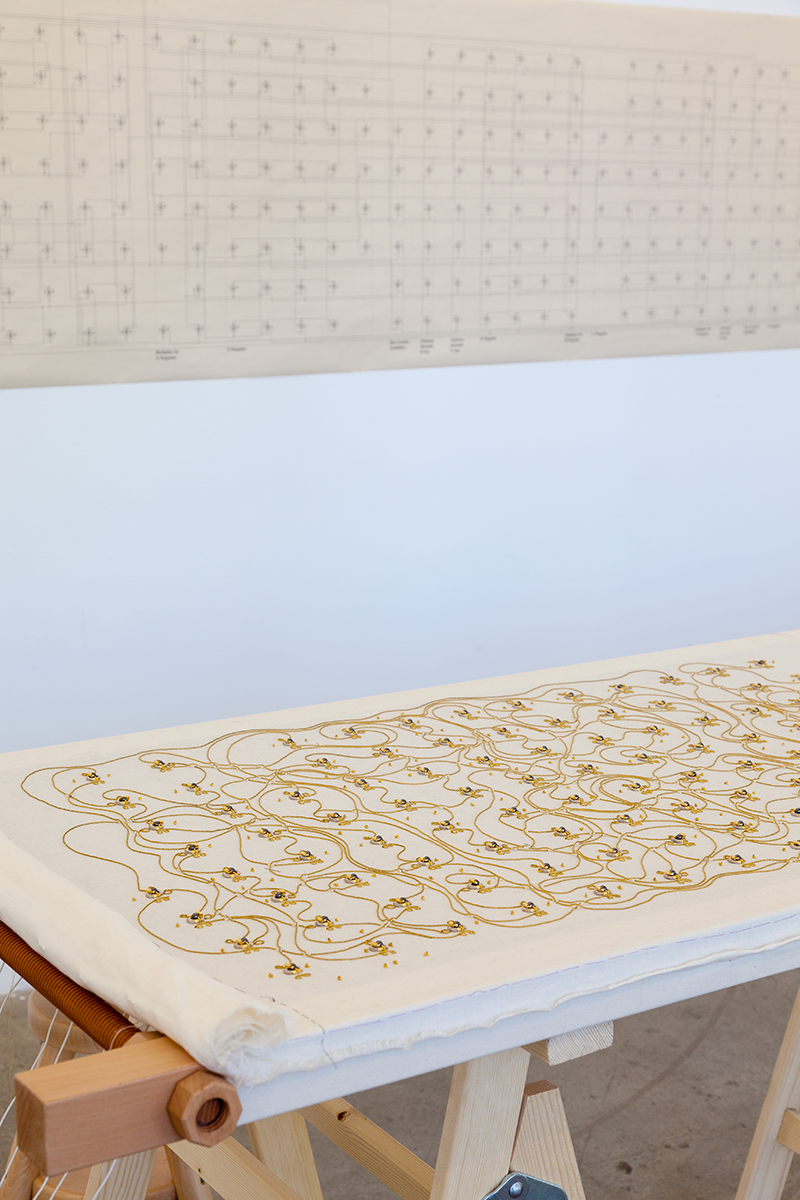
More pictures, and this is glorious. Gold embroidery materials and threads are used to make a small embroidered computer. By small I mean that it has only eight bits, but takes up quite some physical space. It looks super elegant.
6. Beneath the Surface of Bruce Springsteen
Two years ago, I read the autobiography of Bruce Springsteen and discovered there’s so much more to the man than I thought. It’s not an understatement now to say that he’s one of my role models, in terms of being able to live on his terms and in terms of how he’s sustainably thought about and dealt with his mental health. For a while, he had a solo show on Broadway that apparently now is on Netflix (I have never used Netflix yet) and perhaps I should set up an account. When I need to think and brood a bit, I listen to two of his albums that I like the most, The River and Born to Run. I also think it’s time for me to reread the autobiography.
“DNA is a big part of what the show is about: turning yourself into a free agent. Or, as much as you can, into an adult, for lack of a better word. It’s a coming-of-age story, and I want to show how this—one’s coming of age—has to be earned. It’s not given to anyone. It takes a certain single-minded purpose. It takes self-awareness, a desire to go there. And a willingness to confront all the very fearsome and dangerous elements of your life—your past, your history—that you need to confront to become as much of a free agent as you can.
7. How The Lord of the Rings Changed Publishing Forever
The Lord of the Rings was first published in hardcover form in the UK and then the US. As timing and luck would have it, its paperback edition was released at a time when paperbacks were getting a firm push into the mainstream reading population. Ballantine books secured rights to the “authorized” paperback (after some legal wrangling and subtleties with Ace Books who tried to publish it without royalties). I never thought much about how the format of the book would impact the actual literature. The format of the paperback influenced the length of published books, and that’s what made the short sci-fi novellas so popular. People had to write them because that was the size of book that everyone wanted! What about me? I shamelessly read any sci-fi book shorter than 250 pages in one evening to advance my book count for the year.
By the way, I don’t know how you feel about audiobooks, and I don’t know how I feel about them either, but if you enjoy LOTR, then you could consider this audiobook of The Silmarillion read by Martin Shaw. It has been fantastic!
8. The Future Book is here, but it’s not what we expected
Once in a while, Wired brings out a feature that’s fabulous. And I think that this is one of those. Is the Kindle, or any other ebook reader, the “book of the future”? It sure is nice to have a thin and small slate that can contain a thousand books which lets you seamlessly highlight passages in it. But. Is that it? Or are we looking in the wrong place? Is the “future book” more a matter of content and format rather than digital device? The piece also speaks appreciatively of email newsletters, yay! Why? Email is decentralized, not yet subject to algorithmic sorting and in some wholesome way more personal than an Instagram or Facebook post. Apparently every author should have one. Does this mean I’m going to become a writer someday? The piece also talks about Kickstarter, crowdsourcing and crowdfunding. The internet has changed the way books work, and the way books are distributed. Curious to hear your thoughts about this. Do you want to see books change? Become more connected, tech-savvy, or see them as they’ve been for years? To end, Robin Sloan (read his books Sourdough and Mr. Penumbra’s 24-Hour Bookstore) says this about email newsletters:
Why? Because we simply cannot trust the social networks, or any centralized commercial platform, with these cliques and crews most vital to our lives, these bands of fellow-travelers who are—who must be—the first to hear about all good things. Email is definitely not ideal, but it is: decentralized, reliable, and not going anywhere—and more and more, those feel like quasi-magical properties.
9. Nothing can stop Google. But DuckDuckGo is Trying Anyway.
There seems to be a theme in this issue, at least with the last two pieces and this one. I stopped using Google as my default search engine two months ago after finding that DuckDuckGo does a decently good job. Of course, I don’t always see exactly what I want to, but that’s the point. I don’t want my search engine storing all my data in order to give me more accurate results. DuckDuckGo still shows you ads and makes money (of course, it would be suspicious otherwise), but these ads are based only on each search query at a time. Search for “tennis”? It might show you an ad for a Wilson racquet, and not one for membership at the local tennis center you passed within a hundred meters of last Saturday.
10. Why Japan is a Rare Holdout in Asia’s Cash-Free Future
Japan! The land of quirks. Why cash? To respect small businesses. To make it seem, with each transcation, that you’ve actually spent some money. And also that the cashiers are lightning quick in Japan, and you can trust them enough that you don’t need to count your change. What’s there to not like in the system? The fact that the 2020 Olympics are happening in Tokyo, and it’s hard to get cash as a foreigner. Interesting standoff between governmental push and cultural inertia. Will they become more card-friendly in a year? Will they get the credit they deserve?
also: Why is Japan so Attached to Paper?
See you next week.