Hello there. Last week was a rollercoaster, this one’s been the long downward part of the rollercoaster that hasn’t really ended yet. I find that whenever I can’t work or function properly, I pour all my energy into reading. I read some good, and some excellent graphic novels: Saga vol. 9, Marbles (by Ellen Forney), Lost Cat (by Caroline Paul and Wendy MacNaughton), Grass Kings vol. 3 and Brat (by Michael DeForge). Also lots of longform on the internet, which translates into this week’s issue of course. What have you been reading?
Hope you enjoy this week’s list. Until next time, adios. -Kat.
If you got this from a friend and want to subscribe, here’s the link. Also, if any of the links are paywalled and if you don’t want to pay for a subscription, try opening the link in incognito mode in your browser; it usually works. It does for me.
0. Other Newsletters
I was introduced to email newsletters a few months before I started this one, my own. Whether daily, weekly or monthly, they are a wonderful, deliberate and personal way of sharing writing, experiences, and curiosities. I’m currently sharing a few every week as a way of spreading the cheer.
- Dense Discovery: A weekly newsletter with links, creatively oriented articles, nice product recommendations. Also sometimes contains my favorite GIF of the week.
- Hiut Denim: Hiut Denim is a UK-based jeans manufacturer. Their website is a work of art, and someday I hope to afford one of their pairs of jeans (around £200). Their newsletter, however, is free, and a work of ART. It is glorious and does not revolve around selling their jeans. As a company, they embody so much of what I value: make lasting, durable products that you are proud of.
1. Don’t despair: the climate fight is only over if you think it is
Nice writing by Rebecca Solnit. It’s from last October, which was around the time the IPCC came out with its big dire report. Solnit, whose work I tried to get into by attempting to read Wanderlust: A History of Walking (and failed), writes well and appeals to us to not give up. Being pessimistic, feeling that the problem of climate change is too big for any one of us to deal with; these are perhaps rational feelings but they will not get us anywhere. The way I see it: in the end, everything, every industry, institution, act, is done only for human consumption. Somewhere in the middle, due to the system being what it is, we fail to see the effect we may induce by changing our choices and lifestyles. In the end, climate change is a problem caused by humankind, and whether or not you like it, you’re in it.
2. The World Might Actually Run Out of People
Population forecasting models predict that (no surprise) human population is going to increase at a rapid pace and slowly plateau after that. One of the things that scientists grapple with is: will humans hit the “carrying capacity” of the planet? Anyway, will we or will we not have 11 billion people in 2100? According to most modelers, yes. But. A few others say that there’s one important variable that’s missing from all the popular models, which is the increasing rate of education among women. Interesting read, and I shared something similar a few months ago too: Want to fight climate change? Educate a girl.
3. Non cogito, ergo sum
I thought that the Economist ’s 1843 magazine was quite new, but I unearthed this piece from 2012. Some of the most creative things come from instinctive acts, so should we try to incorporate “unthinking” into our acts?
By allowing ourselves to listen to our (better) instincts, we can tap into a kind of compressed wisdom. The psychologist Gerd Gigerenzer argues that much of our behaviour is based on deceptively sophisticated rules-of-thumb, or “heuristics”. […] Unthinking is not the same as ignorance; you can’t unthink if you haven’t already thought. Djokovic was able to pull off his wonder shot because he had played a thousand variations on it in previous matches and practice; Dylan’s lyrical outpourings drew on his immersion in folk songs, French poetry and American legends. The unconscious minds of great artists and sportsmen are like dense rainforests, which send up spores of inspiration.
4. Junk Science or the Real Thing? ‘Inference’ Publishes Both.
This is scary. ‘Inference’ is a scientific journal that is backed by Peter Thiel, who backs Donald Trump, who denies climate change, etc. You get the point. You’d thus expect ‘Inference’ to be a terrible journal full of psuedoscience and wrong science that you’d immediately spot. This is where you’d be wrong. The journal does publish pseudoscience, but it also publishes a good deal of correct science, and has a Nobel laureate in physics, Salman Glashow, on its editorial board. The point is to give legitimacy to wrong science by placing it on the same platform as correct science. It really is scary.
5. The Ethics of Web Performance
I came across this piece via excellent newsletter Dense Discovery , which I wrote about in item #0. Excellent article bringing up relevant points in a cogent manner: why are websites always heavy? Why are they always slow to load on old phones? Most users use websites to consume videos, photos, text and use some interactive content. Why are old phones and laptops always struggling to load new websites? I also recognize the electricity that cloud services consume, and I must say, I do a terrible job of reducing that footprint. Things like editing documents offline instead of using Google Docs or Overleaf, close down old idle accounts, etc. seem to be steps to appease my conscience more than make some real change.
6. Diane Yannick’s review of Marie Kondo’s book
Before Marie Kondo had her Netflix show, she wrote a book. Enjoy this review.
I had NO freaking idea that I was squashing the self-esteem of my possessions. I can NOT find those folding sweet spots and everything in my drawers is in a mosh pit. My hand bag looks sad every time I walk by its nightly fullness. My socks are falling down. I’m not sure why. I hate the word joy now. I’m sleep deprived. My possessions call out to me for help but I don’t know if they want me to summon joy or if they want to leave. The other day my husband heard me thanking my underwear for staying up all day. I’m not sure how much longer I’ll be married.
7. No One Is Prepared for Hagfish Slime
This article’s title is right: you are not prepared for Hagfish Slime. It deserves to be capitalized. Look at this car covered in hagfish and hagfish slime.
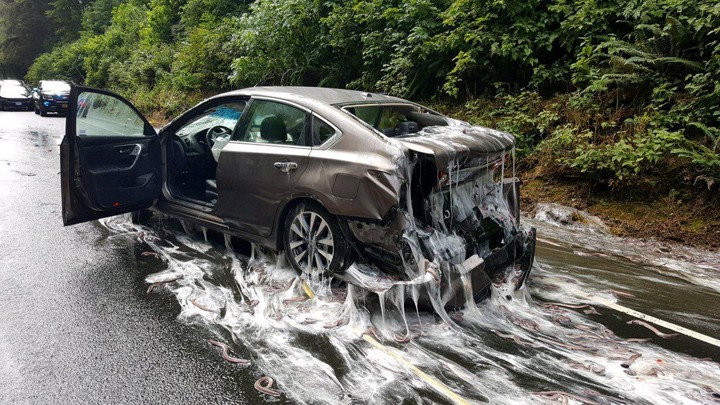
Typically, a hagfish will release less than a teaspoon of gunk from the 100 or so slime glands that line its flanks. And in less than half a second, that little amount will expand by 10,000 times—enough to fill a sizable bucket. Reach in, and every move of your hand will drag the water with it. “It doesn’t feel like much at first, as if a spider has built a web underwater,” says Douglas Fudge of Chapman University. But try to lift your hand out, and it’s as if the bucket’s contents are now attached to you.
8. Welcome to the Bold and Blocky Instagram Era of Book Covers
So interesting. New book covers are designed in such a way that they can be viewed and discerned easily on small screens, because many people now do their shopping on their phones. I knew that new covers were different from older ones, and that everything in a bookshop looked the same from far away, but I didn’t think about it much till I read this piece.

9. Priyamvada Natarajan Maps the Invisible Universe
I have a pet theory that the reason we love profiles, biographies and autobiographies is because they are almost voyeuristic in the view they offer of other people. In the end, all humans want gossip of some form or the other. This profile of Priyamvada Natarajan, an astrophysicist at Yale University, is quite inspiring. She went to MIT for a PhD in the philosophy of science, but later switched to physics proper. I find it inspiring and relevant that she sees the two as one–science and how we think about science are not two separate things. Maybe for scientists they are; but for humanity as a whole, these things should come together.
10. Think Different
Article about how Apple is the single largest entity redistributing wealth into the upper (richer) echelons of society.