Hello! How has your week been? We’re back to regular programming this week. It’s been busy but I have been able to get some reading in and there are some nice pieces in this week’s issue. I hope you enjoy. See you later!
If you got this from a friend and want to subscribe, here’s the link. Also, if any of the links are paywalled and if you don’t want to pay for a subscription, try opening the link in incognito mode in your browser; it usually works. It does for me.
1. The magic of estate sales
Ann Friedman has written this lovely piece about estate sales. I moved to the US two years ago and in my time here, I’ve come to enjoy and relish going to estate sales. What is an estate sale? It’s a garage sale’s bigger brother: when a person passes away, their possessions are displayed at their home and sold by an external company. Last weekend I found a clay pot (called a cloche) that I now use to bake my bread in. It’s at least about 30 years old, because it says “West Germany” on the bottom.
Which is why I love estate sales. The estate sale, unlike its close relative the yard sale, is not a selective culling of possessions. It’s a going-out-of-business event for one person’s life. “Full House Sale—60 Years accumulation,” boasts a local listing on EstateSales.net. A yard sale gives you access to the items that someone has decided don’t spark joy or that have gathered dust too long in the bottom of a closet. […]
When you walk through an estate sale, though, you’re perusing the stuff that was integral to a stranger’s daily life. The mugs they drank coffee from every morning in this kitchen. The chairs they pushed into the soft sand of the beach every summer.
2. The search for the kryptonite that can stop CRISPR
CRISPR is a new gene-editing technology that’s almost too scary to be true. Using the technique and a partner protein, scientists (or anyone who cares to) can snip out and add in custom-edited genes into an organism’s genome. Even a human’s. Is there a way to prevent your genes from being edited without your knowing? Should anyone have the ability to edit somebody else’s genes? It’s scary to think of the implications.
3. To save a keyboard, pt. 1
Marcin Wichary is writing a book about keyboards which is, rather delightfully, called Shift Happens. He has a newsletter which I recommend. Here’s the latest issue where he talks about his role as a historian, and gives an example of some detective work he’s done to decode a particularly eccentric key found on some old typewriters. While you may not believe this to be true of a story of sleuth about keyboards and typewriters, it truly is gripping.

4. Robert Macfarlane’s otherworldly archives: The notebooks that documented Underland
Another piece about writers and their upcoming books. I haven’t read anything by Robert Macfarlane, but here he talks about why he prefers notebooks to anything digital for taking notes on his excursions and expeditions. It’s lovely and personal.
People sometimes ask me why I don’t use a phone to take notes when I’m ‘out’ in the field. The answer is that phones smash, while notebooks bend. I also like the way that notebooks record where they’ve been not just in terms of what’s written in them, but also in terms of the wear they bear as objects.
There are places in these notebooks where my handwriting has been smudged into illegibility by underground streams, or where mud and silt stains the pages brown, or where the spines and corners have been foxed and folded. These are, to me, as much part of the archive of a landscape as my poor-quality biro sketches and my transcriptions of conversations.

5. Why Mathematicians Are Hoarding This Special Type of Japanese Chalk
A math professor wrote this about Hagomoro Fulltouch chalk, which is also known as the “Rolls Royce of chalk”:
There have been rumors about a dream chalk, a chalk so powerful that mathematics practically writes itself; a chalk so amazing that no incorrect proof can be written using this chalk. I can finally say, after months of pursuit, that such a chalk indeed exists.
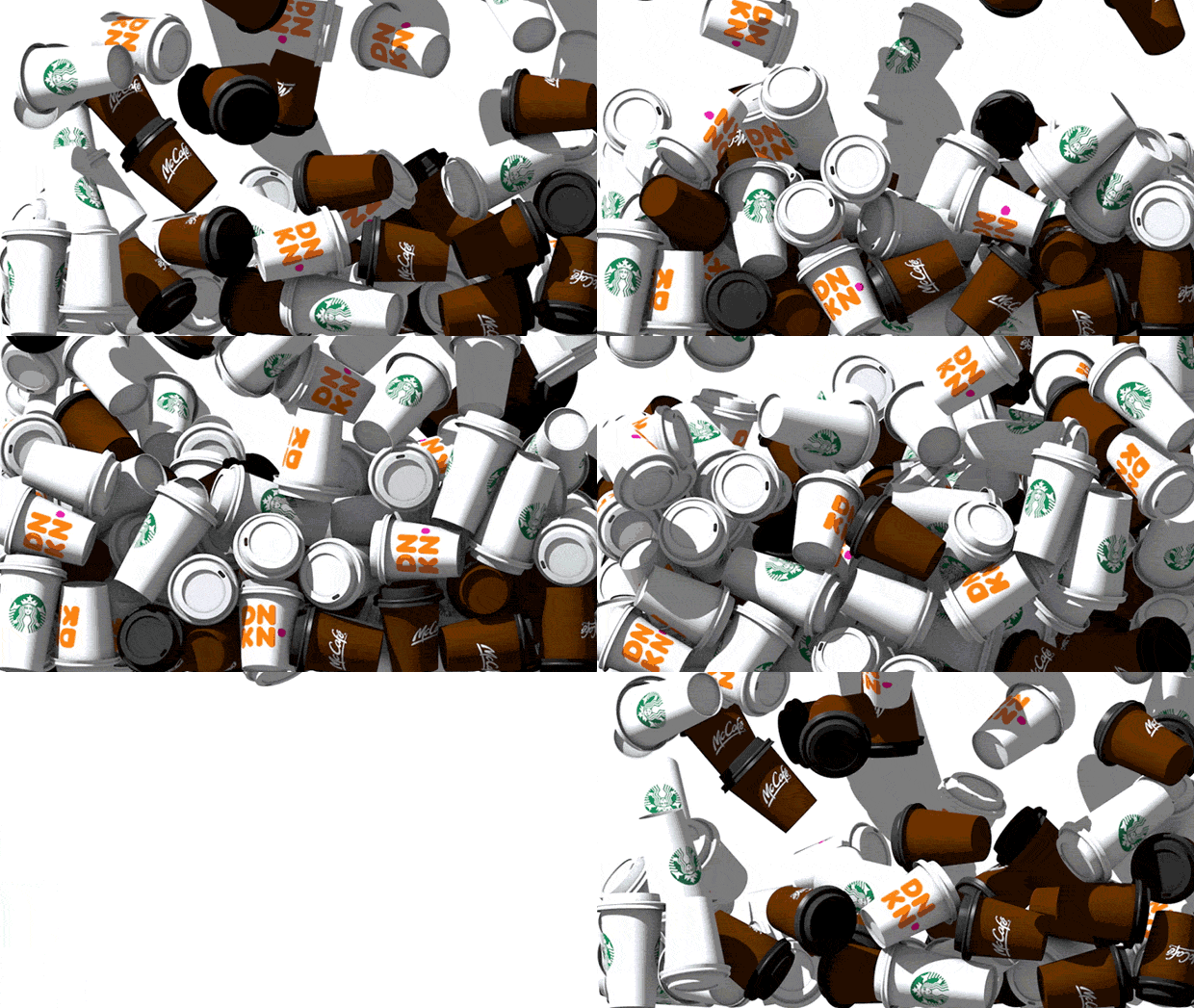
6. Starbucks, Dunkin Race Against Bans, Taxes on Disposable Cups
The city of Berkeley, in California, has come up with something new: a 25-cent surcharge on to-go coffee cups. This is shaking up the biggest coffee retailers in the city, Starbucks and Dunkin. It’s not totally unprecedented, and I see it as a welcome move. The city has done nothing else apart from say that this surcharge be added to drinks. The money is to be kept by the coffee shop, and they can even drop prices so that nothing changes. The world would be a nicer place if people used their own cups.
7. How much can forests fight climate change?
This is interesting information (which I’ve shared something about earlier too): planting trees may not unequivocally cool the planet. In tropical regions, trees definitely cool the entire planet, but in temperate regions, there’s something called the albedo effect, wherein large leaves reflect energy back into the atmosphere. This effect counteracts the positive effect of sucking carbon out of the atmosphere and into the soil. Oh well. This was bound to be complicated. A scientist who wrote about this received death threats!
8. Happy hens, happy world
Instead of jamming more animals into already crowded facilities, Berckmans says that livestock producers could take a big step toward meeting global demand by simply treating their animals better. “Animal welfare is the key to making the process more efficient,” he says. “It took me many years to understand this.”
Weary, for his part, has dedicated his career to improving farm animal welfare to help not so much the world as the animals and the farmers. He says that developed countries already consume far more protein than they really need, so bulkier pigs and cows may not be crucial to the future. “I’m skeptical of the narrative that we have to do X and Y to feed the planet,” he says.
Interesting graph here:

9. An Interview with Michael Pollan
Michael Pollan is an amazing writer, and his latest book is about psychedelics and their role in expanding one’s psyche. Here’s an interview that he did a few weeks ago. He has interesting and almost always well-thought-out views on many, many topics.
Well, I’ll tell you what the transition was: I really thought that the opposite of material was spiritual, or that the opposite of spiritual was material, that these things were in conflict. But I came to see that that’s the wrong term, and the opposite of spiritual is egotistical. Our ego and everything that goes with it—the defenses that are its tools—essentially close us off from connection, whether it’s to nature or other people.
10. The key to loving your job in the age of burnout
Umm. According to this article, we’re “loving” our jobs and loving working because we tie too much of our identity to it.
In his view, the problem has been exacerbated by tech companies that telegraph a woke culture but, in reality, aggressively focus on making money: “A new breed of super-brutal, crystal meth-pure capitalism,” in Hodgkinson’s phrasing.