Hellooooo. It has been a busy and tiring week, but I’ve gotten so much reading done, so it feels satisfying. I hope you enjoy this issue. I’ve been thinking about changing/tweaking the format of the newsletter, but haven’t made up my mind about it yet. However, something that I feel should have been in each issue from the very beginning is a …GIF! Here you go:

If you got this from a friend and want to subscribe, here’s the link. Also, if any of the links are paywalled and if you don’t want to pay for a subscription, try opening the link in incognito mode in your browser; it usually works. It does for me.
1. Patagonia’s Yvon Chouinard on Mindful Consumption
I generally have an aversion to almost all things corporate because they seem too cut-throat and unsustainable. Also, you can’t wear shorts to offices. Patagonia, however, is a company that’s markedly different. They try to make products that last, and they’ll also help you find second-hand users for products that you don’t want anymore. Advertisements actively tell you to not buy their products, etc. etc. Lately, over the past few years, I’ve not tried to buy cheap products, but rather products that will last me a lifetime, and still be worthy of use. I’ve never used any Patagonia products, but now I feel like supporting them and other companies that follow similar philosophies.
2. Stop buying crap, and companies will stop making crap
It seems to be a rather far-fetched idea that one person’s actions or inactions will impact industries and companies on a large scale. To me, there’s always been some sort of gap between individual decisions and large-scale effects. However, there’s bound to be a connection, and that’s what this piece says. It’s a nice complement to the previous one – if you stop buying unsustainable goods, companies will be forced to stop selling them. It’s tempting to sink into a “my decision alone can’t matter” mindset, but I suppose that’s part and parcel of being only human out of a population of billions.
3. The Ecological Footprint of Fish — Chow and Lin
This is a fascinating visualization of data. China’s most popular fish (to eat, of course) is the large yellow croaker. These analysts look at how many varieties, and how much weight, of smaller fish is required to “farm” the yellow croaker. The answer is startling: over 4000 small fish form part of the food pyramid that leads to one croaker. The link has pictures of dead fish, so if that isn’t your thing, don’t click on it.

4. Living with perfect pitch and Synaesthesia – what it’s really like
This was so interesting. LJ Rich is a composer who also has synaesthesia, which manifests as her being able to perfectly identify individual notes in any sound she hears. She tries to break down how amazing it is, and she does a pretty great job.
Now, I’d like you to imagine you’re chatting with your conversation partner. But instead of speaking and hearing the words alone, each syllable they utter has a note, sometimes more than one. They speak in tunes and I can sing back their melody. Once I know them a little bit, I can play along to their words as they speak them, accompanying them on the piano as if they’re singing an operatic recitative.
5. The price of plenty: how beef changed America
This is also rather fascinating, because a British newspaper, The Guardian , examines the historical aspects of America’s beef industry. Before the advent of refrigeration and cheap rail transport, animal husbandry was by necessity a local industry. However, in the late 19th century, that began to change rapidly. In the USA, the industry began to be cornered by four large companies, and this led to the founding of the modern style of “agribusiness”. To me, who’s been vegetarian/vegan, it’s disconcerting to see how impersonal (and seemingly inhumane) the whole industry is. It’s like: if you wish something bad away and avoid thinking about it, it’ll go away.
6. Ebooks for All
I suppose it’s now back to switch back to something nice and cheering. Craig Mod (who is one of my favorite writers/reporters/people) writes about his experience in Ghana reviewing and surveying the progress of a company called Worldreader. Worldreader is attempting to deliver access to books via Kindles, and from this piece, it looks like they’re successful at it! This is a nice hopeful and uplifting story.
I taught daily lessons to the students. I read to them. During breaks they jostled to be photographed. We set up an impromptu photo studio against an outdoor wall. Sometimes I read too slowly, or didn’t finish the lesson quickly enough. Exasperated, a young student would inevitably ask, “Sir, can we please get back to reading on our own?”

7. Why books don’t work
This is an essay that’s been doing the rounds on the internet today. Andy Matsuchak writes about why (and/or how) books aren’t the best way to learn things. Nor are lectures. I don’t know what I feel about this piece yet, but it’s thought-provoking and interesting regardless.
8. The Peculiar Blindness of Experts
This is an essay in The Atlantic that’s adapted from a recent book called Range by David Epstein. The premise of this piece, and of the book, is that narrow experts are surprisingly bad at making long-term (or any term) predictions. They know so much about their field and so little about others that they can fit a story to almost any data. The piece also talks about Isiah Berlin’s essay The Hedgehog and the Fox : hedgehogs are the experts in narrow fields, and foxes are the wily ones who incorporate points of view and facts from various disciplines. Makes me think: Kat’s Kable is the way to be a fox… time to stop the narcissim, though.
9. How to beat procrastination
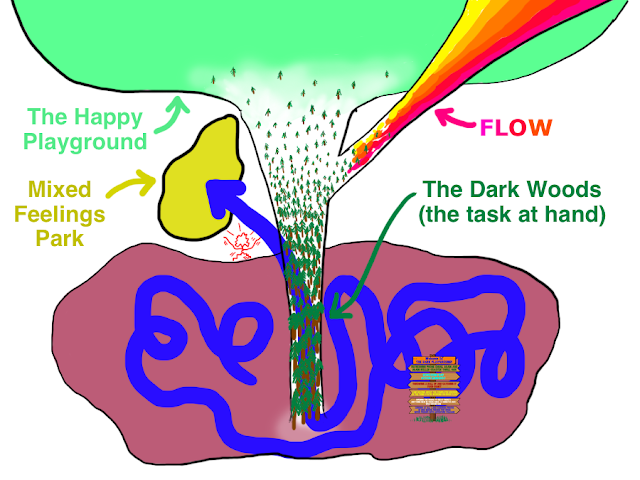
Another oldie but goldie. Tim Urban of Wait but Why talks about procrastination. I don’t want to/need to explain why you should check it out, but I’ll leave you with this picture.
10. We’ll soon know the exact air pollution from every power plant in the world. That’s huge.
I’m tired, so not writing anything for this.
Cya soon. Write back. -Kat.