Hello there! I had a busy (in a nice way) Saturday, which didn’t let me write the Kable as per schedule. However, here we are. Sometimes I’ve wondered about monetizing the Kable of some sort, and at times like this, I am glad that I haven’t. I’m not obligated to anybody right now to write this; I can stop whenever I want to (although that doesn’t seem to be happening any time soon.).
How’s your week been? I’m better. Good reading. It’s been heartening to see the huge response in the global climate strikes. I was part of small events this Friday and the previous one on my university campus, and while we weren’t a large group, we were able to incite some good, rational, and healthy discussions. I live in a state where not everyone even believes in climate change, but at this point, we’ve got to start from wherever we are.
Anyway, I should type this issue, so enjoy this GIF and think of it as a typing kat.

If you got this from a friend and want to subscribe, here’s the link. Also, if any of the links are paywalled and if you don’t want to pay for a subscription, try opening the link in incognito mode in your browser; it usually works. It does for me.
1. A Like Can’t Go Anywhere, But a Compliment Can Go a Long Way
Frank Chimero is a designer whose blog posts are like summer storms: infrequent but welcome and impactful. Here he talks about how to make social media more positive and wholesome. If you’ve spent more than a week on Twitter, you will know already that reading the replies to a viral post that’s not a cute picture of animals is a bad idea. Chimero says: why don’t we, instead of just liking posts, reply with compliments and nice things? They’ll go a long way, and they’ll increase the net positivity on social media, which I feel we need.
There is no feature for displeasure on social media, so if a person wants to express that, they must write. Complaints get wrapped in language, and language is always specific. This creates a situation similar to the Larry David stadium effect, where one heckler with incisive comments can block out the generalized applause of many more people. Specificity overrides vagueness. The nickel-and-dime size relationship amplifies the situation: one negative reply literally takes up more visual space than tens of thousands of undifferentiated likes.
2. The hard truths of climate change — by the numbers
This is a collection of graphs and data about greenhouse gas (GHG) emissions country-by-country, and how it’s changed over the past century or so. The main point of this piece is that “progress”, or developing, countries haven’t done much to curb their GHG emissions, but that is a contentious point for me. Constrained as all countries are by a seeming need to grow, why is it that the currently developed countries can enforce rules that they did not abide by? I believe that developing nations need to take the issue by the reigns, even though they are the ones most cushioned by the effects of climate change.

3. The World Is Complex. Measuring Charity Has to Be Too
One of the reasons philanthropists sometimes fail to measure what really matters is that the global political economy primarily seeks what is efficient and scalable. Unfortunately, efficiency and scalability are not the same as a healthy system. In fact, many things that grow quickly and without constraints are far from healthy—consider cancer. Because of our belief in markets, we tend to accept that an economy has to be growing for society to be healthy—but this notion is misguided, particularly when it comes to things we consider social goods.
(This is a piece by Joi Ito, for whom I have much less respect now as the stories of him accepting funding from Jeffrey Epstein on behalf of MIT have circulated. However, I still think that this piece is good, and worth reading.)
4. The Triumphant Return of England’s Insect-Eating, Bog-Loving, Rad-Looking Great Sundew Plant

5. Where Theory Meets Chalk, Dust Flies
Lovely collection of images from blackboards of academicians around the world. My department has now switched to whiteboards and markers, but there is truly nothing like a good chalkboard. I miss them.

6. ‘There is a problem’: Australia’s top scientist Alan Finkel pushes to eradicate bad science
While we’re on the topic of academic research, here’s a not-nice side of modern research: due to the nature of funding, importance given to number of citations, and other fallacies, research isn’t happening as efficiently as it could be. For example, one is judged based on how many citations one’s papers receive. This can be artificially boosted by, instead of writing one large comprehensive paper, “salami slicing” results into multiple papers so that subsequent works have to cite all of them. Funding agencies also demand that one delivers what one promises to do, which is impossible when doing “research”, because we don’t necessarily know the answer to a question. This results in scientists promising to do work for which they can already guess the answer, which defeats the purpose. There isn’t much ambitious science happening much anymore. Always happy to discuss this further with anyone; reply if you want to talk.
7. An Illustrated Guide to Silvopasture
“Silvopasture is the symbiotic integration of livestock grazing and forest management.” It can be done in regions close to the equator that can support semi-forest ecosystems, and which receive enough rain to keep trees alive. The idea is to slowly forest bare grasslands, or to semi-deforest dense forests, so that there’s enough space for animals to graze, but also enough trees that the overall land can be less carbon-emission-intensive. Animal agriculture causes an enormous amount of greenhouse gas emissions, so I feel like silvopasture can be a good way to make that better. This is from Matters Journal, which I discovered two weeks ago and absolutely love. It’s great.

8. 8 Writing Tips from Jeff VanderMeer
I haven’t read anything by VanderMeer yet, but this list of tips is spot on. For example, from #1:
Once I know these things, it may still be six months to a year before I begin to write a novel. The process at that point is to just record every inspiration I have and relax into inhabiting the world of the novel. To not have a day go by when I’m not thinking about the characters, the world they inhabit, and the situations. If I lose the thread of a novel, it’s not because I take a week off from writing, but because I take a week off from living with the characters, in my head.
9. Quantifying My Cognitive Decline
In this blog post, James Harris talks about recording his “cognitive decline” in quantitative ways. He uses a grammar and spelling tool called Grammarly, which tells him that two years ago, he was more accurate than 65-70% of its users, whereas now that number has dropped to 35-40%. Of course, this can mean that Grammarly has had a large influx of more correct writers, but the drop is still significant.
There’s another reason to keep writing. I want to document my own decline. Like the researchers in Flowers for Algernon , they tell Charlie to keep a journal. I’m going to be my own researcher and subject. I think it’s useful to be aware of my diminishing abilities. Aging is natural, and I accept it. I’m willing to work to squeeze all I can from my dwindling resources. What’s vital is being aware of what’s happening.
(Flowers for Algernon is a beautiful and heartbreaking book, and you can consider reading it.)
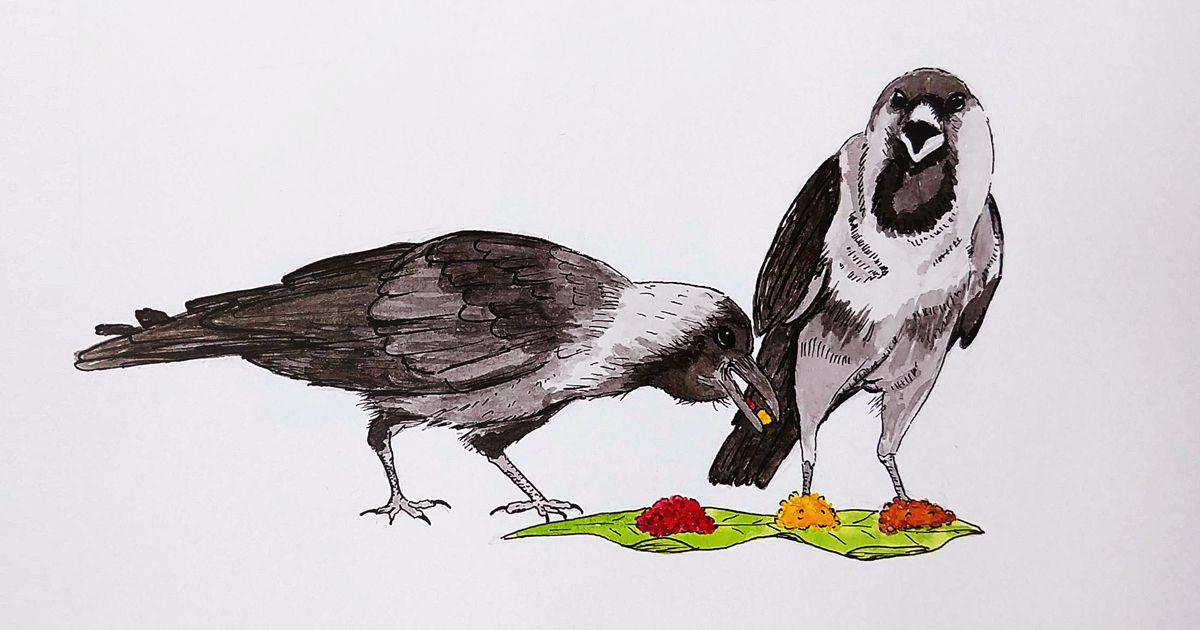
10. First person: What my mother taught me about crows – and life
Lovely autobiographical writing.
Mother would talk to the crows in Tamil, and some of them would look at her with the blank, intelligent look unique to the corvid class. Their genders were indistinguishable, but I noticed that at least one of them would stuff its beak with rice and fly away, presumably to feed young ones nestled elsewhere.
Perhaps it takes a mother to understand another.
See you soon-Kat.