Hello hello. How are you? I am tired and have been busy, but will sleep well tonight. I’m eating summer vegetables for the last time this year, and feel a bit sad about it. It’s getting cold here, and it’s almost like I’ve moved to a new city. I haven’t been reading too much lately. I find that I have less and less time for all the things I want to do. I’m not going to complain, though. I’m lucky to be able to do the things I like to, and even get paid to do physics research.
Feel free to write back if you like. I love receiving mail, and please let me know if you have feedback of any sort. It’s surreal and astonishing that I’m approaching 200 issues, and more than anything else, I think the friends I’ve picked up along the way have been the biggest reward.
If you got this from a friend and want to subscribe, here’s the link. Also, if any of the links are paywalled and if you don’t want to pay for a subscription, try opening the link in incognito mode in your browser. This works if the website has a “soft” paywall. If that doesn’t work, you can access the website using a different browser on the same device, or use a different device altogether.
1. 13 Life-Learnings from 13 Years of Brain Pickings
Maria Popova and Brain Pickings form one of the most wholesome parts of the internet. Brain Pickings the blog has just turned 13 years old, and as a nod to that, Popova has listed down 13 “learnings”. Ten of them are from an older piece, 10 Learnings from 10 Years of Brain Pickings, and there are three additions. I like #13 the best:
In any bond of depth and significance,forgive, forgive, forgive. And then forgive again. The richest relationships are lifeboats, but they are also submarines that descend to the darkest and most disquieting places, to the unfathomed trenches of the soul where our deepest shames and foibles and vulnerabilities live, where we are less than we would like to be. Forgiveness is the alchemy by which the shame transforms into the honor and privilege of being invited into another’s darkness and having them witness your own with the undimmed light of love, of sympathy, of nonjudgmental understanding. Forgiveness is the engine of buoyancy that keeps the submarine rising again and again toward the light, so that it may become a lifeboat once more.
2. Noticing More: You’ve Got Mail
I enjoyed this photo gallery of mailboxes.

3. Indian and Western vegetarians look for entirely different things in meals
Can’t help but nod as I read this piece. It is different to glean niche tastes out of vegetables than to subsist almost entirely on them.
They regard vegetables as curiosities, to be elevated into glorious main courses by the chef’s culinary genius. We regard vegetables as our staples, elevated by years of a great culinary tradition. Indians may try Alain Passard’s charred, roasted onion but 99 per cent of us (100 per cent, even) would prefer to have that same onion thinly sliced, dunked in a besan batter and deep fried into crisp kanda bhajia.

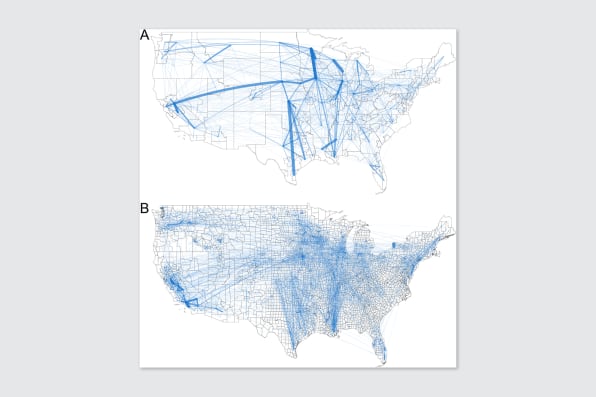
4. The first map of America’s food supply chain is mind-boggling
The USA’s food system is mind-boggling. In the name of “efficiency”, it is extremely inefficient. The system relies heavily on refrigerated trucks, centralized farms and processing centers. The average food item in the USA travels about 1500 miles before reaching someone’s mouth (source: Michael Pollan’s The Omnivore’s Dilemma). It’s crazy. I try to now eat as seasonally as possible, and it is quite lovely. I was craving citrus and oranges for a few months, and now that it is orange season where I live, there is a profusion and I am going to preserve them as jam.
5. The Art of Losing Friends and Alienating People
Nobody or nothing prepared me for the sting of one day finding out that I wasn’t close friends with someone anymore. See also How to cope when a friendship ends.
Absent this kind of betrayal or falling-out, most friendships don’t end so definitively. These no-ending endings can be hard to process. Our culture long ago made peace with the fragility of matrimony, but we still have high expectations for friendships. If you really care about someone, you should be able to pick up where you left off, no matter how long it’s been. Friendship’s something you don’t really lose, right?
6. US Supermarkets Are Doing Bulk Food All Wrong
(paywall: Civil Eats)
I’ve been taking part (partially) and watching the zero-waste movement unfold, and my takeaway is this: the world needs to transition to being imperfectly zero-waste, and it’s not important if 1% of people are “zero”-waste. One of the solutions we need, and have in parts, are bulk sections in stores and supermarkets for grains, seeds, nuts, sugar, salt, etc. I enjoy using a bulk section in the store I frequent, but (a) it’s not very accessible, and (b) it’s not well advertised. Also, if you’re slowly shaking your head thinking, “yes, this is how we did things a hundred years ago”, you’re right. We have the solution, and we have to implement it.
Today, reducing unnecessary packaging waste is no longer a fanciful environmental ambition. For the first time since the introduction of cheap plastics into the supply chain, it no longer makes economic sense to use a material once and throw it away. […] Bulk shopping has emerged an unwilling hero of sustainability: A hero because those rows of refillable gravity dispensers are the centerpiece of every zero waste store in the world. But unwilling, because outside of the small world of zero waste shopping, buying bulk to reduce consumer packaging is almost never encouraged by American businesses, and a good chunk of the time, it is even prohibited.

7. Portrait of an Inessential Government Worker
(paywall: Bloomberg)
Michael Lewis writes about Art Allen, a coast guard scientist who was regarded as “inessential” during the US government shutdown and told not to come to work. This inessential worker developed tools that improved search and rescue capabilities of Coast Guards around the world, and has undoubtedly saved hundreds (or thousands?) of lives.
8. The ‘Economics Nobel’ winners’ triumph is at the expense of the world’s poor
This is a bit of a controversial piece, and I don’t agree with everything it says, but it’s an interesting topic that I’d like to educate myself about. This years Nobel went to three economists for “randomized controlled trials”, which is surprising. Randomized trials have formed part of experiments and drug tests for decades now. What makes me a bit annoyed is that this method is great for producing numbers that people use to make decisions, but in doing so, it reduces its human participants to just that, numbers.
9. Big Oil’s Climate Change Reckoning Finally Arrives in Court
(paywall: Bloomberg)
Yay.