Why, hello there! I am back, and it feels good. For a few weeks on break, I frankly felt almost disgusted by the idea of writing and curating this again, and I thought for a few days that I might just …stop. But three days ago, I woke up and realized that I missed it, and that I felt in the right headspace to be back. So here I am.
Thank you to everyone who wrote back the previous time. You know how they say that the real profit is the friends you gain along the way? That has truly been the case in the almost three years of curating the Kable. I have been bad with replying to emails lately, but I will eventually respond to you. It’s not even like I get that much email. But I hope that you will empathize that with being in isolation and attempting to work from home (which isn’t going great), it is becoming difficult to muster up energy for things that used to be really easy for me.
If you got this from a friend and want to subscribe, here’s the link. Also, if any of the links are paywalled and if you don’t want to pay for a subscription, try opening the link in incognito mode in your browser. This works if the website has a “soft” paywall. If that doesn’t work, you can access the website using a different browser on the same device, or use a different device altogether.
1. My search for the real Moominland - 1843 Magazine
This is really nice. I read Moomin for the first time last year. Dan Richards visits the parts of Finland that Moominland is inspired by, and it is gorgeous. If you’ve ever read Moomin, then you can see how the coastal landscape inspires Moominland. And even if you haven’t read Moominland, it’s still a fun piece because of the sheer beauty of that part of Finland.
In the real Moominvalley that sense of threat behind the beauty is ever-present; Pellinge is a harsh place in the depths of winter. But for the most part life in the area is quiet. “I only want to live in peace, plant potatoes and dream,” Moomintroll remarks in one of his eponymous comic strips. Small wonder that, in a clamouring world, the Moomins and their landscape hold such allure.

2. To Save the Redwoods, Scientists Debate Burning and Logging - Undark
I’ve shared articles earlier about periodically set controlled fires to contribute to the overall health of forests and also prevent huge forest fires that can go out of control. This is a good review of the various perspectives to controlled burns in the woods of North California. The interesting thing, for me at least, is that some entities misuse the controlled burns as a front for plain deforestation. It’s a more nuanced issue than it seems like, but that’s because of people who’re out to profit off of it.
Ultimately, the debate over forest management encompasses more than the interpretation of data. In fact, much of the outcry against thinning has its roots in the fraught history of logging in the state of California, and in a deep mistrust of the true motives for cutting down redwood trees. Russell thinks some of the forest management work Save the Redwoods League is doing is counterproductive, especially when it involves removing trees.

3. Swampland Sublime: The Landscapes of Louisiana - New York Review of Books
This is a review of an exhibit called “Inventing Acadiana: Painting and Place in Louisiana” that was at the New Orleans Museum of Art in 2019/20. So good. I live in Lousiana, and that made me enjoy this even more.
The portion of the Earth containing southern Louisiana has spent most of its history shifting between land and liquid. Only in the last 5,000 years has sediment from the Mississippi River lifted New Orleans out of the water, placing the city, along with the rest of southeastern Louisiana, on an alluvial “doormat” at the edge of the continental crust. Many landscape painters have crawled into low-slung caves and hiked up mountains, or waded through meadows and wheatfields, but relatively few have captured the state’s vast, changeable, young swampland.

4. The Teenage Girl Gang That Seduced and Killed Nazis - Mental Floss
Wow.. this was quite something.
5. Chathexis - n+1 magazine
This is a piece from 2011 about talking, especially about how talking is becoming different in 2011. The funny thing is that I didn’t know it was written in 2011, and most of it was still very relatable to me even though the essay focuses on chatting online, rather than more contemporary conversation (more image and video-dominated, and also mobile-first). This essay focuses on AIM chat rooms, and then GMail and Gchats (now Hangouts). So good. I think I’m about to read it again now.
There is something so literal about video. It reminds you of a world that can’t imagine anything but itself. It’s almost as bad as walking down the street. Our friends are made over into evasive strangers: just try making eye contact in videochat. You can’t.1 It’s as bad as a first date, or a job interview—you sit there, face to face with another human being, and feel unseen. Videochat’s promise of intimacy—friends on the other side of the world, looking at us in our homes!—makes us forget the conditions in which actual intimacy occurs.
-–
There is hope, but not for videochat. All we really need, to know love, is a plain old wireless connection and somewhere to lie down: the best Gchat conversations take place, like those of the salon, with one or both participants in repose, stretched out on a couch or in bed. Tucked beneath our covers, laptops propped on our knees—is this not the posture most conducive to meaningful Gchatting? In addition to being comfortable, our beds are private; on Gchat, we must be by ourselves to best be with others. Night affords another degree of solitude: like the lights in the apartment building across the street, Gchat’s bright bulbs go out, one by one, until a single circle glows hopefully. Like Gatsby’s green light, it is the promise of happiness.
6. On the verge: a quiet roadside revolution is boosting wildflowers - The Guardian
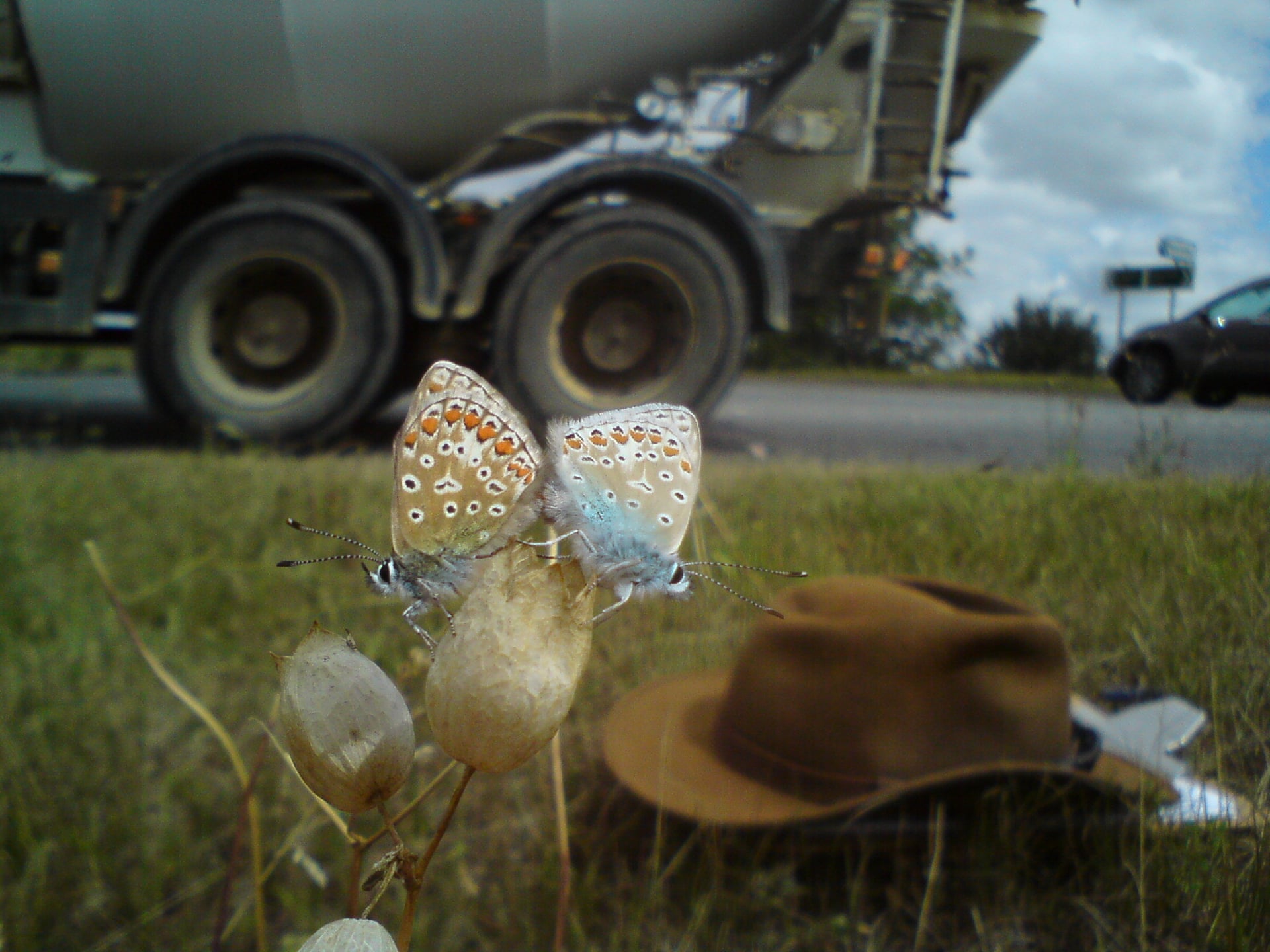
This was a nice article about rewilding efforts by roadsides in the UK. The really interesting thing is that if you want a wide variety of different species, you need poor, rather than fertile, soil. Fertile soil encourages single species to take over (which is why you want fertile soil when doing agriculture), whereas poor soil forces different plants to find different niches. When the people in charge of this project found that out, they stopped applying mulch to the areas that they were trying to wild, and as soil quality has dropped, biodiversity has shot up.
7. The Real-Life Bank Heist that Reads Like an Oceans 11 Sequel - GQ
Absolutely incredible. “They were an all-star crew. They cooked up the perfect plan. And when they pulled off the caper of the century, it made them more than a fortune—it made them folk heroes.” Possibly the most enthralling thing I’ve read this year.
But there’s also this: If they hadn’t been collared, there’d be no books, or movies. The Robbery of the Century would have remained something of a mystery. Which is a satisfying result—pulling off one of the greatest heists in history and walking away with millions. But isn’t there something special about the credit, the recognition warranted by a genius scheme of this magnitude?
-–
For six months after prison, he says, he was depressed. It was difficult to even go outside. “I was Sebastián the mechanic,” he says. “Then I became Sebastián the bank robber.” But over time, that new identity wasn’t so bad. Bolster says he earned a kind of absolution that, he admits, surprised him. “No one has ever said anything bad to me,” he says. “On the contrary, many people congratulate me. That’s very confusing. I know it’s wrong to steal. But they congratulate me.… To understand this, you have to be Argentine.”
8. The Ugly History of Beautiful Things: Orchids - Longreads
Last week I read a book by Susan Orlean called The Orchid Thief , and it was WILD. I did not know that orchids had such a wild and controversial history behind them. As with most European/American obsessions, they center around objects and people in colonized countries. The other really interesting thing about orchids is their status as a sex symbol: they have been seen as a sign of virility.
The role of the orchid collector, then, was to tame the dangerous woman. To own her, to coax forth her beauty in a safe, contained space. To take her out of her natural habitat and show her how to live; growing orchids as wish-fulfillment. It allowed these men to feel virile and manly, as though they had imposed their will on nature itself. Inside the tidy walls of a steel-reinforced greenhouse, they could be masters of their own little harem. If Hugh Hefner had been born 100 years earlier, I imagine he would have kept orchids.
9. Down on the Farm That Harvests Metal From Plants - New York Times (paywalled)
Wow, this was quite incredible. Turns out that there are some plants that are hyper-specialized at extracting specific metals from soils. The immediate application is to get them to grow in places that hosted mines, or refineries, and get them to leach toxic metals out of the ground (and we can use them, too). You don’t even need to genetically modify plants to get them to “hyperaccumulate”. They’re just happy to do it. Plants are amazing.

10. Papas Nativas - Emergence Magazine
Beautiful journey through South America, the land where all potatoes originated. Papas nativas refers to the native potatoes, and there are hundreds (yes, you read that right) of potato varieties. Emergence Magazine is one of my favorite online publications, and this is perhaps their favorite work of everything they have put out so far. I would recommend reading/experiencing this on your computer if possible.
