Well, hello there! I write to you from a frigid morning. Every time the mild winter of Louisiana pokes its head sometime around October or November, my pampered tropical soul feels personally affronted. Who asked for winter to be here? Hmph. Anyway, it means that I can drink tea all the time, and every meal will be a big bowl of soup. Here’s this week’s list. Hope you enjoy.
If you got this from a friend and want to subscribe, here’s the link. Also, if any of the links are paywalled and if you don’t want to pay for a subscription, try opening the link in incognito mode in your browser. This works if the website has a “soft” paywall. If that doesn’t work, you can access the website using a different browser on the same device, or use a different device altogether.
1. The Greatest Upset in Quiz Show History - Slate
The quizzing scene, both at college and open level, is quite poor in the USA. However, back in the 1960s and earlier, College Bowl was a popular and fiercely contested quiz show in the make of modern University Challenge. This article is about the time when the all-women team from Agnes Scott College beat Princeton.
The 1960s GE College Bowl has been all but forgotten. The 1966 Agnes Scott game would have been lost to time if a librarian at the University of Arizona hadn’t found an old tape and posted it online. Why didn’t the tradition of the hypercompetitive intellectual continue on American television?
“There was so much social change, beginning around ’68 or ’69, in the innovations in dress and music and political thinking … and people got interested in other things,” said Snow. “This must have seemed like a mild-mannered program in comparison.” The women of Agnes Scott had manners, but they weren’t mild. Their come-from-behind victory is stirring even today, a tribute to the nerd ladies, the brainy gladiators, the hypercompetitive intellectuals.

2. The Elements of Wok Hei, and How to Capture Them at Home - New York Times (soft-paywalled)
I’ve been enjoying J. Kenji López-Alt’s new column in the NYT. Here he is talking about wok hei, or the “breath of the wok”. It refers to the signature smoked, browned, and charred taste that a hot wok imparts to food that’s stir-fried in it. He goes into a very pleasing (for me at least) level of scientific rigor to try and explain what exactly wok hei is : is it because the oils combust, or is it because of the tossing of the food while stir-frying, or is it something else?

3. Lydia Davis on Making the Decision Not to Fly - Lithub
Ahhh, what a fantastic interview/conversation this is! Lydia Davis is a critically acclaimed essayist, and although I have not yet read her essays (in particular her collection Essays One), I thoroughly enjoyed this conversation she has virtually with Johanne Fronth-Nygren, a Norwegian translator. And the first thing they talk about is both of their decisions to give up flying. That resonates with me because I too plan to give up flying in a few years. This paragraph from the interview is very close to my thoughts as well:
The decision not to fly does imply a limitation, but in a positive sense, I think. It results in a greater concentration on the local, on valuing what is here. Once I am not expecting more and more, looking outward farther and farther, a circle is drawn around what I have, but within that circle there is more attention, I look deeper inside the circle, and what remains has greater value.
4. On Being Bipolar - The Walrus
Obviously, content warning: this article is about bipolar disorder. I’ve found, over the past few years, that the most effective way to gain perspective and empathy for mood disorders and mental illnesses is to read written accounts of people who have been through them. This is one such, by Andrea Bennett:
Sometimes, I dream about how wealthy I would need to be to take a break from feeling the fear that propels me to remain stable. I don’t dream about not being bipolar, because I don’t know where my self ends and where the illness begins—and if there is even really a difference. And I don’t know what I would dream to render the divisions between good sick and bad sick unnecessary, to make it so that we all get to remain people, without sacrificing some of us to quarantine and cautionary tale.
5. A Few Rules For Predicting The Future - Exit the Apple (via archive.org)
Wow, Octavia Butler is amazing. Here is an essay from her about predicting the future, in the context of her science fiction works.
Of course, writing novels about the future doesn’t give me any special ability to foretell the future. But it does encourage me to use our past and present behaviors as guides to the kind of world we seem to be creating. The past, for example, is filled with repeating cycles of strength and weakness, wisdom and stupidity, empire and ashes. To study history is to study humanity. And to try to foretell the future without studying history is like trying to learn to read without bothering to learn the alphabet.
This gives me the same vibes (and chills) that Ursula K. Le Guin’s writing gave me.
6. Inside the airline industry’s meltdown - The Guardian
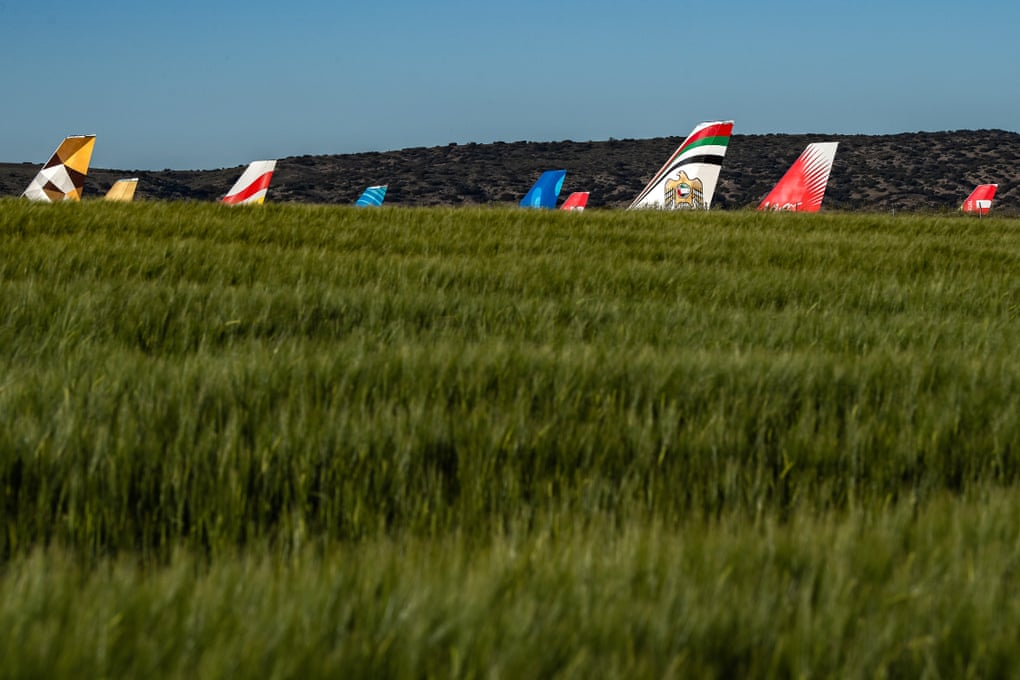
Excellent piece about the airline industry’s meltdown in 2020, as the title says. It talks about putting planes into storage, pivoting from commercial flights to repatriation flights commissioned by governments, using planes to ferry PPE, and so on. So much has happened in the airline industry in just 10 months.
Among all the industries hit by Covid-19, aviation suffered in two distinct ways. Most obviously, there was the fear of contagion. No other business depends on putting you into knee-by-thigh proximity with strangers for hours, while whisking potentially diseased humans from one continent to another. Less directly, there was the tumbling economy. It is an axiom in aviation that air travel correlates to GDP. When people have more money, they fly more. But in the midst of this historic downturn, no one was buying plane tickets.
7. Unmasking China’s invisible fleet in North Korean waters - CBC
This is good reporting. It’s about a huge fleet of Chinese ships that roam the waters surrounding China, especially in North Korea. See also How North Korea Built a Fleet of Ghost Ships from Hakai Magazine.
8. From farm to factory: the unstoppable rise of American chicken - The Guardian
I’ve recently become a fan of Sarah Mock’s work and journalism. Here she writes in The Guardian about the rise of the chicken as a source of meat in the USA. Apparently, before WW2, chickens were primarily eaten in spring, and not much in other seasons. Due to wartime rationing of red meat, there was a huge concerted push to make chicken more popular as a food. And then of course, the corn. Feed companies offered loans and other assistance to chicken farmers. Right now, the amount of chicken eaten in the USA per capita is staggering–about 30 kilos per year.
9. Is Social Media Good For Anything At All? - GQ
This piece was my introduction to Jaron Lanier, who works in the tech industry and primarily uses his voice to persuade his engineering peers to create different forms of social media than we currently have. I think there is no denying that social media as we have it now is fundamentally flawed–when the goal is to maximize “engagement”, then the natural outcome is to prioritize outrageous content and foment division.
His thoughts on this subject have been influential enough that they may sound familiar to you by now: That anytime you are provided with a service, like Facebook, for free, you are in fact the product being sold. That social media companies are basically giant behavior-modification systems that use algorithms to relentlessly increase “engagement,” largely by evoking bad feelings in the people who use them. That these companies in turn sell the ability to modify your behavior to “advertisers,” who sometimes come in the old form of people who want to persuade you to buy soap but who now just as often come in the form of malevolent actors who want to use their influence over you to, say, depress voter turnout or radicalize white supremacists. That in exchange for likes and retweets and public photos of your kids, you are basically signing up to be a data serf for companies that can make money only by addicting and then manipulating you.
10. Astronomy: Star tracker - Nature
Andrea Ghez is one of the two winners of the 2020 Nobel Prize in Physics. This piece is a delightful profile of her from back in 2013.
“I’m positioning myself,” says Ghez. “I want to know how to use these systems, I want to know how to use the data, I want this all to work.” Like other great scientists, says Thomas Soifer, an astronomer at Caltech and another of her early advisers, “she has this single-minded attitude of, ‘I’m going to beat this problem into submission’”.
Ghez is 47 years old and the stars that she has been tracking since 1995 have orbits ranging from tens to hundreds of years. How long does she plan on living? “I don’t know,” says Ghez. “I figure the more fun I have, the longer I’ll live.”