Hello hello there. This is Vishal with another issue of Kat’s Kable. Wherever you are, I hope you’re keeping safe. It’s been an unpleasant time for me in some regards–lots of work, some mental issues, and of course, following and keeping in touch with the spread of covid back home in India. I don’t have the heart to say anything about it, but here’s a link to a document with a number of fundraisers/causes/nonprofits that you can donate to, if you’d like. Anyway, here is this week’s issue. Putting it together helped me take my mind off things for a while, and sometimes it feels really nice to have fingers flying on the keyboard, typing just for fun. That’s why this issue is a bit more verbose than usual. Hope you like it!
If you got this from a friend and want to subscribe, here’s the link. Also, if any of the links are paywalled and if you don’t want to pay for a subscription, try opening the link in incognito mode in your browser. This works if the website has a “soft” paywall. If that doesn’t work, you can access the website using a different browser on the same device, or use a different device altogether.
1. Greens: why we eat the leaves that we do - Botanist in the Kitchen
I don’t remember how I found this blog post (and this whole blog) but it’s very cool. I love plants in all their myriad forms, and sometimes I wonder: why is it that we eat the leaves of only some plants rather than all of them? This post attempts to answer this in a variety of ways. It looks at how thin the leaf is via a quantity called the “leaf mass per unit leaf area”: the thinner the leaf, the more likely we are to eat it since it’s going to contain less indigestible fiber. Very interesting. A lot of leaves also pack physical and chemical weaponry that means that we either avoid them, or process/cook them in such a way that we assimilate them easily.
2. John Muir in Native America - Sierra Club
Thought-provoking essay by Rebecca Solnit. While recognizing that American conservation and the national parks played a role in keeping Native Americans off land that they managed for generations, it also reminds us that these acts were done in an era past, and the only thing to do now is what makes sense now. Also I just realized this piece will go nicely with the Water Is Life piece I shared in the previous issue.
People like Gerard Baker have been making those tools. He made space for other stories to be told, and other people learned to listen. Now he talks about the possibility of Native land management on federal lands and tribal national parks. When I asked Baker about Muir, he replied, “You can’t look at one person. You have to look at the philosophy of that time period. And with that in mind, he did a damn good thing.” Muir cofounded an organization that protected and preserved a great many significant places, and in the 1960s it moved from protecting places by setting them apart to recognizing that everything is connected. And the organization moved, however imperfectly and incompletely, from only embracing those white-collar white people with the desire to camp and climb and hike to trying to address environmental racism and environmental justice (and sometimes trying to bring traditionally excluded people into those beautiful places it had preserved). In addressing pesticides, mining, contamination, energy generation, and eventually climate, the Sierra Club took up issues that, exactly because of environmental racism, disproportionately affect the poor and nonwhite. Now its climate work is in behalf of all life on Earth.
3. The Healing Power of JavaScript - Wired (soft paywalled)
Really enjoy Craig Mod’s writing. Here he talks about code, the solace of mundane tasks, and his ongoing coping with depression. All of these things are relatable for me, and thus make the piece even nicer to read. Some excerpts:
Therein lies part of the attraction: Moving through that jumble—with all of its perverted poetics of grep and vi and git and apache and .ini— and doing so with a fingers-floating-across-the-keyboard balletic grace, is exhilarating. You feel like an alchemist. And you are. You type esoteric words— near gibberish—into a line-by-line text interface, and with a rush not unlike pulling Excalibur from the stone you’ve just scaffolded a simple application that can instantly be accessed by a vast number of humans worldwide.
and
So in my tilted state, my slightly depressive state, I moved websites from my old server to my new server. My tasks were guided by the trusty to-do list. URLs of old sites marked off distinct epochs in my life, of a variety of lenses through which I once saw myself. Perhaps I am this kind of artist or will be this kind of writer?
4. All My Pronouns - Harpers Magazine
Just realizing that this issue is full of nice nice longform pieces by writers I adore! This one is by Anne Fadiman, whose Ex Libris and At Large and At Small (some excerpts here) are some of my favorite essay collections. Here she writes about pronouns, especially the singular they , which is quite new to me, relatively speaking. I had a bunch of lightbulb moments while reading this, for example this:
The most important argument for the singular they is that English is just too damn gendered.
For more than six decades, I’ve accepted without thinking that when we say that someone went to the store, we don’t have to specify whether that someone was old or young, rich or poor, fat or thin, tall or short, but we do have to specify whether the someone was a “he” or a “she.” Now I’m starting to think that’s a little weird.
5. Joni Mitchell: ‘I’m a fool for love. I make the same mistake over and over’ - The Guardian
Joni Mitchell being interviewed is a particular delight: her replies alternate between pity/matter-of-fact and highly illuminating. Thoroughly enjoyable. A case in point:
_Cameron Crowe (interviewer): Yes, the whole phase we’re talking about. Not to divide you into two people! But do you look back on this young artist, and her struggles and her victories, with bemusement, with love?
JM: I guess so. I wouldn’t call it love. It’s just part of the story.
CC: Here’s another strong quote of yours: “As a young person, you’ve got to pull the weeds in your soul when you’re young. Otherwise they will choke you.”
JM: That had nothing to do with creativity. Pulling the weeds in your soul early makes you a better adult.
CC: Are you still doing that during this time period?
JM: Yeah, I think I pulled some out. I think I grew up some._
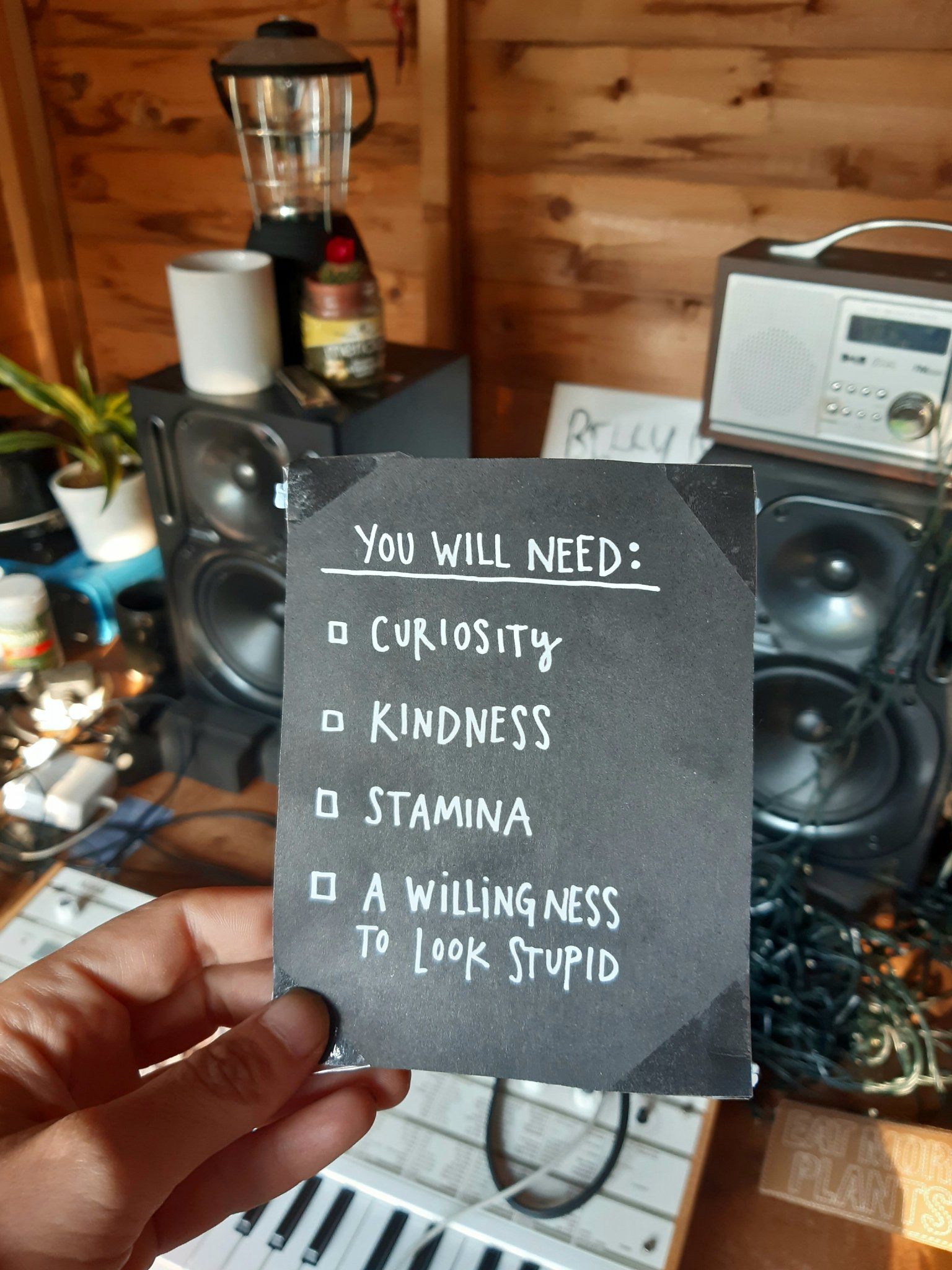
6. Learn to play the fool - Austin Kleon’s blog
Just loving this small item-to-item vibe in this issue, both this piece and the previous one have the word “fool” in their titles. As always, Austin Kleon hits the nail on the head.
If you share a home with anybody long enough, eventually, you will be revealed to be the fool that you are. “Everybody plays the fool sometime / There’s no exception to the rule.” I think a happy home is one in which each member’s individual foolishness is tolerated, maybe even encouraged and developed, but, no matter what, loved. We all live with fools, and we must “suffer them gladly” in order to let them grow. And if we want to grow, we, too, must learn to play the fool, and suffer ourselves gladly.
7. Why Computers Won’t Make Themselves Smarter - New Yorker (soft paywalled)
Another thought-provoking piece about the ways and paradigms in which we think about artificial general intelligences. It’s written by Ted Chiang, who is a sci-fi author and I appreciate his perspective as well as his willingness to engage in a good level of the nitty-gritties involved. He essentially argues that we are not on the path to an intelligence “singularity”, wherein we somehow train intelligences to train even more intelligent ones. If that were to happen, then our collective intelligence would definitely explode, but it does not seem like we are on that path now, and it is unclear whether we will be at all, ever.
8. The Marvellous Maillard Reaction - Chemistry World
Last year I had a bit of a phase when I asked some friends what they’d be more willing to forego: the use of one of their limbs (their choice) or the Maillard reaction. The Maillard reaction is the name given to that generic process of heating and combining proteins and sugars, which can also be given the colloquial name “browning”. It’s truly a magical, marvelous process, and which most of us (hopefully) indulge in regularly. This piece, aptly from a chemistry publication, does a decent job breaking it down (pun intended? maybe).
9. The Mysterious Life of Birds Who Never Come Down - New York Times (soft paywalled)
Ah, what a lovely ode to the swift, written by none other than Helen Macdonald (who wrote H Is For Hawk).
Swifts are magical in the manner of all things that exist just a little beyond understanding. Once they were called the “Devil’s bird,” perhaps because those screaming flocks of black crosses around churches seemed pulled from darkness, not light. But to me, they are creatures of the upper air, and of their nature unintelligible, which makes them more akin to angels. Unlike all other birds I knew as a child, they never descended to the ground.
and
Not all of us need to make that climb, just as many swifts eschew their vesper flights because they are occupied with eggs and young — but surely some of us are required, by dint of flourishing life and the well-being of us all, to look clearly at the things that are so easily obscured by the everyday. To take time to see the things we need to set our courses toward or against; the things we need to think about to know what we should do next. To trust in careful observation and expertise, in its sharing for the common good. When I read the news and grieve, my mind has more than once turned to vesper flights, to the strength and purpose that can arise from the collaboration of numberless frail and multitudinous souls.
