Hello there, reader. This is Vishal and here’s another issue of Kat’s Kable. It’s Sunday afternoon here and it’s hot hot hot outside. I’m in a bit of a fugue state, almost, and it feels weird. However! I have curated this issue of the newsletter and it has a bunch of nice things.
I’ll be off now to re-read the Sherlock Holmes stories. I really like them and get a sense of comfort from immersing myself in that world for a while. I also try to be inspired to look at the world with a more observant eye. I was telling my best friend yesterday about a scene where Holmes chastises Watson for seeing but not observing things; he points out that Watson did not know how many steps there were in their abode’s staircase, despite using them hundreds of times. That particular example has stuck with me, and I can’t stop myself from counting the number of steps in any flight of stairs I climb. This, by Maria Konnikova, is about this particular thing.
If you got this from a friend and want to subscribe, here’s the link. Also, if any of the links are paywalled and if you don’t want to pay for a subscription, try opening the link in incognito mode in your browser. This works if the website has a “soft” paywall. If that doesn’t work, you can access the website using a different browser on the same device, or use a different device altogether. Another, slightly involved, method is to try to disable JavaScript and reload the page. This works on some websites for me.
1. Carlo Rovelli in conversation - Idler Magazine
This is a nice interview of Carlo Rovelli, the famous quantum physicist. There’s nothing that jumps out as “spectacular”, but it contains nice bits about the pandemic, about what science has to learn from philosophy, and about the value of introspection and exploration for learning.
2. An Atlas of the Cosmos - Longreads
This is a longread by Shannon Stirone about DESI: the Dark Energy Spectroscopic Instrument. We really don’t know much about dark energy, even though it comprises more of the universe than “regular” matter. This is a passage I liked a lot, which later becomes a rumination of how humans are always keen to map the world, or the universe itself, only to know their position in it.
One by one, every time I saw him, a piece of his library became mine. He had travelled all over the world and knew how much it could change a person. And whenever I’d visit him, I’d browse the books on the lower shelves and run my fingers along the spines like a car’s wheels over speedbumps, each cover sort of yellowed from years of his cigarette smoke and constant reading. Once this book and I were formally introduced, I began having regular dates with the atlas. […] Every mountain range, every body of water, every large city I would look at longingly wondering one day when I got older, how many of these mysterious places I would see with my own eyes. My wanderlust grew as I grew. There was so much to be explored, there was so much space that existed around my little home in Los Angeles. There was so much I didn’t know.
3. It’s not Jung’s, it’s mine - The London Review of Books
Ah, lovely piece about Ursula K. Le Guin, who is undoubtedly in my top 5 authors ever. I’m currently re-reading the Earthsea Cycle, and coming back to it feels like receiving a warm embrace from a friend who’s telling you, “it’s OK”.
Even now, reading about Ged’s loss of power, provokes the same temptation I felt when I was ten – to see myself as him: surely there is nothing here a grumpy late-middle-aged man hasn’t felt, I think privately. You see the world change around you in ways you don’t quite get, you fight it, feel the power go, and then decide the only thing you can still do is look after the goats – at which Ged turns out to be pretty good. But always in Le Guin there is a sharp ironical turn against any reader who wants to be a hero. Ged without his powers is a self-pitying mess who doesn’t realise that he still knows what he knows, even if he can no longer control the winds with words. And anyway, Le Guin makes us ask, what’s wrong with looking after goats?
4. The School for Scale - The Hedgehog Scale
I am a big fan of Alan Jacobs’ writing (his newsletter, especially, is a treat). This is a recent essay of his, although it’s not really an essay; it’s written in the form of a conversation between two people. One of them is trying to convince the other that humans are just not very good at thinking about things at scale (possibly related to us not thinking well statistically). The essay overall is a proposal for a “school”, or institute, to study and deal with matters that arise when some original proposal is scaled up to size. This was pretty cool:
It occurs to me that you can understand a lot about works of art by understanding the scale on which they are made—and at which they are received. A sonnet can be as great as an epic, though its greatness will take a very different form. Its resources are deployed in a small compass, whereas the epic necessarily sprawls. A single song by Schubert can be as great as an opera; a miniature portrait meant to fit in a locket as great as a vast landscape painting! But the kinds of excellence available to the artists—and to the viewers, listeners, readers—depend on the available scope. This is actually a vital thing to understand.
5. Crush - Believer Magazine
What does it mean to have a crush on someone? It’s not something I really thought about to the extent that Larissa Pham, the writer of this essay, does. It’s a mix of autobiography as well as rumination about desire and crushing on someone. This was quite relatable honestly.
When I say I have a crush on you, what I’m saying is that I’m in love with the distance between us. I’m not in love with you: I don’t even know you. I’m in love with the escape that fantasizing about you promises. Poisoned, stung, bitten and bridled. The promise of being ground down until I disappear.
6. My grandfather’s vagabond past - Aeon
Thus, under my uncaring stewardship, a certain continuity has snapped, and a vast body of inherited knowledge has suddenly and irreversibly decayed. This was the price of progress and modernity, I reasoned at first. Only later did I come to think that the loss of cultural knowledge of any kind is always a tragedy. And yet, contained snugly within these same traditions were elements of blind superstition, of Hinduism’s invidious caste system, and of rigid and impractical ritual. These practices, born of less enlightened times, are unquestionably better off dead. So what, then, is the proper amount of remorse for me to feel here?
7. City of Bees - Plough
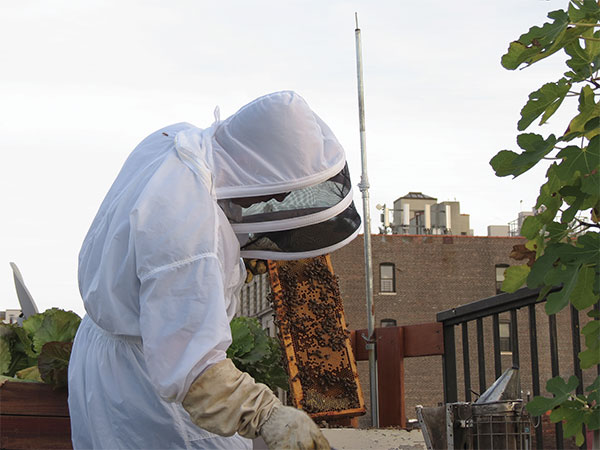
I really, really love bees. I was telling a friend the other day that when I want to calm my mind, I close my eyes and think of bees and flowers. This is a really nice piece about urban beekeeping by Tim Maendel.
It is not my world. Despite being called a “keeper” I have no control here. I am an observer, capable perhaps of small assistance for the needs I see, or of compensating for the limitations of the manmade boundaries that I put them into. I don’t understand half of what is going on; I am often reminded of that.
8. How climate change is changing the Indian monsoon - Mint Lounge
Climate change is making the Indian monsoon more erratic and unpredictable. The effect is in the details: there are fewer days of rain, but more days of heavy rain. The amount of rain received hasn’t changed all that much. The sea’s temperature has gone up by significantly more than the land, and this has weakened the land-sea gradient required for the monsoons to form.

9. ‘If the aliens lay eggs, how does that affect architecture?’: sci-fi writers on how they build their worlds - The Guardian
This is brilliant! Science fiction authors Alastair Reynolds, Nnedi Okorafor, Ann Leckie, Becky Chambers, Kim Stanley Robinson and M John Harrison talk about their differing approaches to world building, and it’s all very fascinating.
10. Walking as a Productivity System - Superorganizers
I really enjoyed this exposition by Craig Mod (whose newsletters are superb) of how and why he walks and also how he sees it as a way to get work done. Considering that much of his creative work surrounds his walking projects/adventures, it is a pretty unique perspective.
For me, a walk is a tool or platform upon which I can build, sort of like an operating system. When I become fully immersed in ‘walk mode’ the operating system begins to hum along, becoming almost autonomous, and I find the experience of this incredibly empowering. It just feels like the world and my place within it vibrates at a higher, more finely tuned level.
I realize this sounds somewhat insane, and I suppose that’s true—but a long walk contains within it the act of losing your mind: the long hours, the endless kilometers. On a properly executed long walk, it feels like the world pops from HD to 4K in terms of detail and texture, if that makes any sense.
See you next week, then.-Kat.