Well, hello there! We had Hurricane Ida hit us here last weekend, and thus this issue of Kat’s Kable is delayed. But as they say, better late than never. I’m very lucky in Baton Rouge to have gotten off very lightly; others are not so fortunate. I’ve been feeling antsy today so I almost “made” myself write this issue, but I also really wanted to. Here’s a few other cool things: a lovely introduction to Ray Bradbury (which he later said was the finest he ever received), and a behind-the-scenes view of how the newsletter Dense Discovery is run (it’s one of my favorites). As always, if you have something to say, please do reply. I’m always happy to hear from you.
If you got this from a friend and want to subscribe, here’s the link. Also, if any of the links are paywalled and if you don’t want to pay for a subscription, try opening the link in incognito mode in your browser. This works if the website has a “soft” paywall. If that doesn’t work, you can access the website using a different browser on the same device, or use a different device altogether. Another, slightly involved, method is to try to disable JavaScript and reload the page. This works on some websites for me.
1. When The Magic Happens - Collaborative Fund
Pretty interesting and thought-provoking for me. This is a piece about how major innovations and breakthroughs happen during times of great upheaval. The article mostly talks about the US, and especially military-funded projects. It was written in 2020, obviously in the middle of the biggest upheaval this century so far, the pandemic.
2. The Invention of Agriculture in the New Guinea Highlands - Patrick Wyman’s Substack
Patrick Wyman’s newsletter is really good. In this particular issue, he talks about New Guinea and their unique independent discovery of agriculture. The highlands there are not very hospitable, and yet groups of people performed agriculture and lived mostly sedentary lifestyles. However, what makes it unique is the way this development was very different from what we see in other parts of the world: primarily that even though agriculture was practiced, it didn’t lead to more “advanced” civilization.

3. Rebecca Solnit on a Childhood of Reading and Wandering - Lithub
Wonderful, wonderful essay. Solnit talks about walking and exploring and the role that libraries played in her youth. It’s poignant and important. Part of the essay consists of excerpts from other work of hers, and one such excerpt really stuck out for me.
Walking, ideally, is a state in which the mind, the body, and the world are aligned, as though they were three characters finally in conversation together, three notes suddenly making a chord. Walking allows us to be in our bodies and in the world without being made busy by them. It leaves us free to think without being wholly lost in our thoughts. I wasn’t sure whether I was too soon or too late for the purple lupine which can be so spectacular in these headlands, but milkmaids were growing on the shady side of the road on the way to the trail, and they recalled the hillsides of my childhood that first bloomed every year with an extravagance of these white flowers. Black butterflies fluttered around me, tossed along by wind and wings, and they called up another era of my past. Moving on foot seems to make it easier to move in time; the mind wanders from plans to recollections to observations.
4. What Is Life? - Bert Hubert’s blog
Nice article whose premise is that for something to be called “alive”, it needs to be built on the same and unique architecture that all life is built on. I know I made it sound like a circular argument, but Hubert explains it properly.
The definition of what life exactly is continues to be fascinating, but at least on Earth, for the life forms we know about, things are pretty simple. If it runs the architecture of life, it is life. If it runs on that architecture hosted by another cell, as for example viruses do, it is not life but software - but it is software that comes alive once inside a host that can run it.
5. Where Camels Take to the Sea - Hakai Magazine
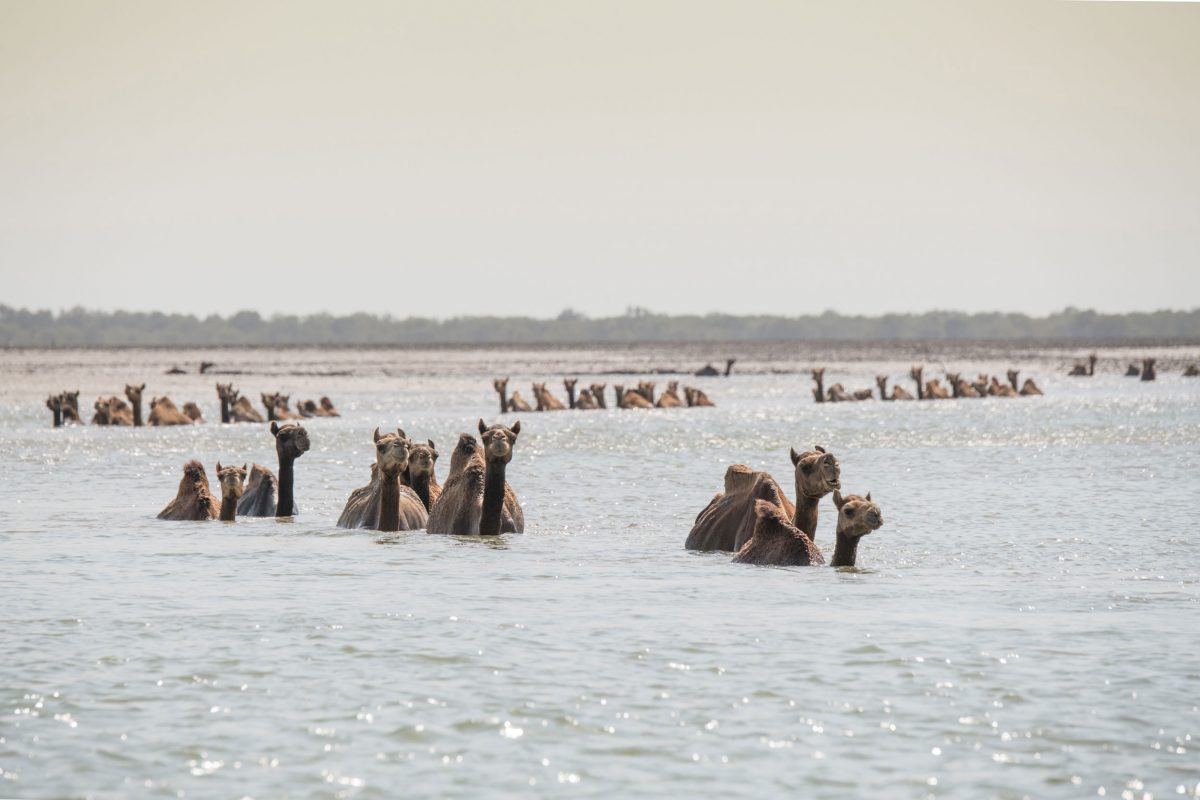
This was also very cool! If you, like me, thought that camels only lived in deserts, prepare to be pleasantly surprised by the existence of kharai camels, which live in the Kachchh region of Western India. They are adept at swimming, which is a very useful ability to have considering that they need to routinely traverse through tidal channels. And of course, as the climate changes and the socioeconomics of the people of the region changes, the camels are going to be impacted too.
6. Stewart Brand’s Strange Trip: Whole Earth to Nuclear Power - Yale Environment 360
I only vaguely knew of Stewart Brand, and that was due to Steve Jobs mentioning the Whole Earth Catalog (which Brand started and run) in his famous 2005 commencement speech at Stanford. Here he talks in a 2009 interview about how his idea of being green/an environmentalist has changed since the 1970s. What’s interesting is his almost about-turn on certain things, like nuclear power, genetic engineering and geoengineering.
7. Rothko and the Beauty of Becoming - Transpositions
I’m not much of an art buff, but there was this thread/argument on Twitter a while ago (as there is always is, find this one here) about appreciating the work of Rothko. The replies to that Twitter thread were quite wonderful, honestly, and one of them led me to this piece.
To my mind, the concept of liminality seems like an especially apt descriptor for the strange power of Mark Rothko’s art. Rothko is best known for his iconic abstract paintings, many of which follow a similar pattern—bold rectangles of colour set off against a field of a different shade. But the most distinctive, and most compelling, dimension of Rothko’s paintings is surely their ethereality. In Rothko’s most famous works, the edges of the central shape are neither sharp nor defined but diffuse into the surrounding colour, evoking a sense of organic emergence or emanation. The effect is arresting: one’s eye is immediately drawn to the boundary between foreground and background, led to ponder where one ends and the other begins.
8. The invisible addiction: is it time to give up caffeine? - The Guardian
Michael Pollan writes about whether we should give up caffeine, and he talks us through his own attempt at doing so. The premise is that once dependent on caffeine, we depend on it to reach our pre-caffeine baseline level of mental activity. I’m honestly not super sure about this, but the thing we can say for sure is that caffeine affects sleep, and then you need more caffeine to counteract that. Maybe I’m just being defensive.. I do love drinking green tea every day as I read and work.
9. Labors of Love - Real Life Magazine
This is an article about the work, ideas and philosophy of Ivan Illich. I’d recommend it if you’ve thought about our relationship with work and consumerism, and about how we measure the worth of a person by their productivity. I’m not really able to summarize the ideas well in a paragraph, so I won’t try to.
We still live in what Illich calls “an age of commodity-defined needs,” and our mentality around “leisure time” continues to be defined by consumption. On the other end of the political spectrum, while Illich’s emphasis on individual autonomy may appear to align with the libertarian opposition to regulation and central planning, there is a fundamental difference: Libertarians associate freedom with the free market; Illich insists that it does not lie in the market at all, but in domains of human activity that can be sustained outside the commodified realm of economic relations.
See you soon-ish.-Kat.