Well, hello there. Here I am back with the “usual” Kat’s Kable. I don’t have much else to say this week, so I’ll simply leave you with the list.
If you got this from a friend and want to subscribe, here’s the link. Also, if any of the links are paywalled and if you don’t want to pay for a subscription, try opening the link in incognito mode in your browser. This works if the website has a “soft” paywall. If that doesn’t work, you can access the website using a different browser on the same device, or use a different device altogether. Another, slightly involved, method is to try to disable JavaScript and reload the page. This works on some websites for me.
1. Stepping into the portal - Austin Kleon’s blog
I really like Austin Kleon’s blog because each post is like an extended metaphor. This one is a rambling post that talks about different portals (using the word quite loosely) he’s encountered in his life and reading, and concludes by saying that writing is the ultimate portal: you step into a new world and you don’t know where the writing is going to take you. This also reminds me of Ursula K. Le Guin’s wonderful blog post Pard and the Time Machine.
2. Tank Man - Jeff Widener
This is really amazing. Jeff Widener is the Pulitzer Prize-winning photojournalist most famous for his photo “Tank Man” taking in 1989 in China during the Tiananmen Square uprising. In this essay he talks about the behind-the-scenes story of how he got to take the picture which is, predictably, incredible.

3. Messenger Founder Pavel Durov The Telegram Billionaire and His Dark Empire - Der Spiegel
Among the messaging apps used in the mainstream, Telegram is the most ..interesting. It’s controversial because it strictly refuses to hand over user data to governments when they ask for it, and has also taken on the mantle of being a wild place where lots of shady things go on regularly. Therefore, depending on where it’s being used and who you ask, people either hate or love the role that Telegram has taken. This piece is a pretty good deep dive into the role that Telegram plays globally, its place in power dynamics, and also goes into details about Pavel Durov, who along with his brother Nikolai runs (and funds) Telegram.
But Telegram isn’t just a WhatsApp with different roots. The service touts itself as a platform that is beyond the reach of states and authorities, a place where anyone can write and make whatever claim they want. This attracts conspiracy theorists, […] Crimes are openly and visibly planned and committed on Telegram. The app has become the equivalent of a darknet in your pocket.
and
Yet in repressive countries, the same app is often one of the most effective weapons available to pro-democracy movements, such as those in Hong Kong, Iran and Belarus. When tens of thousands of people took to the streets of Minsk in August 2020 to protest election fraud, the Telegram channel Nexta quickly became the movement’s most important instrument. Dictator Alexander Lukashenko blocked access for days on end to websites and messaging services, but Pavel Durov ensured that Telegram remained online.
4. A mystery cube, a secret identity, and a puzzle solved after 15 years - Wired (soft paywalled)
Wow this was really fun! It’s about a game called “Perplex City” (which I hadn’t heard of until I read this article). Perplex City was started in 2005 and is an alternate reality game with 50,000 players who engaged in a virtual and in-real-life scavenger hunt. After the game was “finished”, there was one thing to take care of, and that was to find a man called Satoshi from just a photograph of him. It took a long time, and what was most interesting to me was that the game designers originally did not anticipate this portion of the game lasting well into a different sort of internet that existed in 2005.
Hall is what you could call a completist. She also appreciates how a good story can transform a puzzle into something transportative. Perplex City did just that. Like Alice in Wonderland meets The Matrix, it was conceived as a 21st century version of Masquerade, a puzzle book by Kit Williams that was published in 1979 and contained clues to the location of a golden hare buried somewhere in England. Two decades after Masquerade sparked a national frenzy, Perplex City used the architecture of the internet to construct not just a treasure hunt, but a parallel universe that was accessed via the computer screen. “The thing that drew me to these games, and the immersive genre more broadly, is that the potential for adventure is there, if you’re willing to take the leap,” Hall says.
5. Return to Nib’s Knoll - Aeon Essays
When Robin Sloan writes something, I read it. Here he talks about how he used MicroMUSE on early computers a long time ago to create a virtual city for himself. It’s a nice writeup even though it hearkens back to a stage of the internet I have no relationship with.
6. No One Imagined Giant Lizard Nests Would Be This Weird - The Atlantic (soft paywalled)
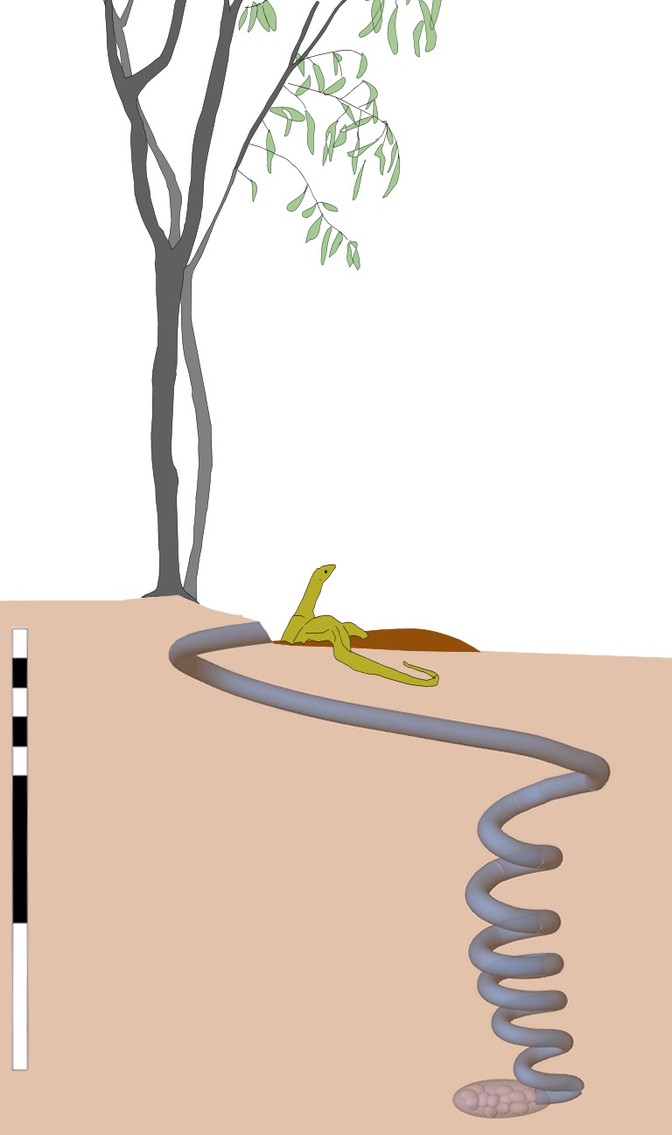
Well, this was fun too. It’s about Australia’s spotted goanna, a large predatory monitor lizard. Until recently, nobody knew where it laid its eggs. It turns out that the lizards burrow deep into the desert sand in a corkscrew fashion and then lay their eggs before climbing back up. They do this because the eggs need to incubate for a long time and thus need to be shielded from the harsh weather at ground level.
7. Some Thoughts on the Common Toad - berfrois magazine
This is a 1946 essay by George Orwell on the common toad. I’m not sure how I came across this, but I’m glad I did, especially considering that Orwell is not the sort of person I’d expect to write an essay like this. But of course, since it is Orwell and this essay is written the year after the end of WW2, it’s not only about toads and Nature.
As for Spring, not even the narrow and gloomy streets round the Bank of England are quite able to exclude it. It comes seeping in everywhere, like one of those new poison gases which pass through all filters. The spring is commonly referred to as “a miracle,” and during the past five or six years this worn-out figure of speech has taken on a new lease of life. After the sort of winters we have had to endure recently, the spring does seem miraculous, because it has become gradually harder and harder to believe that it is actually going to happen. Every February since 1940 I have found myself thinking that this time Winter is going to be permanent. But Persephone, like the toads, always rises from the dead at about the same moment. Suddenly, towards the end of March, the miracle happens and the decaying slum in which I live is transfigured.
8. A pilgrimage to the keeper of Puerto Rico’s past, before she disappears - illyanna Maisonet’s newsletter (originally published in 2019 by SF Chronicle)
Lula must have been convinced we’d be impressed with her yuca bread. She waved us in her direction, as if about to reveal a magic trick. She grabbed a simple wooden frame, placed it on the buren, dumped handfuls of cassava flour into the mold, made some impressions with a primitive wooden paddle and left it alone. She added nothing more than the flour — no liquid, no fat. After a minute, she flipped the mold and showed us the bread. It was solid, golden brown and crispy. She told us to dip a piece into a bubbling cauldron of red liquid. The bread tasted like pure yuca, but with toasted nutty notes. Dipped into the seasoned red sauce, it mirrored the act of dipping bread into an Italian gravy. Magic.
9. A New AI Lexicon - AI Now Institute (published on Medium)
This is an interesting post that is part of the AI Now Institute’s “AI Lexicon” project, “a call for contributions to generate alternate narratives, positionalities, and understandings to the better known and widely circulated ways of talking about AI.”
The computer is not, of course, a brain, and this particular imaginary is not necessarily helpful for examining today’s computing worlds. However, these terms do help put into perspective the shifting meanings, central concepts, and unifying ideas that underlie our thinking around computers and AI. The vocabularies we use to orient ourselves and to understand technologies are not mere coincidence or quirk but are instead, continually adapted including to and from scientific communities, corporate entities, and the public sphere, shaping in part, our ideas of what these technologies are and can be.
10. Wild Rice Waters - Places Journal
Wild rice is a crop that was foraged and managed extensively by Native Americans in the past. Here in the US, we can buy wild rice, but it’s not “wild” in the sense that it is a cultivated crop in flooded fields. The “real” wild rice is wild–it is not cultivated like other agricultural crops but is harvested each year while leaving enough to replenish the stock for the future. This essay talks about wild rice restoration in Kettle Lake in Minnesota, where the wild rice population has been dropping year on year. Part of this is due to excessive pollutants in the water, and hence restoring wild rice is intertwined with the task of remediating the entire watershed.

See you soon.-Kat.