Hello there! This is Vishal and I bring with me yet another issue of Kat’s Kable. It’s been a while since I sent this out last. Every time that happens, it feels rusty when I return. It definitely felt rusty today. I’ve been trying to take things easy and slow, and hence writing the newsletter (or even reading much online) took a backseat. In the meantime, though, I did do something nice which I’m happy to share. Rohini, who runs The Alipore Post (one of the first email newsletters I ever subscribed to!), asked me to put together a photoessay of sorts describing my 2021. Here it is, if you’d like to take a look.
If you got this from a friend and want to subscribe, here’s the link. Also, if any of the links are paywalled and if you don’t want to pay for a subscription, try opening the link in incognito mode in your browser. This works if the website has a “soft” paywall. If that doesn’t work, you can access the website using a different browser on the same device, or use a different device altogether. Another, slightly involved, method is to try to disable JavaScript and reload the page. This works on some websites for me.
1. In Memory of My Parents, the Late Gabriel García Márquez and Mercedes Barcha - Lithub
This is an adapted excerpt from Rodrigo Garcia’s book A Farewell to Gabo and Mercedes: A Son’s Memoir of Gabriel García Márquez and Mercedes Barcha. It’s really quite touching.
Much of our parents’ culture survives in some form in the new planets created by my brother and me with our families. Some of it has merged with what our wives brought, or chose not to bring, from their own tribes. With the years, the splintering will continue, and life will lay upon my parents’ world layers and layers of other lives lived, until the day comes when nobody on this earth holds the memory of their physical presence. I am now almost the age my father was when I asked him what he thought about at night, after turning out the lights. Like him, I am not too worried yet, but I am aware of time. For now, I am still here, thinking of them.
2. KTAQMKUK - Maison Neuve
This is a long piece by Justin Brake and it took some attention from me to get through. Brake writes about learning of his Mi’kmaw (a tribe native to what is not Quebec in Canada) ancestry, and coming to terms with it. What I found very striking and nice is the way the essay brings together the past, the present and the future of Indigenous identity and life.
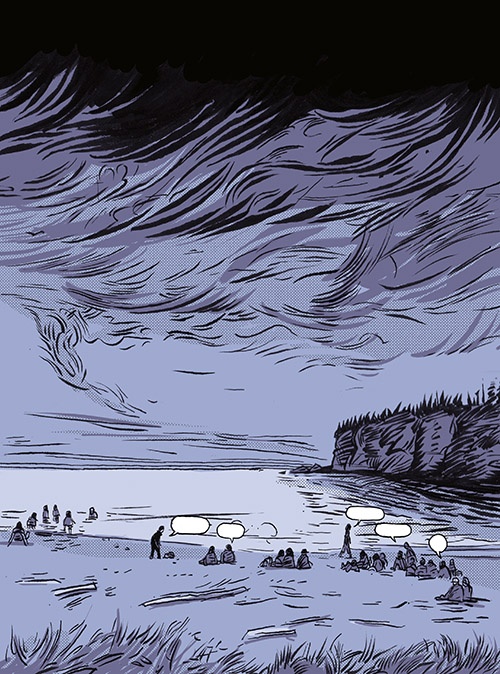
3. The Big Here and Long Now - Long Now Foundation
Humans are capable of a unique trick: creating realities by first imagining them, by experiencing them in their minds. When Martin Luther King said “I have a dream”, he was inviting others to dream it with him. Once a dream becomes shared in that way, current reality gets measured against it and then modified towards it. As soon as we sense the possibility of a more desirable world, we begin behaving differently, as though that world is starting to come into existence, as though, in our minds at least, we’re already there. The dream becomes an invisible force which pulls us forward. By this process it starts to come true. The act of imagining something makes it real.
I also recently read this interview of his, Brian Eno: Another Green World in Port magazine where he talks about his environmental activism.
4. Familiarity and Belonging - Simon Sarris’s Substack
I’ve been enjoying Simon Sarris’s writing recently. This is an essay from late 2020 about reveling in the same situation or place for an extended period of time. I relate to it a lot, especially in recent times when it feels like I eschew travel and instead love to put down roots, so to speak, and stay put.
Familiarity is a misunderstood virtue. Cultivating a sense of belonging is under-practiced and misunderstood. No matter where you live it is worth trying to improve the small things of your world. Romanticism has always elevated the pleasure of adventure over the pleasure of belonging, to an almost comical degree in recent times—everyone’s favorite hobby just so happens to be “travel”. I think this is something of an oversight. (however I am not against travel! I think seeing the world is a great hobby, but it’s one that you should try at home, too.)
I have other thoughts about this too, especially regarding social media and online personae, but I will probably save those for another time.
5. Tend - The Rumpus
This is a nice essay pondering the meaning and form of the act of tending. It starts with the author Ayla Samli choosing to make her own bone broth instead of buying it from a store. It’s a long process to make it, and has to be tended to properly. Again, like the previous piece, it’s something I relate to strongly. I tend to my plants and my garden, and also to a myriad of fermenting foods and drinks on my kitchen counter. It’s nice because I tend to always use the word “tend” in present tense. I also really like the closing paragraph of this essay.
Before my daughter was born, fire seemed loud, fast, explosive, and dazzling: flash pots, fireworks, flame throwers. I was once drawn to the short, scorching pyrotechnics show of an outdoor concert. But my tastes and desires have changed. In terms of my daughter’s tending, her survival will be covered: There will be a water fountain, and she will stay with her flock. But I care about stoking her curiosity. Who will help her fire burn? At one of the schools we visited, the children take a class called “Life,” where they learn to cook and sew and build fires. It appeals to me endlessly, intellectually, because she will learn while doing—she will use her hands to make what humans, for millennia, have made.
6. Shearing Sheep and Hewing to Tradition on an Island in Maine
Really nice and cozy photoessay about raising and, yes, tending to sheep.

7. Notes on Web3 - Robin Sloan’s blog
The topic of Web3 has gotten very popular in recent times, at least in my circles. There are a lot of strong opinions about it (going both ways), but not many cogent arguments. That’s why I’m happy to see this from Robin Sloan. He despises it, and calls himself an enemy of Web3, but does it in a point-by-point way.
8. The Recycling Myth - Reuters
This is a long piece that starts off with talking about “advanced recycling” technologies implemented in parts of the USA. These projects haven’t worked well so far, and while that may be expected of projects in their infancy, some studies point to advanced technologies like pyrolosis being no better than simply burning plastic in a kiln (for fuel). The overarching point is that a lot of modern recycling hype is artificial, and consists of mostly propaganda and empty promises made by oil companies as they strive to stay relevant and profitable.
9. 640 Pages in 15 Months - Bob Nystrom’s website/blog
Wow, this was super cool. I hadn’t heard of Nystrom before this, but he’s written a few books. This piece is all about his recent book Crafting Interpreters and he talks you through the entire process of converting the written material into a… book. As in, an actual book. He goes into lots of technical details and describes his tools, struggles and progress. It’s really nice! Appeals a lot to the nerd part of me.
10. Rewilding your attention - UX Collective
This is quite nice and talks about “rewilding your attention” when it comes to social media and consumption of information and content on the internet. The basic premise of the piece is to seek out content according to our own interests (which may be too nuanced for algorithms to automatically recommend to you) rather than aimlessly let yourself be guided by social media/platform algorithms. I agree with that.
But our truly quirky dimensions are never really grasped by these recommendation algorithms. They have all the dullness of a Demographics 101 curriculum; they sketch our personalities with the crudity of crime-scene chalk-outlines. They’re not wrong about us; but they’re woefully incomplete. This is why I always get a slightly flattened feeling when I behold my feed, robotically unloading boxes of content from the same monotonous conveyor-belt of recommendations, catered to some imaginary marketing version of my identity. It’s like checking my reflection in the mirror and seeing stock-photo imagery.
See ya next time.-Kat.