Hello there! This is Vishal with another issue of Kat’s Kable, your weekly roundup of ten good things to read on the internet. I’m about to go tuck into some ice cream, so there’s not much to say except that I hope you like what’s in this week’s list and as always, feel free to reply to this email.
If you got this from a friend and want to subscribe, here’s the link. Also, if any of the links are paywalled and if you don’t want to pay for a subscription, try opening the link in incognito mode in your browser. This works if the website has a “soft” paywall. If that doesn’t work, you can access the website using a different browser on the same device, or use a different device altogether. Another, slightly involved, method is to try to disable JavaScript and reload the page. This works on some websites for me.
1. Hopepunk, Optimism, Purity, and Futures of Hard Work - Before We Go blog
This is a long but cool piece by Ada Palmer, who as always, writes so well. According to her, the genre of “hopepunk” is the opposite of “grimdark”. Grimdark is a genre where the style and events are dystopian, violent or amoral. Palmer describes hopepunk as not just being purely hopeful, but also as something that incorporates elements of punk, i.e., productive anger and an anti-establishment outlook, to name a few. What is nice is that hopepunk is a direct response to the despair-filled view of the world that a lot of toxic media dole out on a daily basis. It reminds me also of solarpunk, and this piece that I’d shared a while ago: On the Political Dimensions of Solarpunk.
2. Aravallis: Love and Fresh Air - Roundglass Sustain
Neha Sinha here writes nicely about the Northern and Central Ridges, which are forests accessible from the bustle of India’s capital, Delhi. The pictures are quite lovely.
The thrill of real wilderness, touched by mysterious animals, creates a unique heritage that should outlive our own development plans. The architecture of time and human hand is of great interest too. Many parts of the Ridge are dotted with old monuments, but the gentle hills and tongues of rock are older still.

3. Blossom’s 20th anniversary makes visible Bengaluru’s invisible transformations - News Nine
This is a tribute to Blossoms Bookstore in Bengaluru, which recently completed twenty years of existence. It’s quite nice to read about the beginning of the store, as well as see it through the lens of Arul Mani, who’s written this article. I’ve been to Blossoms a few times, and it’s a lovely place (as many more will readily confirm).
Blossom surviving is an event because it is a success that has been more durable than other shinier successes from that time. Hotmail was a success in the early 2000s that we celebrated and claimed because Sabeer Bhatia was from Bangalore. I still use my Hotmail account, and I still go to Blossom, but only one of these is out of nostalgia. Hotmail would keep deleting old mails without even asking, but if something is reported to be out of print or unavailable online, there is still the chance that I might find it by sheer dint of looking in those many shelves. Blossom lives essentially out of an inventory that has been abolished and would have been pulped in a more sensible country, and its survival is thus a paradoxical event.
4. I blew $720 on 100 notebooks from Alibaba and started a Paper Website business - Ben Stokes’ Tiny Projects website
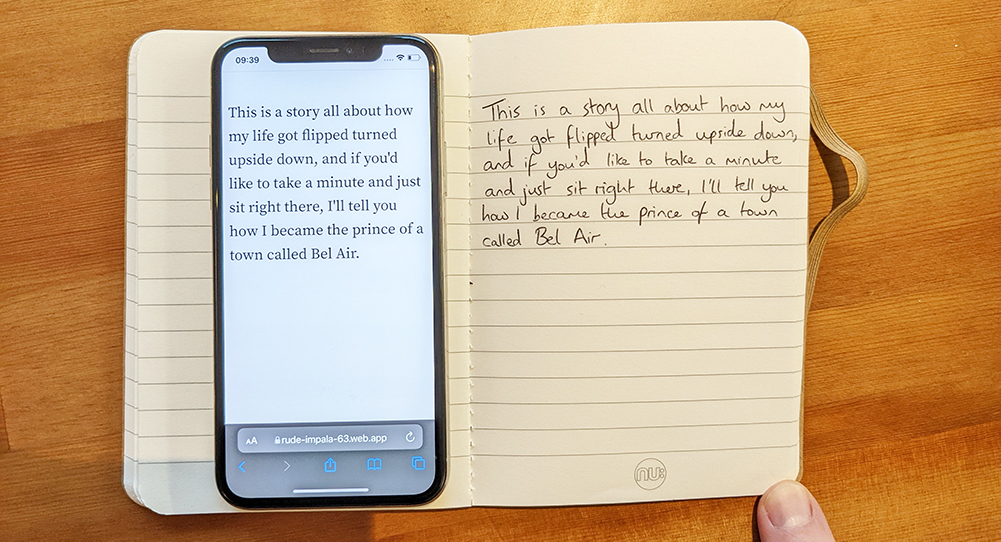
Ha! This is neat. It’s about a project where you can build simple websites by simply writing things down in a notebook and taking pictures of what you’ve written. The tech involved is cool, but I was more impressed by the enterprise needed to actually get this project off the ground.
5. The Internet Changed My Life - Pointers Gone Wild blog
This is a lovely personal story. The author describes how having access to the internet in the 1990s and 2000s changed his life much for the better. They start the story by saying that this is a counter to recent discussions online about how the internet is proving to be a negative to society. Having access to a computer and the internet helped the author to cope with bullying, dealing with a mentally ill mother and loneliness. Some of this is relatable, especially about alleviating loneliness via the internet.
This is part of the story of how the internet changed my life for the better. I’m an early millennial and I was raised online. Through the internet, I found friends, support, and the human connection that I was lacking in real life. I also found valuable information that helped me help myself and sometimes help others. The key with information is always to effectively filter the good from the bad, which is a genuine life skill unto itself. My life today isn’t perfect, but it’s better than it’s ever been. My message to all the people out there who are struggling is to believe in yourself. If you help yourself and you let others help you, things are never hopeless.
6. The Gradual Extinction of Softness - Hippocampus Magazine
Chantha Nguon here writes about her childhood in Cambodia and how everything changed after the Khmer Rouge took over. She describes the change in Cambodia as an “extinction of softness”, as softness as a quality was seen as weakness by the Khmer Rouge. Her story is mediated by food, beginning with her childhood of plenty (food, love, care), moving on to her middle age flight from Cambodia, and ending with her move back to Cambodia to work as a social worker. She has a graphic novel coming out, and I’m looking forward to it.

7. Hard sells and ‘toxic’ targets: How Indian edtech giant Byju’s fuels its meteoric rise - Rest of World
Sigh, this is quite sad. Byju’s is an outsized ed-tech firm in India which is continuing the tradition of selling coaching services to kids for various entrance examinations. More than the kids, though, its the parents who are the real customers, and the way to make more sales is to prey upon the parents’ insecurities. Byju’s forces its salespeople to tap into this, which results both in a toxic work environment and the growth of the company.
8. Why autoimmunity is most common in women - Nature Outlook
I just learnt that autoimmune diseases are more common, on average, in women than men. There are different hypotheses for why this happens, and more research needs to happen. Two of the competing hypotheses are that the difference is due to the different levels of hormones between men and women, and that it’s due to the sex chromosomes specifically.
9. Why efficiency is dangerous and slowing down makes life better - Psyche
This is something I think about often, and which also seems kinda obvious when you think about it. To have more stability in any system, it’s important to have a degree of redundancy so you can deal with negative events (think supply chains). However, building in redundancy makes the system less efficient. The premise of this article is basically that; optimizing efficiency over everything else can be dangerous.
10. Powder - Fifty Two
This is one of the first few pieces that Fifty Two put out (it’s from late 2020) but I read it only some time ago. It’s about custard powder, which I have some fond childhood memories of. Custard is traditionally hard to make and doesn’t keep for a long time. However, using custard powder (corn starch) made custard more accessible. Also, the fact that it was lacto-vegetarian meant that it would be more popular in Indian families’ pantries. This story is nicely put together and combines food science and some social aspects of custard powder along with its historical development in India. This also reminds me, we used cornstarch at home just the other day to thicken a cheesecake (ha!).

See you next week.–Kat.