Hello there reader! Here I am with another issue of Kat’s Kable. I’ve had a really nice extended weekend spending time at home and with dear friends. There really isn’t much else to say right now, except that as usual, there’s been articles to read and a newsletter to curate. One idea I’ve been toying around with is retiring the current format of the newsletter at the end of this calendar year. I like this format, but perhaps I like it too much to consider alternatives to it. Do you have any ideas about that? Alternative formats of the Kable, still centering around longform content, but taking different visual, stylistic or organizational modes? If you do, please let me know! More than anything, I’d like to change things up just to keep things fresh. I used to think (and still do, mostly) that this “boring” format is ideal because it lets me write whatever I want within its framework while still maintaining coherence. But there are surely other ways of attaining similar goals. As always, you can simply hit reply to this email if there’s anything you’d like to say.
If you got this from a friend and want to subscribe, here’s the link. Also, if any of the links are paywalled and if you don’t want to pay for a subscription, try opening the link in incognito mode in your browser. This works if the website has a “soft” paywall. If that doesn’t work, you can access the website using a different browser on the same device, or use a different device altogether. Another, slightly involved, method is to try to disable JavaScript and reload the page. This works on some websites for me.
1. Here Comes the Sun—to End Civilization - Wired (soft paywalled)
Definitely a clickbaity title, and this piece is way longer than it needs to be. It deals with coronal mass ejections, which are large groups of charged plasma particles that the sun emits. Sometimes, the ejection may fly directly at the Earth, and in case the Earth’s magnetic field can’t repel it, the ejection may cause a large-scale blackout in terrestrial electrical grids. So it’s worthwhile to watch out for these, better understand how these are formed, and also figure out how to prevent large-scale damage that they can cause (a basic fix is installing transformers with large capacitors to block DC).
2. Collections: Logistics, How Did They Do It, Part III: On the Move - Bret Devereaux’s blog
I’d shared another piece from Bret Devereaux’s blog Collections: Why No Roman Industrial Revolution? in Kat’s Kable #287, and here I am again with another of his posts. I really enjoyed it–it goes into detail about how armies move, what the limiting factors are to an army’s speed, and simply put, how every addition to an army slows it down, no matter the addition. It’s a long post, as his posts usually are, but the style is somewhere halfway between conversational and academic, which I love (and also strive for generally).
3. Folk Interfaces - Maggie Appleton’s website
I’d shared A Short History of Bi-Directional Links from Maggie Appleton’s website in issue #266 and remember being super impressed by her website and the way it was organized. During one of my recent browser tab reorganization sessions, I found a few more really nice things she’s written, this being one of them. She talks about “folk” repurposings of digital (and non-digital) technologies, like using a web browser as a JavaScript IDE, or making art using a spreadsheet. It’s a really optimistic essay, because it recognizes that the developers who design tools cannot fulfil their users’ ever need, but users can still repurpose the tools available to them to make what they need. I also like the use of the word “folk” here, as it signifies what people make on their own outside of the usual institutions.
Historically, the term “folk” was used when talking about the rural poor and illiterate peasants. It’s fitting that folk practices in software are often developed by people illiterate in programming. Without access to formal programming skills, they use what they have to make things work. In ways that demonstrate profound creativity and logical problem-solving.
This scavenging in the SaaS landscape is how people express agency and control in a computing environment that limits who has access to programmatic power. Only professional programmers and designers get to decide what buttons go on the interface, what features get prioritised, and what affordances users have access to. Subverting that dynamic is the only way people can get their needs met with the computational tools they have at hand.
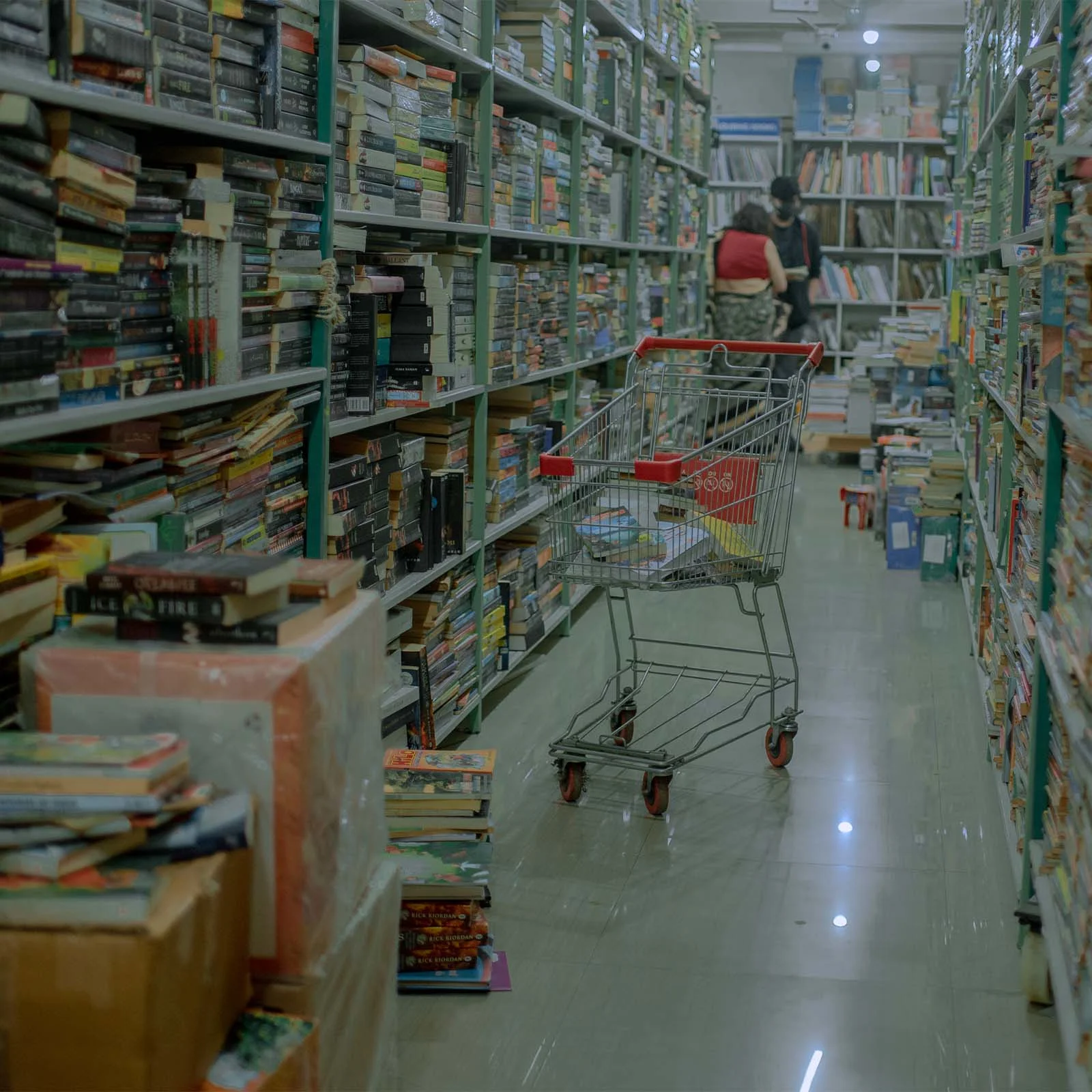
4. Blossom Book House: selling secondhand in Bangalore - Courier magazine
Blossoms Bookstore is a really nice place in the Indian city of Bangalore, and here’s another piece about it. It’s an interview-ish thing featuring Mayi Gowda, the person who started Blossoms. I’d shared another article about Blossoms marking its 20th anniversary back in issue 261, Blossom’s 20th anniversary makes visible Bengaluru’s invisible transformations.
5. $100 Hand of Blackjack, Foxwoods Casino - McSweeney’s
I know McSweeney’s primarily as a purveyor of good humour. This personal essay, however, is far from humourous. I found it on some online list of someone’s favourite pieces of longform writing. David Hill, in 2011, writes about joining a card-counting group in the US, and stitches that experience together with writing about his family, particularly his sister. The feeling I got when reading this essay was “pathos”, which is also one of my favourite words.
I look up to my sister despite all of this. Her kind of life has been a hard kind, one filled with heartbreak of epic proportions, only the surface of which I’ve scratched here. Even now, hearing her brush aside any suggestion that a hard life is a form of hard luck, I still won’t be angry with her for the choices she has made. Her choices had terrible consequences, and they affected more people than just her, myself included. All the same, they were hers to make alone. Sitting here next to me in this prison yard, telling me about how luck is bullshit, holding this tiny little hat, she’s paying the price alone. I still can’t protect her. I will not judge her.
6. The Art of Negativity - PrzeKrój Magazine
PrzeKrój is a pretty interesting magazine and I honestly have no idea how this article on “constructive negativity” (I came up with that term now) found me. But it’s an interesting perspective! It’s about “rejecting positive thinking”, which is.. I don’t know how to put it, but it’s kinda about being responsible or constructive with your negative thinking instead.
Accepting the fact that life is inherently fraught with difficulty does not demand that this be seen as a concession that life is not worth living. On the contrary. In today’s desperate times, unaided by the pandemic, we need to be alive to complacency and ever-more candid in sharing emotional pain when it feels right to do so. Accepting opposition and negated values also requires others to listen and offer real compassion, even if this involves difficult conversations. In the negative is the promise of the positive.
7. The side heroes of panta bhaat - Mint Lounge
Panta bhaat is a fermented rice dish that’s usually eaten for breakfast. I’m familiar with the Tamil Nadu version of the dish, where leftover rice is fermented overnight just covered in water, then eaten with curd, some chillies, chutneys, and whatever else you prefer (for me, some more lactofermented vegetables). Other rice-eating parts of India too have their variations on this dish, as it’s so simple and more a framework than a recipe. This article is a deep dive into this dish and its regional variations across Odisha and Bengal, and I really enjoyed it.

8. The evolution of whales from land to sea - Knowable Magazine
So cool!
“Around 400 million years ago, the ancestor of all four-limbed creatures took its first steps onto dry land. Fast-forward about 350 million years, and a descendant of these early landlubbers did an about-face: It waded back into the water. With time, the back-to-the sea creatures would give rise to animals vastly different from their land-trotting kin: They became the magnificent whales, dolphins and porpoises that glide through the oceans today.”
So when the land-lubbing mammals went back into the water, they lost a bunch of genes, mostly because those encoded functions that were not useful in the water. In particular, I thought this was cool.
Another lost gene — and this one surprised Hiller — encodes an enzyme that repairs damaged DNA. He thinks this change has to do with deep dives as well. When cetaceans come up for a breath, oxygen suddenly floods their bloodstreams, and as a result, so do reactive oxygen molecules that can break DNA apart. The missing enzyme — DNA polymerase mu — normally repairs this kind of damage, but it does so sloppily, often leaving mutations in its wake. Other enzymes are more accurate. Perhaps, Hiller thinks, mu was just too sloppy for the cetacean lifestyle, unable to handle the volume of reactive oxygen molecules produced by the constant diving and resurfacing. Dropping the inaccurate enzyme and leaving the repair job to more accurate ones that cetaceans also possess may have boosted the chances that oxygen damage was repaired correctly.
9. Infinite Images and the latent camera - Herndon Dryhurst Studio
This is a post from May 2022, and given that it’s about AI-generated artwork, it may already be well out of date now. But Kat’s Kable prides itself on showing off cool stuff well after its initial wave of popularity. I like this essay because it compares the current rapid boom in AI generative art (where you give an AI a prompt and it gives you a piece of art in response) with other advances in democratization of visual art, particularly the history of photography. The rapid advance of photography is similar to this current boom in many aspects. The democratization of the thing in question is accompanied with concerns along the lines of “is this real art?” and “this will ruin the real deal”.
Larry Tesler’s pithy description of AI, “Artificial intelligence is whatever hasn’t been done yet.”, is equally applicable looking back to the birth of photography. Photography had also not been done yet, and was then (a phenomenon described as the AI effect) soon integrated into most artistic and industrial practices. Sensor based imaging remains a discrete focus of research pursuing things that have not been done yet.

10. Psychiatry wars: the lawsuit that put psychoanalysis on trial - The Guardian
I just read this today, and it’s quite fascinating and eye-opening. It centers on the lawsuit filed by Dr. Ray Osheroff suing a hospital for not giving him antidepressants while he was checked in there for psychological issues. I didn’t know that this lawsuit dictated mental health discourse in the US in a big way, and by extension, affected the whole world. The lawsuit coupled with the corporatization of health meant that psychiatric care changed its nature to a checklist-based approach rather than a personalized one. The article is quite long, but if like me you’ve thought about the way we as a society look at things like depression and antidepressants, then this is well worth a read.
See you next week.–Kat.