Hello there, reader, and welcome to another issue of your favourite email newsletter, Kat’s Kable. As always, ten great things to read from around the internet. Before that, though, some self-indulgence. I’ve gotten myself a Claude subscription to use Claude Code and I’ll preface this by saying that every day is a struggle against my (Claude Pro) usage limits. But. I got it to start unifying my database/collection of Kat’s Kable articles and it popped up some interesting statistics. From issues #70 to 371:
- I’ve shared 2829 articles.
- These have been from 860 unique sources.
- Of these 860, 550 sources have had just a single article make it to the Kable.
- The most frequent source (The Guardian) is at ~4%, which is not bad, I think!
- Topic-wise, too, my highest topic is science/tech which is at about 13%. Again, not too high.
I just wanna take a minute to say I’m really happy about the diversity of sources and topics on the newsletter! Yay to being an omnivorous reader (and sharer).
I’ll spend some time next weekend (when my weekly Claude limits reset) seeing if I can get it to help me with more detailed analysis a level deeper than whatI have currently. If you’re using a coding agent, let me know what fun personal “folk software” (see this blog post) you’ve been building.
1. The Case That A.I. Is Thinking - The New Yorker
I’ve shared James Somers’ writing in the past (the excellent The McPhee Method in issue #359). He’s written this essay in November 2025 where explores a question that no doubt we’ve all asked ourselves: does an LLM like ChatGPT actually think? He makes a lot of great points but the key takeaway I walked away with is this:
Even some neuroscientists believe that a crucial threshold has been crossed. “I really think it could be the right model for cognition,” Uri Hasson, a colleague of Cohen’s, Norman’s, and Lake’s at Princeton, said of neural networks. This upsets him as much as it excites him. “I have the opposite worry of most people,” he said. “My worry is not that these models are similar to us. It’s that we are similar to these models.” If simple training techniques can enable a program to behave like a human, maybe humans aren’t as special as we thought.
2. Beyond the Bubble: Why AI Infrastructure Will Compound Long after the Hype - KKR
Another November 2025 AI read about the bubble. You know, the big fat AI bubble? I feel I’ve also gotten to a point where I’m sharing an essay a week about it.
3. How China built its ‘Manhattan Project’ to rival the West in AI chips - Japan Times
Pretty cool read about the intense Chinese effort to build its own extreme ultraviolet lithography (EUV) machines which are critical for the most advanced semiconductor chips. I don’t know if it’s a fair thing to compare this to the Manhattan Project, but it’s a significant achievement nonetheless. And very impactful in today’s geopolitical scenario.
4. Willis Whitfield: A simple man with a simple solution that changed the world - Sandia National Lab
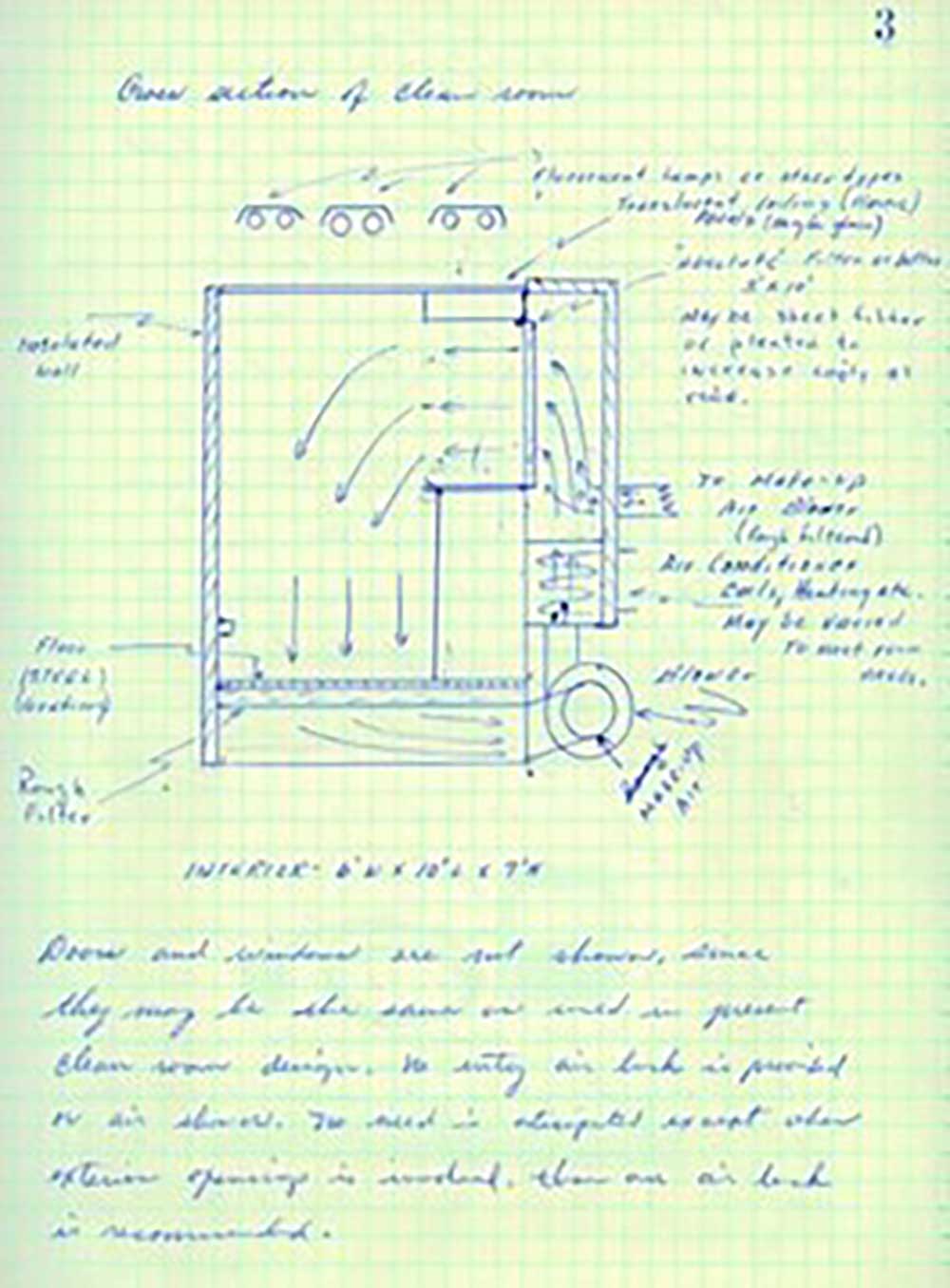
2024 article about Willis Whitfield, the inventor of the modern cleanroom. Cleanrooms are another key technology pillar in our modern lives, maybe even more so than EUV mentioned in the previous article. Whitfield had the idea to have laminar air flow, “or the constant sweeping of a room with highly filtered air”, to reduce the number of airborne particles in rooms by over a factor of thousand! He’s a really inspiring person.
5. Limit Thinking - Asimov Press
This is really cool! It talks about science that was done before we defined or discovered the theoretical limits of performance, and after. For example, steam engines started off at pretty low efficiencies (single digit %s) and those engineers didn’t think of how good their engines could be because theoretical limits hadn’t been defined.
What was missing was a notion we might call “Limit Thinking.” This abstract approach forces one to focus solely on the features of a system essential for its performance, so that one can make predictions or evaluations, regardless of the specifics of how each individual system is built. It grounds problems in mathematics — as one cannot calculate limits without being precise about what is being measured and in what units. Once such calculations have been determined, they often drive rapid progress, signaling not only when we have reached diminishing returns, but also just how far we can aspire.
6. The realities of being a pop star. - Charli XCX’s Substack
OK, wow. Never thought I’d be sharing something from Charli XCX, but her Substack is really good and this particular post is just, really good too! It’s just overall so cool and insightful. She says, (a) it’s really fun, (b) you spend “a lot of time inhabiting strange and soulless liminal spaces”, (c) you “cannot avoid the fact that some people are simply determined to prove that you are stupid”, and (d) there’s an expectation for you to be truthful and morally responsible, but why?
7. The Secret History of Indian Science Fiction. - Alter Magazine
Lovely design and great words. It’s by Gautam Bhatia, so you know it’s going to be a good one. This is a great tour of Indian SF and I’ve added so many books now to my to-read list.
8. Meet the Woman on a Mission to Photograph Every Species of Hummingbird in the World - Audobon
“In less than a decade amateur photographer and Hummingbird Spot founder Carole Turek has photographed more than 250 hummingbird species, including one that was long considered extinct.”

9. The story of the SR-71 Blackbird that outran Gaddafi’s SAMs during a BDA flight of Libya in support of Operation El Dorado Canyon - The Aviation Geek Club
I read Ben Rich’s Skunk Works a couple of weeks ago and that prompted me to read more about the SR-71, a truly legendary airplane. This is an excerpt from Major Brian Shul’s book Sled Driver and talks about how the SR-71 daringly and seemingly easily outpaces missiles launched it from Libya.
10. How to paint with sound, by a virtuoso classical guitarist - Aeon
“In the hands of a great musician, the gloriously simple guitar can create the most complex works of art. Here’s how.” Beautiful essay. So, so evocative.
When an experienced performer blends these different techniques, the audience may be moved by the beauty, rightness and subtlety of the result without necessarily being aware of the choices the guitarist has made. In the hands of a great musician, this simple instrument embodies expressive possibilities that are almost limitless – we literally sculpt with sound.