Hello there, and welcome to another midweek Kat’s Kable issue! It’s been a crazy few weeks and I had to miss our usual weekend date for the Kable, but fret not - as always, ten great things to read.
Going with the times, I also have a fun new vibe-coded way to look at what’s going on with the Kable archive. I got a coding agent to run a quick K-nearest neighbours classification to create a bunch of clusters. It’s honestly really fun to look at. Here’s a screenshot and the link if you want to look in more detail.

I’ve been enjoying vibe-coding these kinds of things - primarily because the “raw data” for these kinds of visualizations exists already, and the act of putting together a visualization is standard. I’ve also tried to put together some sorts of automations/workflows/agents for new or “current” tasks, and have found those to be boring. The takeaway for me is that I want to have my own habits, and then I want to use or build tooling to smooth out the rough edges of the habit, rather than co-build the tool and the habit. Good to realize!
1 The “Crown of Nobles” Noble Gas Tube Display Scott Shambaugh’s blog
Very cool hardware hobby project! Scott works on ion thrusters for spacecraft for his day job - these thrusters’ job is to turn electricity into Xenon gas that flies out the back to provide thrust. Scott then wanted a fun way to visualize xenon as well as all the other noble gases, and made this!

2 Lessons Learned Shipping 500 Units of my First Hardware Product Simon Berens’ newsletter
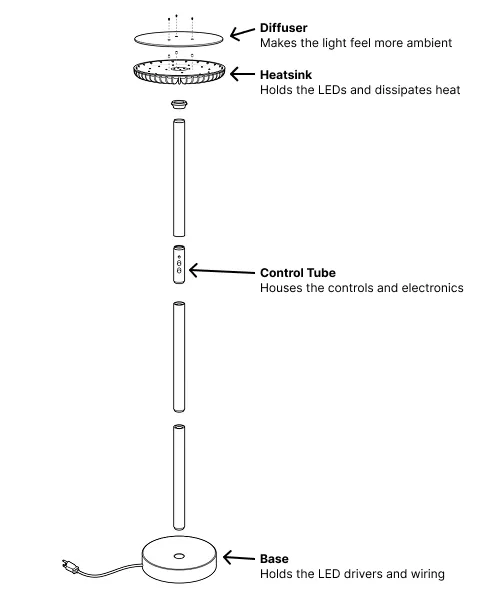
Phew. Fully enjoyed! Berens has created a product called Brighter - it’s a 50,000 lumens lamp. This translates to roughly 25 times brighter than a normal standing lamp. What makes the journey more interesting and fun is that this was his first hardware product, and of course, there was a lot of design, iteration, and QC back-and-forth, and trips to China to meet with and convince suppliers.
3 How did we make stardust think? Silen Naihin’s blog
I’ve talked quite a bit over the past few months about the rise of new beautiful interactive explainers. I really loved this one. It’s a 3 part piece that talks about turning the raw materials of the compute (stardust!) into intelligence. I really loved it, and spent a happy hour plus marveling at the narration and animations that put things into place for you.
4 Cameras and Lenses Bartosz Ciechanowski’s website
I’m a simple man - I see something from Bartosz Ciechanowski’s website, and I share it immediately. I’d earlier shared his exploration of mechanical watches in issue #278, sound in issue #294 and GPS in issue #328. Please clear half a day, and enjoy all of them. Or even better, pace yourself and do one per weekend.
5 The Politics of Height in Indian Cities Thinking Incentives on Substack
I remember sharing an essay a year or so ago on urban planning in India, and the effect that floor area ratio (FAR), or floor space index, has on the way our cities are structured. Basically - FAR is capped and kept usually at 1 or 2. This means that you cannot build very tall structures and have dense office or housing space. The key unlock to liberalize urban centres in India is to allow for high FAR in more spaces, and to use it creatively to encourage synergy between workspaces, housing and transit. I really want to work on this more because after living in multiple Indian metros, I can see what a big difference this would make.
6 The Olivetti Company Abort Retry Fail
I knew that Olivetti made beautiful typewriters, but I did not realize:
- that they were founded pre-WW1
- they were part of the anti-fascist resistance movement in WW2 Italy
- they made microcomputers and personal computers.
Olivetti is such a cool company!
Olivetti’s history can be divided into three distinct parts. First, there were typewriters. As the crisis of this first era mounted, the company moved into microcomputers for its second era. With the IBM PC dominating the world, the company moved into its PC era. When this era came into crisis, the company ultimately ended in a merger, and that entity became a telco. Olivetti was an impressive company that achieved greatness. It was cut down by the same forces that affected so many others. The race to the bottom in PC pricing meant that only the most efficient manufacturers remained standing.

7 The Extra Mile Atavist
Such an affirming story.
“After a horrific accident, doctors told Todd Barcelona that he’d likely never run again. So he and his wife decided to run farther than they ever had before.”

8 The death of an argument V.H. Belvadi’s blog
I can’t remember how I stumbled upon this piece, but this was a good one. It’s about the way to navigate arguments, particularly between two highly partisan groups, and how one mustn’t bring analogies into the picture when debating a specific thing. There’s not much to gain in reducing a complex topic into something simpler to handle, and the big downside is that it lets bad faith actors change the surface of the debate entirely. I want to read this again slowly, because while I’m not sure of my takeaway opinion, it did give me good handles on how to approach this topic. I’ve buried my head in the sand to some extent recently in terms of having opinions on contentious topics.
9 You can’t lose if you never quit SF Alexandria
I didn’t know anything about Declan Gessel, and this intro piece was, well, gushing. Fun read about a person who seems to have infinite energy, and a supreme sense of confidence in himself.
“I just have this way of living I think is better. And I want everyone else to experience it too.”
and
Playing with Declan is like having a golden retriever on your team. He jumps for every rebound. Sprints to save the ball any time it’s going out of bounds. Shoots the ugliest jump shot and having faith it’ll go in. Always asking for tips to improve. Always smiling. He’s given me a black eye and sprained ankle during our runs, but it’s impossible to get mad at him because he’s always so positive.
10 Why Satyendra Nath Bose was more than Einstein’s sidekick Aeon
SN Bose, one of India’s most impactful physicists, is best known in the physics world for creating the mathematical framework that predicts the behaviour of indistinguishable particles, called bosons. Albert Einstein was instrumental in getting his first paper on the topic published, and then they worked together on Bose-Einstein condensates. This essay argues that while Bose’s largest renown seems to have come from his work with Einstein, his work has spanned a much wider arc, and he’s carved that out for himself. I agree!