Hello there, good morning or good evening, welcome to another issue of Kat’s Kable, your favourite internet newsletter. It’s issue #400! Another milestone just a few weeks after hitting ten years.
It’s been a strange week for me, but I have had a good time reading a bunch of interesting things, some of which you will see in the newsletter below, and also some books - I have been thoroughly enjoying listening to Matthew McConaughey’s autobiography, Greenlights. The entire book is pure chutzpah. I’ve also been on a John McPhee binge. I am just about to finish The Pine Barrens which might replace Oranges as my favourite book of his.
I’ve been meaning to write a longer post, maybe sometime outside of the cable, about the way I have been interacting with AI and coding agents while developing, writing and curating the Kable. But I think I’ll just share a few things here.
I have a full blown personal app with an audience of one to manage the back end operations of the newsletter. I write the newsletter in this app right now because it helps me do quick searches in the archive when I’m looking for things to reference - that’s why you might be seeing that I have referenced a lot more from my archives in the last month or two months than I ever did.
Another interesting thing that I’ve been doing is that as I’ve been writing the newsletter just right now, I have a Codex window open and I quickly just talk to it verbally about things that I want to improve or issues that I have. I have really been enjoying making these small incremental improvements. These improvements barely move the needle - it takes me more time to make these improvements than it saves me time. However, I enjoy it. It’s a bit of a craft. I don’t know how seriously I should be taking myself, but I am enjoying it.
Anyway, more later. Enjoy the newsletter. I think it’s a great ten pieces to read this time. And let me know if you like it.
1 Fireworks Are Not Patriotic. Drone Shows Are - Wired
“This Fourth of July will feature more drone shows than ever. I went on a pilgrimage to drone country—and had a near-religious experience.”
So good!? I loved this. And the images, of course!

.jpg)
2 Restored Images Show the 1945 Trinity Nuclear Test In Vivid Detail - IEEE Spectrum
I read Richard Rhodes’ The Making of the Atomic Bomb a few years ago and loved it (while also being somewhat horrified). I’ve had a strange interest in everything nuclear since, and I liked this photoessay of pictures from the first ever nuclear weapon test in human history.

3 The Mom Who Runs a Household With a Staff of AI Agents - The Cut
I found this really interesting, and kind of strange too - a mom who has four kids has a team of AI agents that do all sorts of things like make personalized education plans, order the groceries, and deal with legal and financial paperwork. If this too sounds a bit horrifying, I feel it is? A little? Maybe not horrifying, but just strange. I found this to be a super cool perspective:
She has a theory about why she’s been willing to go further than her more technical friends. “The programmers I know are 70 percent threatened by AI and 30 percent ‘This is a cool tool,’” she says, so they keep their agents on a tight leash. Genet, by contrast, doesn’t feel like she has a profession to defend; AI, after all, isn’t trying to raise her kids. “So I’m zero percent threatened and 100 percent empowered. I have no skin in the game to prove I still have value in my job. I understand that’s not the norm.”
4 If America’s So Rich, How’d It Get So Sad? - Derek Thompson’s Substack
“Or: How the 2020s broke our brains”. Interesting piece that tries to find the root cause behind plummeting sentiment in the US. Long story short - there’s no “silver bullet” or single explanation - it’s a lot of things. Lack of community, rising inflation, the housing crisis, and a general continuation of the pandemic’s negatives are what have caused the “tragic twenties” in the United States.
5 Where Are the Economies of Scale in Homebuilding? - Construction Physics
I am back with another piece from Construction Physics (An Engineering History of the Manhattan Project in issue #359, How Does the US Use Water? in issue #356, and Will We Ever Get Fusion Power? in issue #333).
I really liked this because the US in particular has homes that can be somewhat centrally built and are somewhat standardized. So why aren’t there crazy economies of scale as you build more homes, especially containerized or prefabbed homes? It’s actually a really interesting answer, it’s again, not a single point of failure but a menagerie of them primarily centred around logistics costs.
6 Is math big or small? - Chessapig’s website
This is a pretty technically involved piece about mathematics, but I also think it’s really, really fun. Instead of me talking about it, I’m just going to reproduce the summary of the piece here below. It’s actually not an essay, but it is the transcript of a talk.
“When Illustrating a mathematical idea, the first thing you need to decide is the scale. Is this concept something you can hold in your hand, or something to wander around in? I will reflect on the scale of various analogies used by research mathematicians, such as Thurston’s train tracks and pictures of symplectic manifolds. Topologists use the metaphors of “geography” and “botany” to organize problems in their field. I will argue that geography and botany are flexible analogies, which give a natural scale for mathematical illustrations.”
and going further into geography and botany:
The “isoperimetric island” illustrates the analogy behind geography and botany. We envision math as an island, with mathematical objects as plants populating the island. Mathematicians, exploring the island, first act as geographers and map out the coast of the island, understanding the range of possibilities of the mathematical flora. As a geographer, math is big. Next, the botanists sit in place with a magnifying glass, classifying all the critters in that part of the island. As a botanist, math is small.
7 Glamorous Crossing: How Pan Am Airways Dominated International Travel in the 1930s - Longreads
I knew that Pan Am Airways was the airline pre- and post-World War II. I did not know, however, how much or to what extent that was true. This essay is a history into the vision behind the company in the pre- and post- jet engine era, the role that Charles Limberg played in expanding to new routes, and the crossborder lobbying needed!

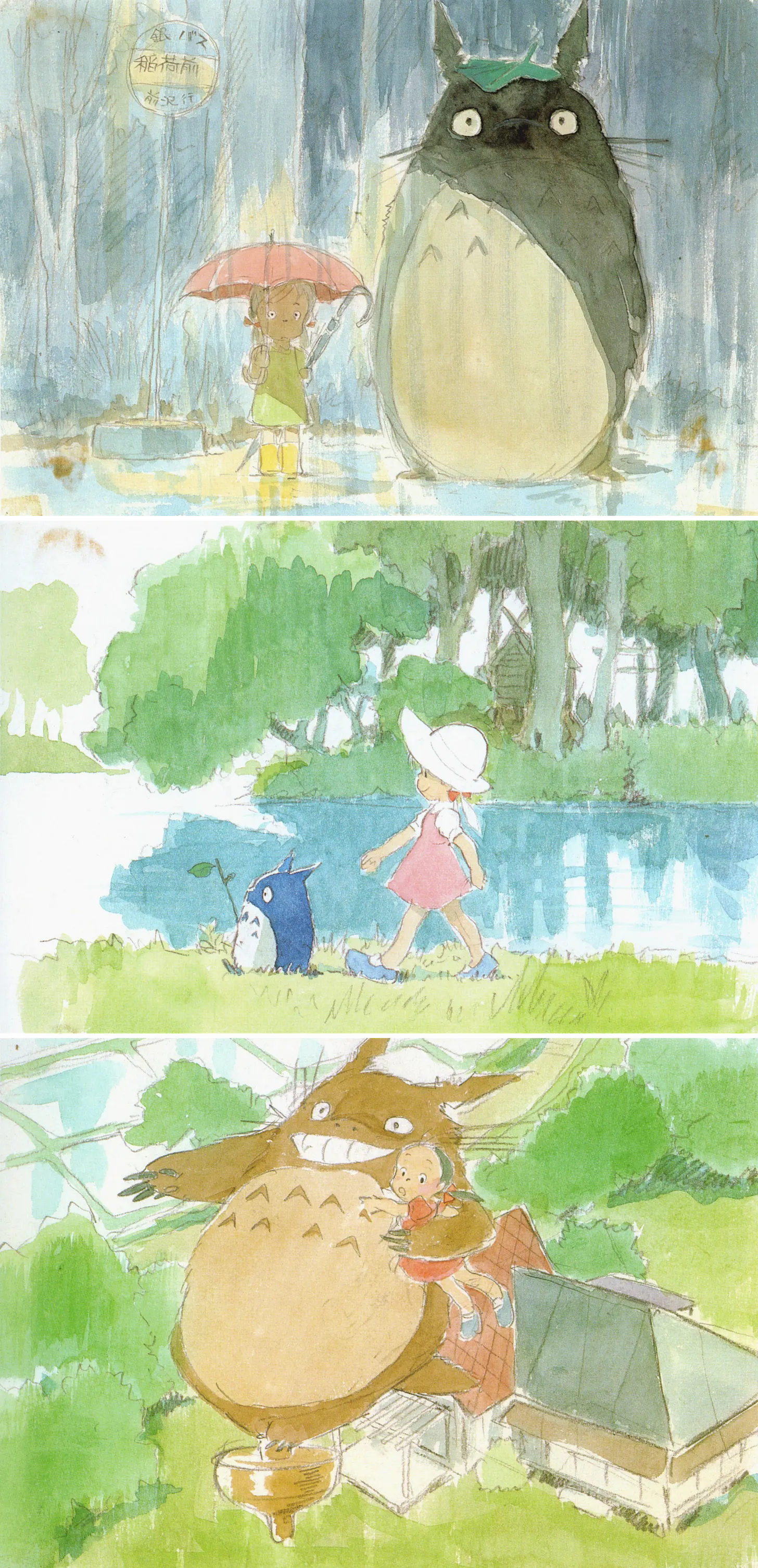
8 The Image Boards of Hayao Miyazaki - Animation Obsessive
Gorgeous, I repeat gorgeous feature on the evolving image boards of legendary Hayao Miyazaki. His evolution is captured in this essay by a bunch of interesting phrases: By the late ‘80s, a powerfully assured technique was visible in these sketches he tossed off so quickly., Every line and form is wobbly, but the impression is sharp, exact and effortless. and His image boards for The Boy and the Heron show a master’s touch, an absolute clarity of imagination.
9 The Heat Shield at the Edge of Space - Arena Magazine
Joseph P. Krause is the co-founder and CEO of Radical AI, a materials company using AI and self-driving lab tech to discover breakthrough new materials. It’s thus apt for him to chart the history of heatshield tech, possibly the technological bottleneck preventing us from having fully reusable rockets right now. I had an inkling of the issue, but I didn’t realize how hard the problem is and how much mental firepower we’ve thrown at the problem so far. Will AI help us get better? Krause obviously believes it, and I hope it’ll happen.
10 Frank Sinatra Has a Cold - Esquire
Just like Playing Doc’s Games (issue #397), this is another of those classic pieces. This one, in fact, is possibly even more famous and well-known that that 1986 personal essay. This is a 1965 piece by Gay Talese about Frank Sinatra, and it’s unbelievably good. Not only does it capture Sinatra’s presence and his aspect of being a mafia don or Il Padrone, but it also captures his vulnerability, his irritability, his loyalty and his behaviour towards others. Just an amazing piece of writing.