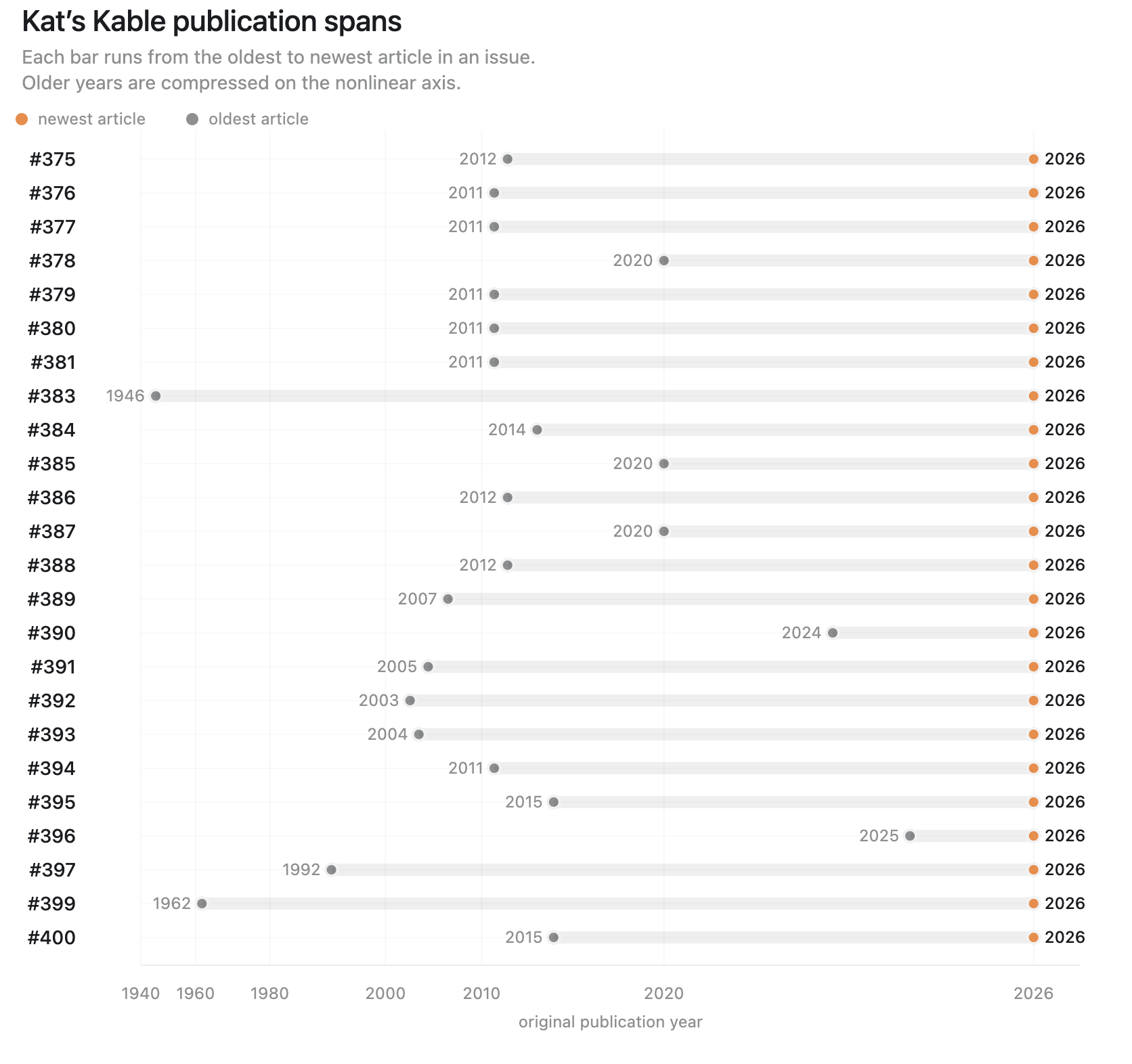
Hello there, reader and welcome to another issue of the Kable! Before we get into anything, I wanted to share something pretty cool. I took the last few issues of the Kable and plotted the oldest and newest piece shared per issue. The newest is always from 2026, which is nice, but the oldest ones go back years and decades!
I missed last weekend, and honestly I’ve not been having the best time mentally, and thus might not be as punctual going forward for some time. My stats tell me that I’ve been on a ~63 week streak (not weekly, but 63 issues in 63 weeks), and it feels sad that I may not keep to it. I will strive to, of course, but won’t force myself too.
One interesting development for me with the Kable of late has been the desire to have a bigger pool to curate from. I’ve thus read a lot more than I normally would. Instead of reading “just enough” for me to have 10 good things to pick each week, I’ve put myself in a position of having a pool of about 50 things to pick from. This is great and it’s (a) much more relaxing, and (b) much more expansive for me.
That’s all from me. Enjoy the newsletter. Enjoy the weekend! As always, write to me anytime by replying to any of my emails.
1 My Writing Education: A Time Line - The New Yorker
This is a great piece by George Saunders. He talks about starting off as a writer in 1986, at the Syracuse Creative Writing program - his formative experiences with Tobias Wolff and Doug Unger, meeting his wife at the program, starting to write “serious” stuff which causes him to lose his magic, and more. It’s such a great personal history.
Why do we love our writing teachers so much? Why, years later, do we think of them with such gratitude? I think it’s because they come along when we need them most, when we are young and vulnerable and are tentatively approaching this craft that our culture doesn’t have much respect for, but which we are beginning to love. They have so much power. They could mock us, disregard us, use us to prop themselves up. But our teachers, if they are good, instead do something almost holy, which we never forget: they take us seriously. They accept us as new members of the guild. They tolerate the under-wonderful stories we write, the dopy things we say, our shaky-legged aesthetic theories, our posturing, because they have been there themselves.
2 How Many Errorrs Are in This Essay? - The Millions
Nice piece about errors and typos. This is a bit of a historical piece too, except it spans errors in the printed or written English language starting from… the King James Bible. It’s a lot of fun - it combines a survey of errors with a sharp sense of humour that’s part writing, part choice of the errors the author, Ed Simon, chooses to highlight.
3 Curved origami and tangent developables - Chessapig
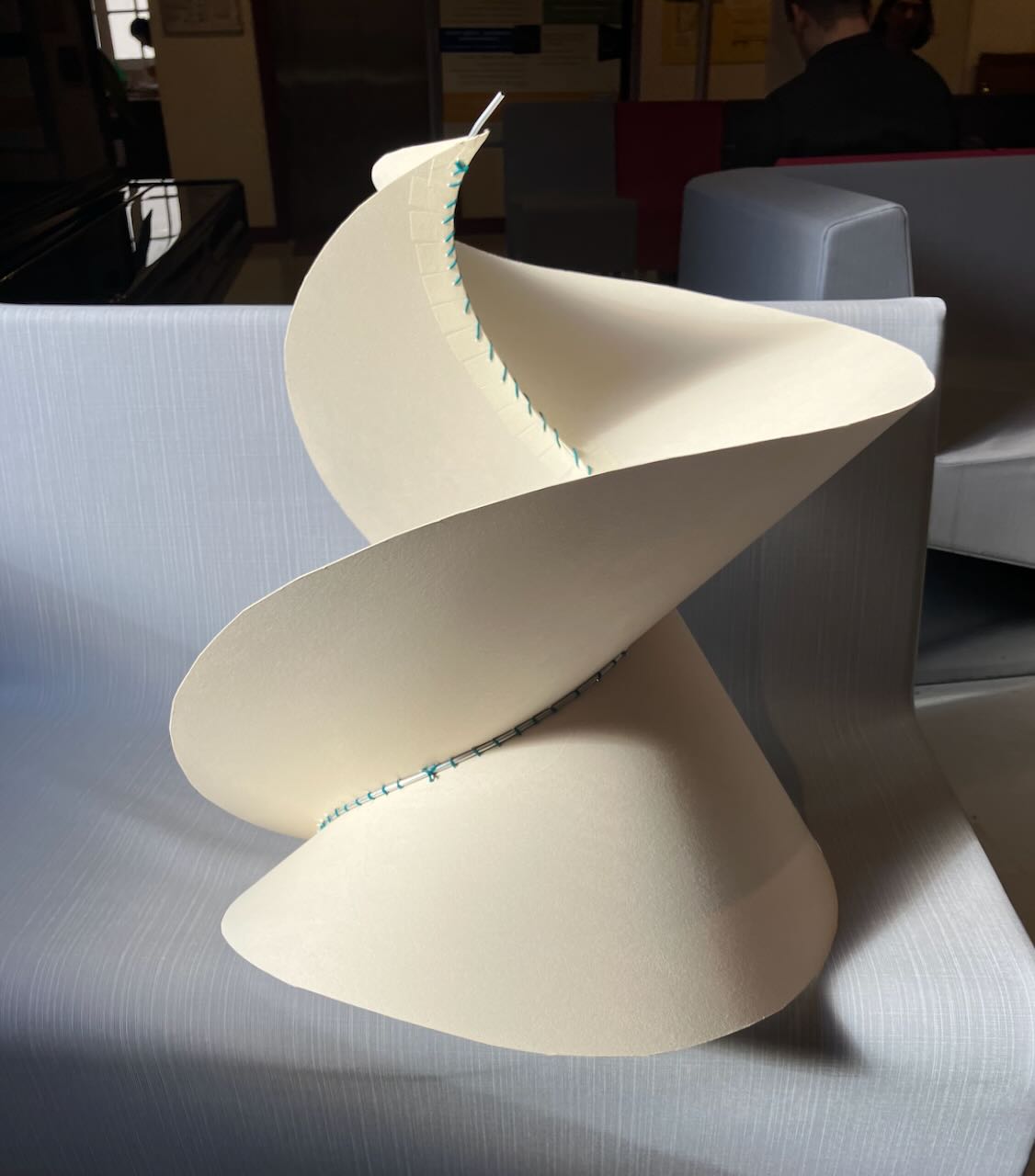
Wow? I shared I’d shared Is math big or small? in issue #400, and it was so good! Here’s another one from Elliot Kienzle. Here, Elliot describes “developable surfaces” and how to make cool shapes with paper without stretching or folding it. There’s some math here, but overall this is so cool!
4 Making Indian Cities Habitable - The India Forum
I re-read this piece by Ramachandra Guha about Patrick Geddes.. and I realized I had shared it back in issue #229! Anyhow, there’s no harm in sharing it again. It’s such a great piece from 2020 that talks about Geddes’ contributions to Indian urban planning. Lots of the social and environmental problems that India is facing due to urbanization were actually predicted by Geddes, over a century ago between 1914 and 1924. He talked about three things primarily: the relationship between cities and water access, spaces that could be claimed by trees, and resource management, primarily water management via wells.
5 Silicon Valley Circuits - Places Journal
I really liked this. I was in Silicon Valley a couple of months ago, and obviously only saw it at a single point in time. Hua Hsu talks about the last 30 years and the highway development in Silicon Valley - how Route 85 was constructed due to the rapidly changing fabric of the Bay Area and how its establishment accelerated that change. His personal essay is both personal and full of details of surrounding events, which I very much enjoyed. It goes into so many details of the evolution of arguably one of the most important areas of the world! As someone constantly trying to optimize life, the first part of this paragraph was a good wake-up call for me:
For teenagers, suburban commute times were not of great concern. More time in traffic meant more time to gossip or flirt, daydream and hope for that one song to come on the radio. How often do we recognize the uniqueness of our circumstances? I dreamed of a highway that would take me somewhere new, truly new. Deeper into San José didn’t count. I was a typical teenager, jaded and hard to impress. Yet that morning I did recognize that something unusual was happening. As I took a walk on a highway, I realized that my reality was circumscribed by infrastructure. Maybe this new road wouldn’t take me to the destinations I sought, but I recall that it shifted my thinking about the place I was from. Now that Cupertino was worthy of an exit, I began to understand the city as a node along some larger, abstract circuit.
6 The Mystery of the Bloomfield Bridge - Tyler Vigen’s website
Whoa. What a good and honestly, bizarre, sequel to the previous piece. Tyler Vigen explores the history of a pedestrian bridge that crosses the interstate I-494 near the Minneapolis airport. It doesn’t make any necessary connect for pedestrians, and nobody uses it… so why was it built? It took a crazy amount of research for him to get to the bottom of it - which even included flying to Kansas City to look through dedicated federal archives! I’m not going to share the actual reason the bridge was built here, but honestly, you want to read this piece for the journey and not the destination.

7 Trekking Across Switzerland, Guided by Locals’ Hand-Drawn Maps - The New York Times
“Nostalgic for a time before ubiquitous connectivity, a writer ditched his phone and relied instead on serendipity — and maps made by people he met along the way.”
Look at these maps! So cute.


8 Your data is yours - Patrick Dugan’s website
I’m a big nerd on capturing data from my digital life and doing stuff with it. In today’s age of AI, this is both cooler and more dangerous, especially if you don’t own either your data or the pipes through which it moves. Patrick Dugan writes this piece starting from this point, “Every platform I depended on eventually shifted its priorities away from mine, so I built my own infrastructure for publishing, personal data, and the privacy controls they never offered.”, and talks us through some of the honestly delightful way he uses his own data.
9 Calvin and Hobbes and the Price of Integrity - The Republic of Letters
Calvin and Hobbes fans, unite! Matthew Morgan writes in the Republic of Letters about Bill Watterson’s integrity in standing up for his art and sometimes against the all-powerful comic syndicate. What a person.
10 What Roasting Does to a Coffee Bean, Seen From the Inside - Lumafield
As always, very fun CT scan explorations from Lumafield.
