Hello there, reader, and welcome to another issue of Kat’s Kable - your favourite internet newsletter. I’m writing this just before lunch on a nice and slow Sunday morning. I always feel a deep satisfaction when I finish writing the Kable up - many days I wake up slightly anxious on Sunday mornings, but feel settled as I work on the Kable. In a sense, it’s me leaning on years of comfort of feeling “enough” by “doing things”, but with the Kable, it feels a lot more wholesome. A part of myself that I’m nourishing, you know?
1 The Boeing 747 Begins Its Final Descent - The Atlantic
The last Boeing 747 was manufactured in 2022, and it’s pretty much absent from passenger aviation today. I am too young, I think, to have any concrete memories of the 747, but the YouTube videos I’ve watched about it have almost always been centred around awe and wonder. What an amazing plane! I honestly can’t believe that the first 747 was made in 1969. This essay is an ode to the 747, and quite a delight to read. Fun to pair with Glamorous Crossing: How Pan Am Airways Dominated International Travel in the 1930s (issue #400).
2 The product of the railways is the timetable - Ben Springbett’s Substack
Fun exploration of how the real outcome of the railways is not the infra or the tracks or the coaches or even the concept of “travel”, but rather the timetable. Railway networks need to optimize for speed, which is not just the speed of the train, but the speed at which you can connect from any two different nodes on the network. Now, of course, the Swiss railways are the world’s best at this, and they have designed their entire rail network around seamless interchanges (so you wait very little for your connection). Once you realize that the timetable is your north star, then even your infrastructure starts to be designed around it. As a bit of a transportation nerd, I loved this.
3 The Unhappy King of Snooker - The New Yorker
I recently read snooker player Ronnie O’Sullivan’s autobiography Running, and well, it’s one of the most entertaining autobiographies you can ever read. I appreciated how candid he was, and especially so about his struggles with depression. This is a 2015 profile of his (2 years after his book came out) and it’s a pretty good read - very insightful into the kind of person Ronnie is, the extent of his genius and conversely of his internal demons.
4 For Humpbacks, Bubbles Can Be Tools - Hakai Magazine
“A lungful of air is like a multifunction toolkit for humpback whales.”
This is amazing!

5 Are Crows Really Our Friends? - Audubon
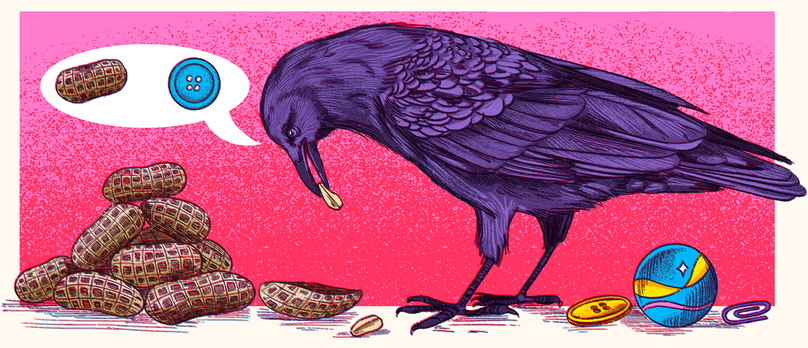
Well, isn’t this a fun sequel to the previous piece? It’s a fun exploration of how we think about our relations with crows, and whether it’s possible or not to have meaningful relationships with them (I think it is).
Gibson doesn’t have relationships with any of these specific birds. He’s spent almost 500 nights considering them as a group, wild and anonymous. “They’re putting on a good show for you!” he shouts. Really, though, these birds aren’t paying attention to us; they’re performing for one another. We’ll continue to tell stories about corvids, but in this moment, their story is their own.
6 Why Am I Left-Handed? - Quanta Magazine
Always a big fan of Natalie Woolchover’s writing - here she writes in Quanta’s new Qualia series about the biological and cultural factors behind left-handedness. About 10% of humans are left-handed - this fact kinda makes sense because southpaws are going to be vulnerable while fighting (the heart’s on the left) but a small fraction of them will develop some surprise element and survive. The other way to think about this is that left-handedness has a lot of stigma associated with it, and our brains’ plasticity has enabled some of us to just become right-handed anyway?
7 Richard Feynman and The Connection Machine - The Long Now Foundation
This is a very fun 2017 piece about Feynman written by Danny Hillis. He reminisces on the time when he worked together with Feynman on the Connection Machine, a massively parallel supercomputer developed in the 80s. I’ll just leave you with the first paragraph: One day when I was having lunch with Richard Feynman, I mentioned to him that I was planning to start a company to build a parallel computer with a million processors. His reaction was unequivocal, “That is positively the dopiest idea I ever heard.” For Richard a crazy idea was an opportunity to either prove it wrong or prove it right. Either way, he was interested. By the end of lunch he had agreed to spend the summer working at the company.
8 The Man Who Reads Books For a Living (One Every Two Days) - Lithub
Another amusing and entertaining and hyper-specific profile of someone very cool - Clarke Speicher’s job is to read books and provide recommendations to film producers on the screenplay-a-bility of books. He reads ~6 books a week, which is about 300 a year. 6000 over two decades of doing this job! What a crazy world we live in that this is literally someone’s job.
9 San Gimignano, how it used to be and what to do now - En
Samira sent me this cute account of San Gimignano - a very well-known and beautiful town-on-a-hill in Tuscany. We went there on a rainy day last year, and it was charming! This piece is by Giulia Scarpaleggia, who grew up in San Gimignano and has seen it develop into a popular tourist destination - it’s obviously a great peek into a locals’ view of an evolving city.